Comparing the Two Theories (Leaving Cert Chemistry): Revision Notes
📚Revision Notes
Comparing the Two Theories
When studying acids and bases, it's important to understand how the Arrhenius theory and the Brønsted-Lowry theory relate to each other. Rather than being competing ideas, the Brønsted-Lowry theory actually builds upon and extends the Arrhenius theory, addressing several of its limitations whilst providing a more comprehensive understanding of acid-base behaviour.
Note
The relationship between these theories is a perfect example of how scientific understanding evolves - newer theories don't always replace older ones, but rather extend and build upon them to provide a more complete picture.
Key differences between the theories
The two theories differ in five main areas, each highlighting how the Brønsted-Lowry theory provides a broader and more flexible approach to understanding acids and bases.
Role of water
The most significant limitation of the Arrhenius theory is its restriction to aqueous solutions. This theory can only explain acid-base reactions that occur in water, which severely limits its scope. In contrast, the Brønsted-Lowry theory applies much more broadly - it can explain acid-base behaviour in gaseous reactions, non-aqueous solvents, and any environment where proton transfer can occur.
Example
Worked Example: Gas Phase Acid-Base Reaction
When hydrogen chloride gas reacts with ammonia gas:
Step 1: Identify what's happening
- No water is present in this reaction
- donates a proton to
Step 2: Apply the theories
- Arrhenius theory: Cannot explain this reaction (no water present)
- Brønsted-Lowry theory: is the acid (proton donor), is the base (proton acceptor)
Hydroxide ions
Important
The Arrhenius theory defines bases as substances that produce hydroxide ions () when dissolved in water. However, this creates problems because many substances that clearly behave as bases do not produce hydroxide ions.
Ammonia () is a perfect example - it acts as a base but doesn't contain or produce ions. The Brønsted-Lowry theory solves this issue by defining bases as proton acceptors. This broader definition includes all Arrhenius bases plus many additional substances that can accept protons without producing hydroxide ions.
Classification of acids and bases
Under the Arrhenius system, certain substances cannot be classified as either acids or bases, even though they clearly exhibit acid or base behaviour in reactions. Carbonate ions () and hydrogencarbonate ions () are prime examples - they can accept protons and behave as bases, but the Arrhenius theory cannot classify them as such.
The Brønsted-Lowry theory provides a more inclusive classification system. Since these ions can accept protons, they are properly classified as bases under this theory, giving us a more complete understanding of their behaviour.
Note
This expanded classification is particularly important in environmental chemistry, where carbonate and hydrogencarbonate ions play crucial roles in natural buffer systems like ocean and soil chemistry.
Hydronium ion
The Arrhenius theory doesn't account for the formation of hydronium ions () when acids dissolve in water. It simply states that acids produce hydrogen ions (), but in reality, these hydrogen ions immediately combine with water molecules to form hydronium ions.
Important
The Brønsted-Lowry theory explicitly recognises the existence and importance of hydronium ions, providing a more accurate picture of what actually happens at the molecular level when acids react with water.
The actual reaction is:
Amphoteric substances
Perhaps the most significant limitation of the Arrhenius theory is its inability to explain amphoteric substances - materials that can act as both acids and bases depending on the reaction conditions. Water itself is amphoteric, as are many other important compounds.
The Brønsted-Lowry theory elegantly explains amphoteric behaviour through the concept of proton transfer. A substance can donate protons in one reaction (acting as an acid) and accept protons in another reaction (acting as a base), depending on what it's reacting with.
Note
Understanding amphoteric behaviour is essential for predicting how substances will react in different chemical environments. This concept is particularly important in biochemistry, where many biological molecules can act as both acids and bases.
Comparing the theories
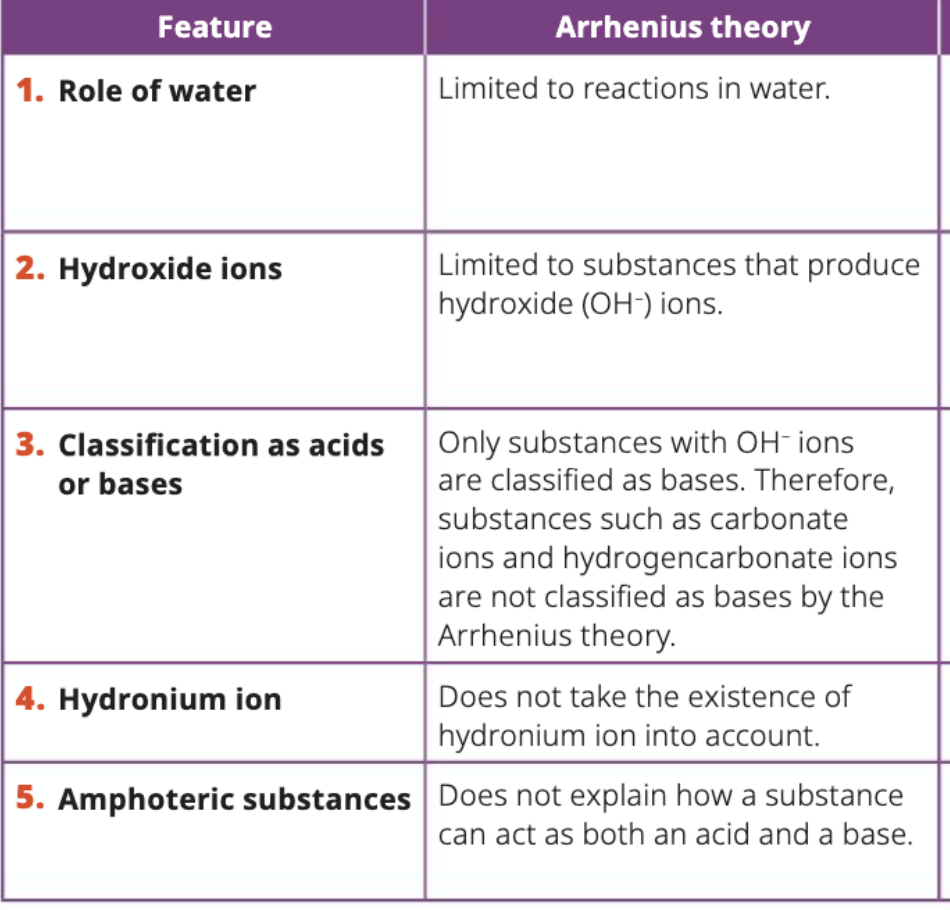
The comparison table clearly shows how the Arrhenius theory has several limitations that are addressed by the Brønsted-Lowry theory. Each feature demonstrates how the newer theory provides a more comprehensive and flexible understanding of acid-base chemistry.
Understanding the relationship
It's crucial to understand that these theories are not in conflict with each other. The Brønsted-Lowry theory doesn't replace the Arrhenius theory - instead, it builds upon it and extends our understanding. All reactions that can be explained by the Arrhenius theory can also be explained by the Brønsted-Lowry theory, but the Brønsted-Lowry theory can explain many additional reactions that the Arrhenius theory cannot.
Note
This relationship is common in science - as our understanding develops, new theories often encompass and extend older ones rather than completely replacing them. Think of how Einstein's theory of relativity extended Newton's laws of motion rather than making them completely obsolete.
The Arrhenius theory remains useful for understanding acid-base behaviour in aqueous solutions, whilst the Brønsted-Lowry theory provides the broader framework needed for more complex situations.
Summary
Key Points to Remember:
- The Brønsted-Lowry theory extends and builds upon the Arrhenius theory rather than replacing it
- Arrhenius theory is limited to aqueous solutions, whilst Brønsted-Lowry theory applies everywhere proton transfer can occur
- The Brønsted-Lowry theory can classify more substances as acids or bases, including carbonates and hydrogencarbonates
- Only the Brønsted-Lowry theory can explain amphoteric substances and the formation of hydronium ions
- Both theories are valuable - use Arrhenius for simple aqueous reactions and Brønsted-Lowry for more complex situations