Acid-Base Indicators (Leaving Cert Chemistry): Revision Notes
📚Revision Notes
Acid-Base Indicators
What are acid-base indicators?
Acid-base indicators are special chemical substances that change colour depending on whether a solution is acidic or basic. They are extremely useful in chemistry, particularly when carrying out titrations, as they help us identify the end point - the moment when the acid and base have completely neutralised each other.
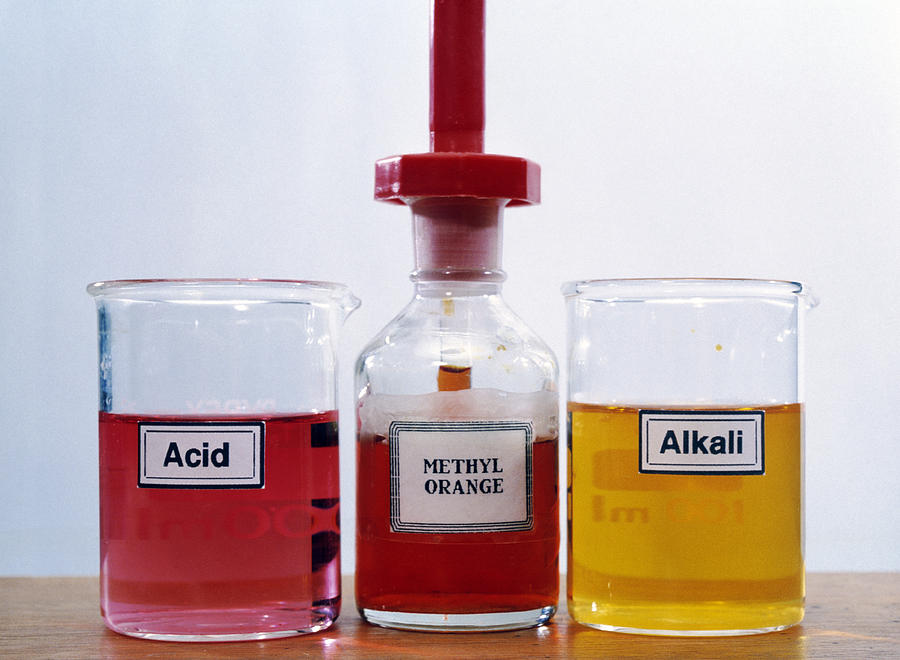
The key principle is simple: an acid-base indicator changes colour according to the pH of the solution it's placed in. This colour change acts like a visual signal, telling us about the chemical environment of the solution.
Note
Many indicators actually come from natural sources. For example, you can extract indicators from red cabbage, elderberry juice, and blackberry juice. However, in the laboratory, we typically use three main synthetic indicators that give us reliable and predictable results.
How do indicators work?
The science behind indicators is fascinating and involves chemical equilibrium. Most indicators are weak acids that exist in two different forms - one that's joined to a hydrogen ion (H⁺) and one that's not.
When an indicator is in solution, it establishes an equilibrium that can be represented by this equation:
Here's what each part means:
- HIn represents the indicator molecule with a hydrogen attached (the acidic form)
- In⁻ represents the indicator molecule without the hydrogen (the basic form)
- The double arrow shows this is a reversible reaction
Important
The clever part is that these two forms have completely different colours. In acidic solutions (lots of H⁺ ions), the equilibrium shifts to favour the HIn form, showing the acidic colour. In basic solutions (fewer H⁺ ions), the equilibrium shifts to favour the In⁻ form, showing the basic colour.
This shift happens because of Le Chatelier's Principle - when you change the conditions of an equilibrium, the system responds to oppose that change. Adding acid pushes the equilibrium one way, adding base pushes it the other way.
Common indicators and their properties
There are three indicators you need to know well for your exam. Each has its own pH range where the colour change occurs:
Methyl orange:
- pH range: 3-5
- Acidic colour: Red
- Basic colour: Yellow
- Best used for titrations involving strong acids and weak bases
Litmus:
- pH range: 5-8
- Acidic colour: Red
- Basic colour: Blue
- The most familiar indicator, good for general pH testing
Phenolphthalein:
- pH range: 8-10
- Acidic colour: Colourless
- Basic colour: Pink
- Best used for titrations involving weak acids and strong bases
Note
Choosing the right indicator for a titration is crucial - you want the indicator's range to match the pH change that occurs at your equivalence point. This ensures you get an accurate end point detection.
Range of an indicator
The range of an indicator refers to the pH interval over which you can clearly observe the colour change. This is typically about 2 pH units wide.
Why does an indicator need this range? The colour change isn't instant - it happens gradually as the pH changes. You need a difference of roughly 2 pH units to see a distinct, clear colour change that leaves no doubt about which form of the indicator is dominant.
Example
Example: Understanding Indicator Ranges
For methyl orange:
- Shows distinct red colour below pH 3
- Shows distinct yellow colour above pH 5
- Between pH 3-5, you'll see intermediate colours like orange as both forms exist together
For litmus:
- Shows clear red below pH 5
- Shows clear blue above pH 8
Important
Don't expect an instant colour change at exactly one pH value. The gradual transition over ~2 pH units is normal and necessary for reliable indicator function.
Universal indicator
Sometimes we want to know the approximate pH of a solution across a wide range, not just whether it's acidic or basic. This is where universal indicator becomes invaluable.
Universal indicator isn't a single substance - it's actually a mixture of several different indicators. This mixture has been carefully designed so that it shows a gradual colour change across the entire pH range from 1 to 14.
Example
Example: Universal Indicator Colour Progression
The colour progression typically goes:
- pH 1-3: Red (strongly acidic)
- pH 4-6: Orange to yellow (weakly acidic)
- pH 7: Green (neutral)
- pH 8-10: Blue (weakly basic)
- pH 11-14: Purple (strongly basic)
Note
Universal indicator is perfect for getting a rough estimate of pH, though it's not precise enough for accurate titrations. Use it when you need to know the approximate pH across a wide range.
Key Takeaways
Summary
Key Points to Remember:
-
Acid-base indicators are weak acids that change colour based on the pH of their environment
-
The three key indicators are methyl orange (pH 3-5, red to yellow), litmus (pH 5-8, red to blue), and phenolphthalein (pH 8-10, colourless to pink)
-
Indicators work through chemical equilibrium - the balance between HIn and In⁻ forms shifts depending on H⁺ concentration
-
Each indicator has a range of about 2 pH units where the colour change occurs clearly
-
Universal indicator is a mixture that shows gradual colour changes across the full pH scale, making it ideal for estimating pH values