The pH Scale (Leaving Cert Chemistry): Revision Notes
📚Revision Notes
The pH Scale
What is the pH scale?
The pH scale is a numerical system used to measure how acidic or basic a solution is. It runs from 0 to 14, where values below 7 indicate acidic solutions, 7 represents neutral solutions, and values above 7 indicate basic (alkaline) solutions. Understanding the pH scale is essential for chemistry students as it appears throughout acid-base chemistry topics.
The pH scale is logarithmic, meaning each unit change represents a ten-fold change in acidity. For example, a solution with pH 3 is ten times more acidic than a solution with pH 4.
Note
The logarithmic nature of the pH scale is crucial to understand - this means that small changes in pH represent very large changes in actual acidity. A difference of just 2 pH units represents a 100-fold change in hydrogen ion concentration!
Development of the pH scale
The pH scale was developed in 1909 by Danish chemist Søren Sørensen while working for a brewery. He needed a simpler way to express hydrogen ion concentrations in solutions, as these numbers were often very small and cumbersome to work with (like 0.0001 or moles per litre).
Instead of using these tiny decimal numbers or negative powers, Sørensen created the pH system to make these values easier to handle and communicate.
Note
Sørensen's work at the Carlsberg brewery wasn't just about making beer - he was studying enzyme activity and needed a practical way to measure and communicate acidity levels. His innovation revolutionised how chemists work with acid-base systems.
Mathematical definition of pH
The pH of a solution is defined mathematically as:
Where represents the hydrogen ion concentration measured in moles per litre.
This definition means that:
- The "p" in pH stands for "power" (referring to the power of 10)
- The negative sign ensures that as hydrogen ion concentration increases, pH decreases
- Higher hydrogen ion concentrations result in lower pH values (more acidic)
- Lower hydrogen ion concentrations result in higher pH values (more basic)
Important
Common Mistake Alert! Many students forget the negative sign in the pH formula. Remember that the negative sign is essential - it's what makes high concentrations correspond to low pH values (acidic conditions).
Relationship between hydrogen ion concentration and pH
There is a direct relationship between hydrogen ion concentration and pH values.
Key relationships to remember:
- pH 3: mol/L (acidic)
- pH 6: mol/L (acidic)
- pH 7: mol/L (neutral at 25°C)
- pH 9: mol/L (basic)
- pH 12: mol/L (basic)
Notice how each change of 3 pH units represents a 1000-fold change in hydrogen ion concentration.
Example
Worked Example: Comparing Acidity Levels
Let's compare the acidity of lemon juice (pH 2) with coffee (pH 5):
Step 1: Calculate for lemon juice mol/L
Step 2: Calculate for coffee
mol/L
Step 3: Find the ratio
Therefore, lemon juice is 1000 times more acidic than coffee!
Temperature dependence of pH
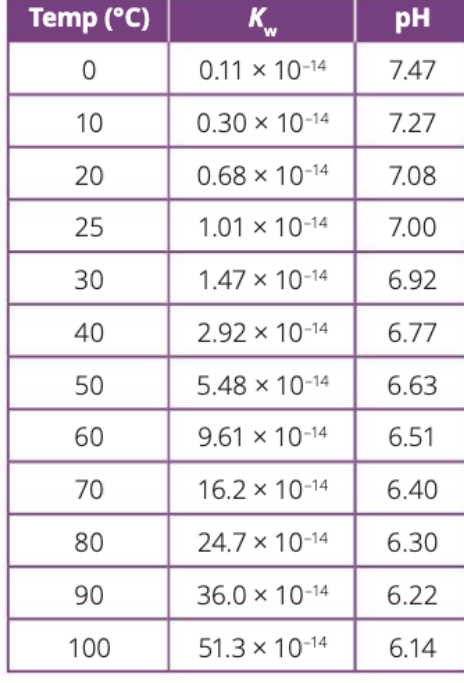
An important concept that many students miss is that the neutral pH of pure water is not always 7. The neutral pH only equals 7 at 25°C. At other temperatures, the neutral pH changes because the water dissociation constant () changes with temperature.
Key temperature effects:
- At 0°C: Pure water has pH 7.47 (appears basic, but is actually neutral)
- At 25°C: Pure water has pH 7.00 (neutral)
- At 100°C: Pure water has pH 6.14 (appears acidic, but is actually neutral)
This happens because as temperature increases, water molecules dissociate more readily, producing more and ions. However, equal amounts of both ions are still produced, so the water remains neutral despite the lower pH.
Important
Critical Concept: Temperature and Neutrality
Don't assume that pH 7 always means neutral! Neutrality means , and this equality can occur at different pH values depending on temperature. At body temperature (37°C), pure water has a pH of about 6.8 but is still perfectly neutral.
Measuring pH
There are several methods to measure pH in laboratory and everyday situations:
pH sensors and digital metres
Modern pH measurement often uses electronic pH sensors connected to digital metres or data-logging equipment. These provide accurate, precise readings and can monitor pH changes continuously.
Universal indicators
Universal indicator paper or solution changes colour depending on the pH of the solution being tested. Different colours correspond to different pH ranges, allowing for quick estimation of pH values.
Note
pH Measurement Applications
These measurement tools are essential for:
- Quality control in food and beverage production
- Environmental monitoring of water sources
- Medical diagnostics and blood analysis
- Research applications in chemistry and biology
- Educational demonstrations and experiments
Calculations with pH
When working with pH calculations, understanding the mathematical relationships is crucial for accurate results. Here are the key conversion processes you need to master:
Example
Worked Example: pH Calculations
Problem 1: Converting from to pH If mol/L, find the pH.
Solution:
Problem 2: Converting from pH to If pH = 8.3, find .
Solution: mol/L
Key steps for successful pH calculations:
- Converting from to pH: Use
- Converting from pH to : Use
- Always include units: should be in mol/L
- Check your calculator settings: Ensure you're using (common logarithm)
For exam success, practice these conversions until they become automatic, as pH calculations appear frequently in acid-base chemistry questions.
Summary
Key Points to Remember:
- pH scale ranges from 0-14: Lower values = more acidic, higher values = more basic
- Mathematical definition: where is in mol/L
- Logarithmic nature: Each pH unit represents a 10-fold change in acidity
- Temperature matters: Neutral pH = 7 only at 25°C, changes at other temperatures
- Measurement methods: Digital pH metres and universal indicators are common tools for determining pH values