The Continuum of Chemical Bonding (Leaving Cert Chemistry): Revision Notes
📚Revision Notes
The Continuum of Chemical Bonding
Understanding chemical bonds as a spectrum
Chemical bonding doesn't exist as distinct, separate categories. Instead, bonds exist along a continuum or spectrum that ranges from purely covalent bonds to purely ionic bonds. This continuum is based on the electronegativity difference between the two atoms forming the bond.
The electronegativity difference tells us how unequally electrons are shared between atoms in a chemical bond. Understanding this concept helps us predict what type of bonding will occur in different compounds.
Note
Think of chemical bonding like a colour spectrum - just as colours gradually transition from one to another (red to orange to yellow), chemical bonds gradually transition from pure covalent to pure ionic based on how unequally electrons are shared.
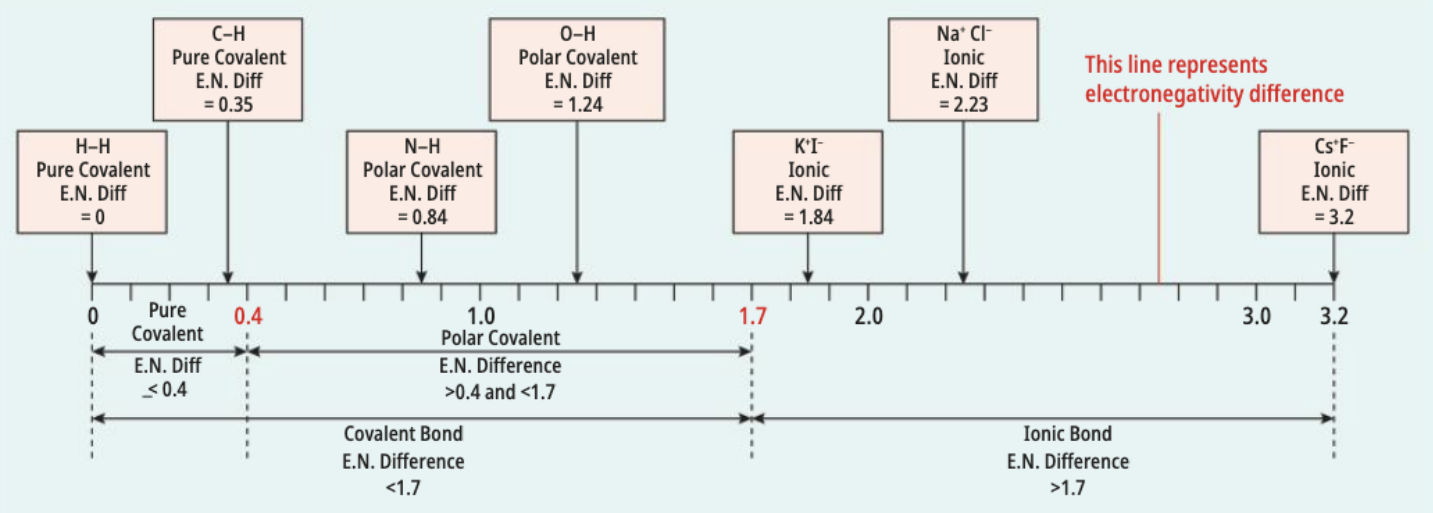
The electronegativity difference scale
The bonding continuum can be represented on a scale that ranges from 0 to 3.2, where the electronegativity difference between atoms determines the bond type:
Pure covalent bonds (0 to 0.4)
- Electronegativity difference: 0 to 0.4
- Electrons are shared equally or nearly equally between atoms
- When the difference is exactly zero, the bond is pure covalent and completely nonpolar
- When the difference is greater than zero but ≤0.4, the bond is slightly polar but often considered nonpolar in practice
Note
Key examples:
- : difference = 0.00 (pure covalent)
- : difference = 0.35 (slightly polar, considered nonpolar)
Polar covalent bonds (0.4 to 1.7)
- Electronegativity difference: greater than 0.4 but less than 1.7
- Electrons are shared unequally between atoms
- One atom has a partial negative charge () and the other has a partial positive charge ()
- The bond is polar covalent
Note
Key examples:
- : difference = 0.84
- : difference = 1.24
Ionic bonds (greater than 1.7)
- Electronegativity difference: greater than 1.7
- Electrons are essentially transferred from one atom to another
- Forms ionic compounds with distinct positive and negative ions
Note
Key examples:
- : difference = 1.84
- : difference = 2.23
- : difference = 3.19
Using electronegativity differences to predict bonding
You can determine the type of bonding in any compound by calculating the electronegativity difference between the atoms involved. This method provides a reliable way to predict whether a compound will have ionic or covalent bonding.
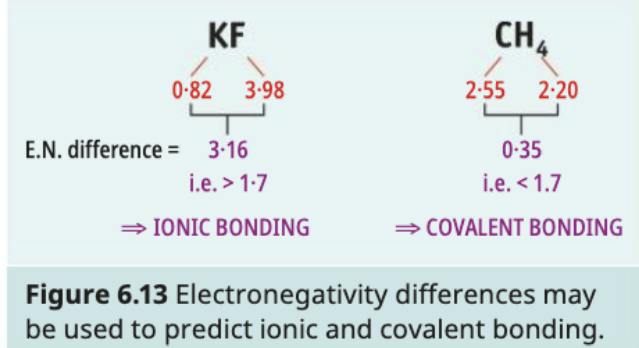
Example
Worked Example: Predicting Bond Types
Example 1 - Potassium fluoride (KF):
- K has electronegativity 0.82
- F has electronegativity 3.98
- Difference = 3.98 - 0.82 = 3.16
- Since 3.16 > 1.7, KF has ionic bonding
Example 2 - Methane (CH₄):
- C has electronegativity 2.55
- H has electronegativity 2.20
- Difference = 2.55 - 2.20 = 0.35
- Since 0.35 < 1.7, CH₄ has covalent bonding
The rule of thumb
There's a useful rule of thumb that provides guidelines for predicting bonding types:
Important
The Electronegativity Rule of Thumb:
- Electronegativity difference > 1.7 → Ionic bonding
- Electronegativity difference ≤ 1.7 → Covalent bonding
- Electronegativity difference > 0.4 and < 1.7 → Polar covalent bonding
- Electronegativity difference > 0 but ≤ 0.4 → Slightly polar covalent (often considered nonpolar)
- Electronegativity difference = 0 → Pure covalent and nonpolar
Remember the key threshold values: 0.4 and 1.7!
Important limitations and exceptions
Remember that this rule of thumb is a guideline, not a definitive law. It's a useful method for predicting bonding types, but there are exceptions that you should be aware of.
Important
Major Exceptions to the Rule:
Metal hydrides: Compounds like lithium hydride (LiH), sodium hydride (NaH), potassium hydride (KH), and calcium hydride (CaH₂) are ionic despite containing the hydride ion H⁻. The rule of thumb would incorrectly suggest covalent bonding.
Hydrogen fluoride (HF): This compound has an electronegativity difference of 1.78, so the rule suggests ionic bonding. However, HF actually forms covalent bonds.
Beryllium fluoride (BeF₂): The electronegativity difference is 1.94, suggesting ionic bonding, but BeF₂ is actually a covalent compound.
These exceptions remind us that the rule of thumb has limitations and should be used as a starting point for understanding bonding, not as an absolute rule.
Summary
Key Points to Remember:
-
Chemical bonding exists on a continuum from pure covalent (0) to pure ionic (3.2) based on electronegativity differences
-
Key threshold values: 0.4 (polar vs nonpolar) and 1.7 (covalent vs ionic)
-
The rule of thumb: >1.7 = ionic, ≤1.7 = covalent, with polar covalent falling between 0.4-1.7
-
Calculate electronegativity difference to predict bonding type by subtracting the smaller value from the larger value
-
Remember the exceptions - the rule of thumb is useful but not perfect, especially for metal hydrides and some fluoride compounds