Shapes, Properties, and Uses (Leaving Cert Chemistry): Revision Notes
📚Revision Notes
Shapes, Properties, and Uses
Molecular shapes and bonding
Understanding the shapes of hydrocarbon molecules is crucial for predicting their properties and behaviour. The shape of a molecule depends on the bonding around each carbon atom, which follows VSEPR (Valence Shell Electron Pair Repulsion) theory.
Basic hydrocarbon shapes
Different hydrocarbons have distinct molecular geometries based on the number and types of bonds around carbon atoms:
Ethane (C₂H₆) has a tetrahedral shape around each carbon atom. With four sigma bonds and bond angles of 109.5°, ethane represents the typical alkane structure. The molecule is non-planar, meaning the atoms don't all lie in the same plane.
Note
The tetrahedral geometry in alkanes results from the four electron pairs around each carbon atom arranging themselves to minimise repulsion, creating the characteristic 3D structure that gives alkanes their flexibility.
Ethene (C₂H₄) shows a trigonal planar arrangement around each carbon. The presence of a double bond (one sigma and one pi bond) creates bond angles of 120°. This molecule is planar, with all atoms lying in the same flat plane.
Ethyne (C₂H₂) demonstrates linear geometry with bond angles of 180°. The triple bond (one sigma and two pi bonds) forces the molecule into a straight line configuration.
Benzene (C₆H₆) has a special structure with trigonal planar geometry around each carbon atom. The delocalised pi bonding system creates a planar ring structure with equal bond angles of 120°.
Key bonding concepts
Important
The number of electron pairs in sigma bonds around each carbon atom determines the molecular shape. Sigma bonds provide the basic framework, while pi bonds (found in double and triple bonds) don't affect the overall geometry but do influence the planarity of the molecule.
Physical properties
Boiling points in alkanes
The boiling points of hydrocarbons follow predictable patterns based on molecular size and structure. As the number of carbon atoms increases, molecular size and the number of electrons also increase, leading to stronger intermolecular forces.
Straight-chain alkanes show a clear trend: boiling points increase progressively with chain length. This occurs because larger molecules have stronger London dispersion forces between them. The first four alkanes (methane through butane) are gases at room temperature, while pentane and hexane are liquids.
Structural effects on boiling points
Note
Branched alkane isomers typically have lower boiling points than their straight-chain counterparts. This happens because branched molecules are more compact, leading to weaker intermolecular forces compared to straight-chain molecules which can pack together more closely.
Boiling points in alkenes
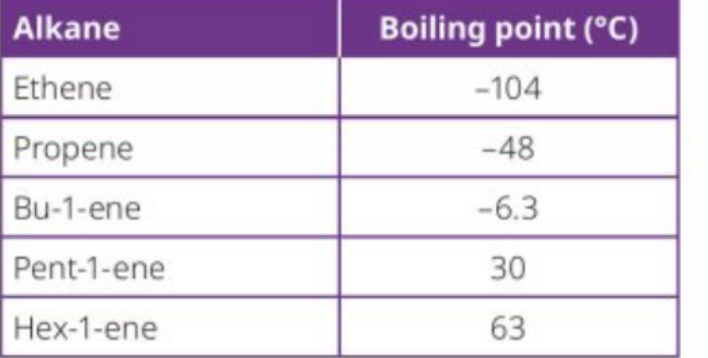
Alkenes follow similar trends to alkanes, with boiling points increasing as molecular size increases. The presence of the double bond slightly affects the boiling point, but the primary factor remains the overall molecular size and resulting intermolecular forces.
Solubility and chemical properties
Hydrocarbons generally show similar solubility patterns regardless of their specific structure:
- Water solubility: All hydrocarbons are essentially insoluble in water because they are non-polar molecules, while water is polar
- Organic solvents: Hydrocarbons dissolve readily in non-polar organic solvents like hexane and benzene
- Chemical reactivity: Alkenes are more chemically reactive than alkanes due to their C=C double bonds, making them useful for addition reactions
Uses of hydrocarbons in industry and society
Hydrocarbons play essential roles across many industries and aspects of daily life. Different types of hydrocarbons serve specific purposes based on their physical and chemical properties.
Alkanes as fuels and feedstocks
Methane serves as the primary component of natural gas, providing fuel for domestic heating, cooking, and electricity generation. It's also used as a feedstock for producing chemicals like ammonia in industrial processes.
Butane finds use in portable gas canisters for camping equipment and as an aerosol propellant. Its convenient liquid form under moderate pressure makes it ideal for portable applications.
Octane represents the key component of petrol, powering transportation vehicles worldwide. Its combustion properties make it suitable for internal combustion engines.
Alkenes in polymer production
Note
Ethene and propene serve as crucial building blocks for the plastics industry. These molecules undergo polymerisation reactions to form polyethene and polypropene, creating everyday plastic products from bags to containers.
Specialised hydrocarbon applications
Ethyne provides the intense heat needed for oxyacetylene welding and cutting operations in construction and manufacturing industries.
Aromatic hydrocarbons like benzene and methylbenzene function as solvents in chemical and pharmaceutical industries, helping dissolve other substances for various processes.
Liquefied petroleum gas (LPG), containing propane and butane, offers clean-burning fuel for domestic and industrial heating and cooking applications.
Bitumen, composed of high molecular mass hydrocarbons, provides essential materials for road construction and roofing, creating durable surfaces for infrastructure projects.
Environmental and economic importance
Important
The extensive use of hydrocarbons demonstrates their crucial role in modern society, from providing energy and materials to enabling transportation and construction. Understanding their properties helps explain why different hydrocarbons suit different applications, making them indispensable in contemporary industrial and domestic settings.
Remember!
Summary
Key Points to Remember:
-
Molecular shapes depend on bonding: Tetrahedral (alkanes), trigonal planar (alkenes), and linear (alkynes) geometries result from different bonding patterns around carbon atoms
-
Boiling points increase with molecular size: Larger hydrocarbon molecules have stronger London dispersion forces, leading to higher boiling points in both alkanes and alkenes
-
Hydrocarbons are non-polar: This makes them insoluble in water but soluble in organic solvents, affecting their practical applications
-
Different hydrocarbons serve specific purposes: From methane for heating to ethene for plastics, each type has properties that make it suitable for particular industrial applications
-
Structure affects properties: Branched isomers have different boiling points than straight-chain molecules, demonstrating how molecular structure influences physical characteristics