The Alkanes (Leaving Cert Chemistry): Revision Notes
📚Revision Notes
The Alkanes
What are alkanes?
Alkanes are a family of hydrocarbons where all the atoms are connected by single bonds only. This means there are no double or triple bonds present in their molecular structure. Because of this characteristic, alkanes are classified as saturated compounds.
Note
A saturated hydrocarbon compound is one where there are only single bonds between the carbon atoms in the molecule. This makes alkanes relatively stable and less reactive compared to other hydrocarbon families.
The general formula for all alkanes is one of the most important concepts to understand in organic chemistry:
Important
General Formula for Alkanes:
Where n represents the number of carbon atoms in the molecule. This formula applies to all straight-chain and branched alkanes.
Molecular representations
Understanding how to represent alkanes in different ways is essential for studying organic chemistry. Alkanes can be represented in several different ways, each showing different levels of detail about their structure:
Types of molecular representations
Molecular formula: This shows just the types and number of atoms in the compound. For example, butane has the molecular formula C₄H₁₀.
Condensed structural formula: This shows the carbon atom chain and indicates how many of each type of atom are bonded to each carbon atom. However, it doesn't show lines to illustrate how the atoms connect. For example, butane can be written as CH₃CH₂CH₂CH₃.
Expanded molecular structure (structural formula): This shows every atom and every bond in the molecule. It provides the most detailed view of how atoms are connected together.
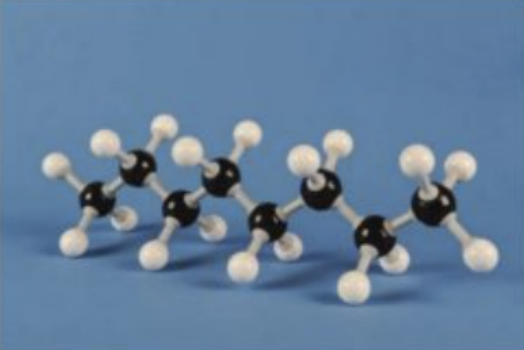
3-D physical models: These show the actual three-dimensional shape of the molecule, helping you understand that molecules aren't flat but have depth and specific geometries.
Physical properties of alkanes
Boiling points and molecular size
One of the most important trends in alkanes is how their physical properties change as the molecules get larger. Understanding this relationship is key to predicting alkane behaviour.
Note
Key Trend in Alkane Properties:
As you move through the alkane series from methane to decane, several key patterns emerge:
- Boiling points increase as the number of carbon atoms increases
- Molecular size affects state of matter: smaller alkanes (methane through butane) are gases at room temperature, while larger alkanes are liquids
- This trend occurs because larger molecules have stronger van der Waals forces (also called London dispersion forces) between them
Chemical stability
Alkanes show relatively low chemical reactivity because of their molecular structure and bonding characteristics:
- All bonds in alkanes are strong covalent bonds
- Each carbon-carbon bond and carbon-hydrogen bond is a sigma bond
- There is very small difference in electronegativity between carbon and hydrogen atoms, making alkanes non-polar molecules
- They don't easily react with polar molecules, acids, bases, oxidising agents, or reducing agents
The homologous series
Alkanes form what chemists call a homologous series. This concept is fundamental to understanding organic chemistry families.
Note
Definition of Homologous Series:
A homologous series is a group of compounds that:
- Share similar chemical properties
- Show gradual changes in physical properties
- Have a general formula that applies to all members
- Can be prepared using similar methods
- Differ from each other by a CH₂ unit
Naming alkanes (IUPAC rules)
The International Union of Pure and Applied Chemistry (IUPAC) has established systematic rules for naming organic compounds, including alkanes. Mastering these naming conventions is essential for success in organic chemistry.
Basic alkane names
The first ten members of the alkane family have these names:
- Methane (CH₄)
- Ethane (C₂H₆)
- Propane (C₃H₈)
- Butane (C₄H₁₀)
- Pentane (C₅H₁₂)
- Hexane (C₆H₁₄)
- Heptane (C₇H₁₆)
- Octane (C₈H₁₈)
- Nonane (C₉H₂₀)
- Decane (C₁₀H₂₂)
Naming branched alkanes
When alkanes have branches (side chains), we need to follow specific systematic rules. The process is methodical and must be followed carefully:
Example
Worked Example: Step-by-Step Naming Process
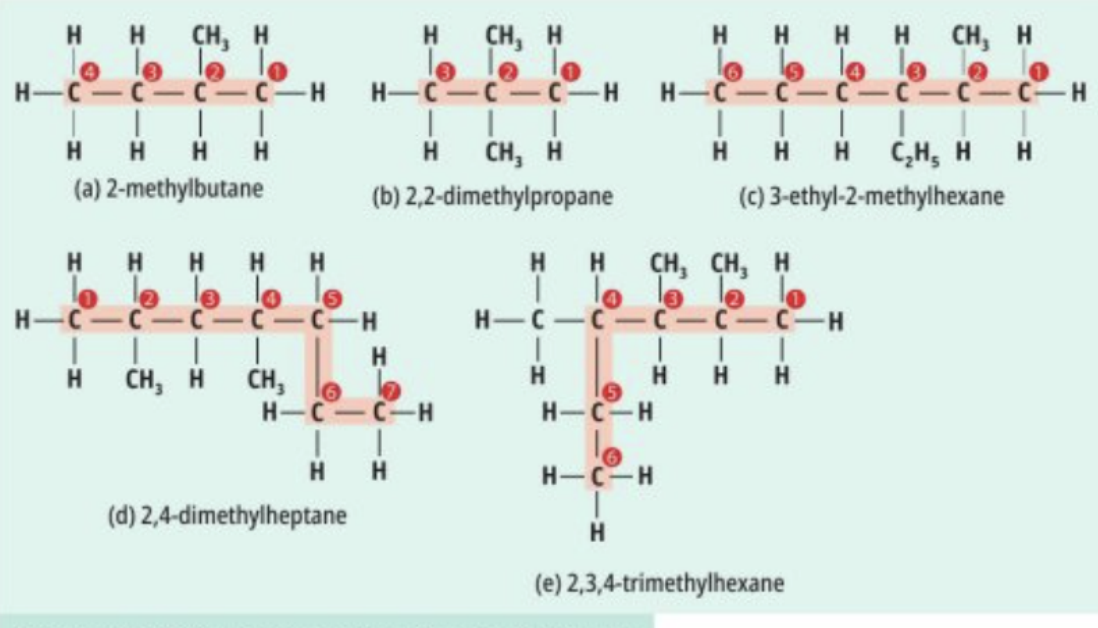
Step 1: Find the longest continuous carbon chain - this gives you the parent alkane name.
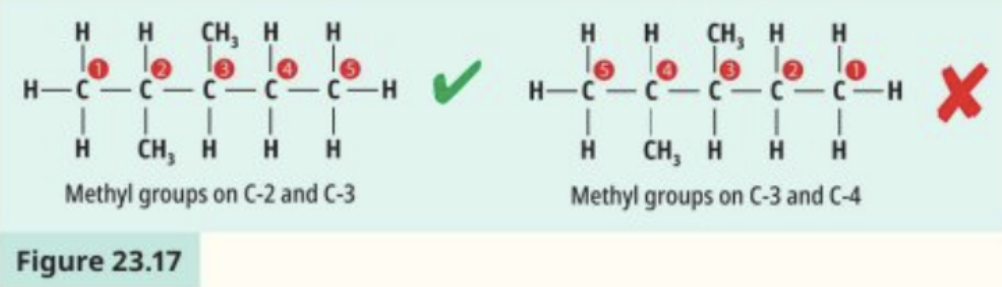
Step 2: Number the carbon atoms in the main chain starting from the end that gives the substituents (branches) the lowest possible numbers.
Step 3: Identify the type and position of substituents:
- Methyl group (CH₃) - when a hydrogen atom has been removed from methane
- Ethyl group (C₂H₅) - when a hydrogen atom has been removed from ethane
- Propyl group (C₃H₇) - when a hydrogen atom has been removed from propane
Step 4: Name the compound by listing substituents in alphabetical order, followed by the parent alkane name.
Examples of named alkanes
Important
Critical Naming Rules to Remember:
- When multiple identical groups are present, use prefixes like di-, tri-, tetra-
- Substituents are always listed in alphabetical order
- Numbers are separated by commas, and numbers are separated from letters by hyphens
- Always choose the longest possible carbon chain as your parent
Structural isomers
Structural isomers are compounds that have the same molecular formula but different structural arrangements. This concept becomes important when alkanes have four or more carbon atoms.
Example
Worked Example: Structural Isomers of C₄H₁₀
C₄H₁₀ can exist as two different structural isomers:
Isomer 1 - Butane: A straight chain of four carbon atoms CH₃-CH₂-CH₂-CH₃
Isomer 2 - Methylpropane: A three-carbon chain with a methyl branch CH₃-CH(CH₃)-CH₃
These compounds have identical molecular formulas but different physical properties, such as different boiling points, because their molecular shapes are different.
Cyclohexane - ring structures
Alkanes don't always form straight or branched chains. They can also form ring structures. Cyclohexane (C₆H₁₂) is an important example where six carbon atoms join together in a ring.
Key features of cyclohexane include:
- Each carbon atom is bonded to two hydrogen atoms and two other carbon atoms
- The ring structure means there are fewer hydrogen atoms compared to the straight-chain equivalent (hexane has C₆H₁₄)
- The molecule can adopt different three-dimensional shapes, commonly described as 'boat' and 'chair' conformations
- It can be represented using a skeletal formula - a simple hexagon where each corner represents a carbon atom with appropriate hydrogen atoms
Summary and Exam Success
Understanding alkanes is fundamental to organic chemistry success. These saturated hydrocarbons follow predictable patterns and systematic naming rules that form the foundation for more complex organic molecules.
Summary
Key Points to Remember:
Structure and Properties:
- Alkanes are saturated hydrocarbons with the general formula
- They contain only single covalent bonds and are relatively unreactive
- Boiling points increase as molecular size increases due to stronger van der Waals forces
Naming and Identification:
- IUPAC naming follows systematic rules: longest chain first, lowest numbers for substituents, alphabetical order
- Always draw the expanded molecular structure clearly showing every atom and bond
- Remember that the condensed formula gives more information than the molecular formula
Important Concepts:
- Structural isomers have the same molecular formula but different arrangements of atoms
- Alkanes form a homologous series with predictable properties
- Ring structures like cyclohexane follow the same bonding principles