Tetrahedral Carbon Compounds (Leaving Cert Chemistry): Revision Notes
📚Revision Notes
Tetrahedral Carbon Compounds
Introduction
Tetrahedral carbon compounds are organic molecules where carbon atoms maintain their characteristic tetrahedral shape whilst being bonded to various functional groups. This family includes chloroalkanes and alcohols, which are essential compounds in organic chemistry. Understanding their structure, properties, and behaviour is crucial for Leaving Cert Chemistry success.
Note
The tetrahedral shape around carbon atoms remains consistent even when functional groups replace hydrogen atoms, making this a unifying concept across different organic compound families.
Chloroalkanes
Definition and structure
A chloroalkane is a compound where one or more hydrogen atoms in an alkane molecule have been replaced by chlorine atoms. These compounds are part of the broader family of haloalkanes, where hydrogen atoms are substituted by halogen atoms (fluorine, chlorine, bromine, or iodine).
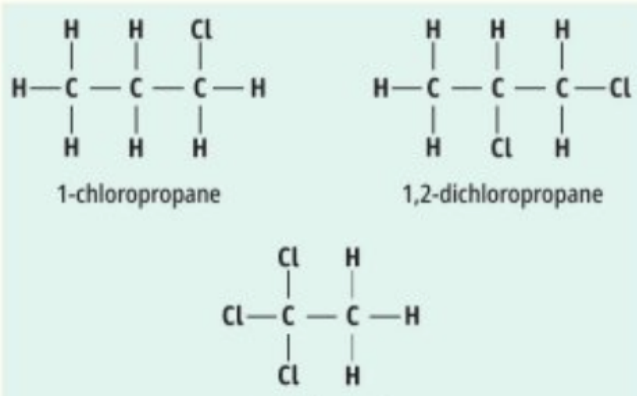
Chloroalkanes maintain the same basic tetrahedral geometry as their parent alkanes. The carbon atoms still form four bonds arranged in a tetrahedral shape, but now some of these bonds are to chlorine atoms instead of hydrogen atoms. This structural similarity means chloroalkanes are also saturated compounds.
Examples and molecular structure
Example
Common Chloroalkanes and Their Structures:
- Monochloromethane () - one chlorine atom
- Dichloromethane () - two chlorine atoms
- Trichloromethane () - three chlorine atoms, also known as chloroform
- Tetrachloromethane () - four chlorine atoms
Each compound shows systematic replacement of hydrogen with chlorine while maintaining tetrahedral geometry.
Each of these compounds demonstrates how chlorine atoms can systematically replace hydrogen atoms whilst preserving the tetrahedral arrangement around carbon.
Physical properties
Chloroalkanes exhibit distinctive physical properties that differ from their parent alkanes:
Note
Boiling points: Chloroalkanes generally have higher boiling points than corresponding alkanes due to stronger intermolecular forces. As more chlorine atoms are added, boiling points typically increase.
Solubility: Chloroalkanes are not soluble in water but are soluble in organic solvents. This occurs because the carbon-chlorine bond has some polarity, but not enough to allow dissolution in water. The molecules cannot form strong hydrogen bonds with water, so they dissolve readily in non-polar solvents instead.
Physical state: Most chloroalkanes are liquids at room temperature, unlike many of their corresponding alkanes which are gases. This is due to stronger intermolecular forces caused by the polarity of the carbon-chlorine bond.
Uses of chloroalkanes
Chloroalkanes serve as excellent solvents for removing oil and grease marks from machinery and dry cleaning of clothes. They are particularly effective because they dissolve oil, grease, and other water-insoluble substances without damaging fabrics. Many paint-strippers contain chloroalkanes as the active solvent component.
Alcohols
Definition and functional group
Alcohols form a homologous series of organic compounds characterised by the presence of the hydroxyl group (-OH). This -OH group is the functional group of alcohols - the atom or group of atoms responsible for the characteristic properties of the compound series.
Important
A functional group is an atom or group of atoms which determines the characteristic properties of an organic compound or series of organic compounds. For alcohols, the -OH group gives these molecules their distinctive chemical and physical properties.
Structure and molecular models
Alcohols can be represented using various methods including molecular formulas, structural formulas, and three-dimensional models. The progression from simple alcohols like methanol to more complex ones like the butanol isomers demonstrates the diversity within this compound family.
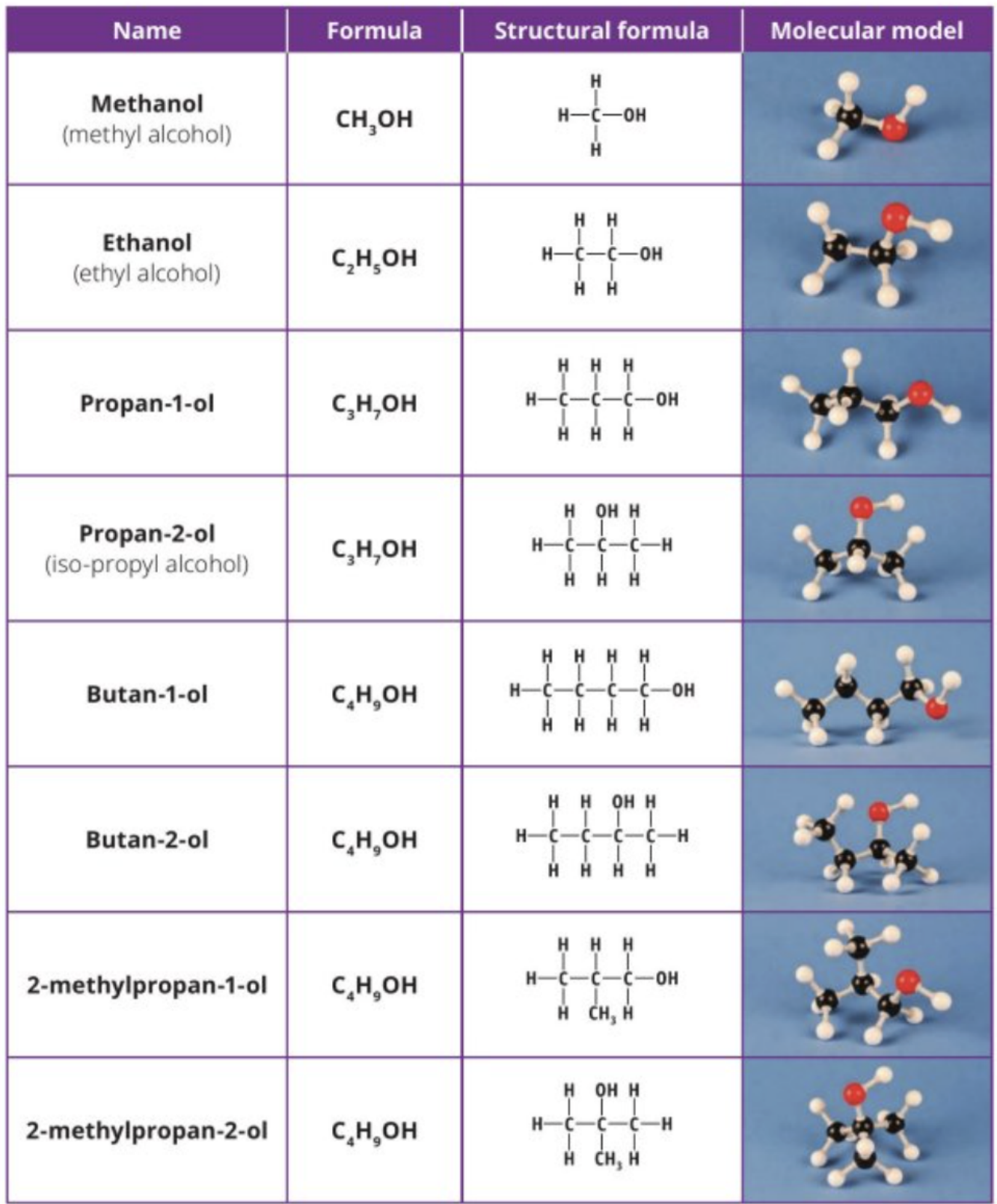
The three-dimensional models show how the tetrahedral geometry around carbon atoms is maintained even with the presence of the hydroxyl group. The oxygen atom in the -OH group has two lone pairs of electrons, contributing to the molecule's overall shape and properties.
Classification of alcohols
Alcohols are classified based on how many carbon atoms are attached to the carbon bearing the hydroxyl group.
Example
Classification of Alcohols:
Primary alcohols: The carbon atom joined to the -OH group is attached to at most only one other carbon atom. Examples include methanol and ethanol.
Secondary alcohols: The carbon atom joined to the -OH group is attached to two other carbon atoms. Example: propan-2-ol (isopropyl alcohol).
Tertiary alcohols: The carbon atom joined to the -OH group is attached to three other carbon atoms. Example: 2-methylpropan-2-ol.
Memory aid: Primary = 1 connection, Secondary = 2 connections, Tertiary = 3 connections
Physical properties of alcohols
Boiling points
Alcohols have significantly higher boiling points than their corresponding alkanes. This dramatic difference is due to hydrogen bonding between alcohol molecules.
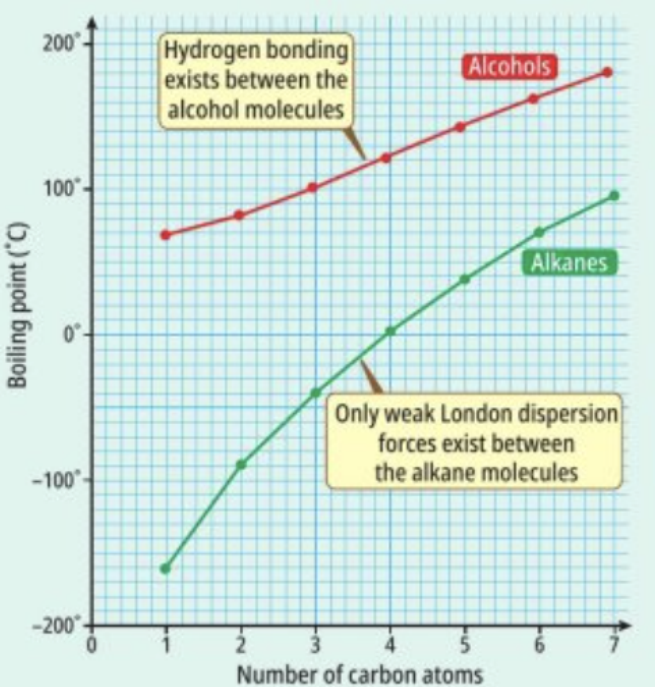
The graph clearly shows that alcohols (red line) have much higher boiling points than alkanes (green line) with the same number of carbon atoms. This occurs because hydrogen bonding between alcohol molecules requires additional energy to break during boiling.
Hydrogen bonding
Important
The high boiling points of alcohols result from intermolecular hydrogen bonding. The oxygen atom in the -OH group is highly electronegative, making the hydrogen atom slightly positive (δ+) and the oxygen slightly negative (δ-).
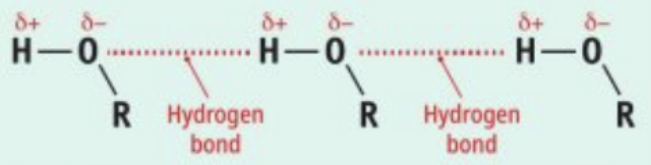
These partial charges allow hydrogen atoms from one molecule to form weak bonds with oxygen atoms on neighbouring molecules. Breaking these hydrogen bonds requires extra energy, explaining why alcohols boil at higher temperatures than alkanes.
Solubility in water
Alcohols can form hydrogen bonds with water molecules, making them soluble in water. The first few members of the alcohol series (methanol, ethanol, propan-1-ol) are completely miscible with water.
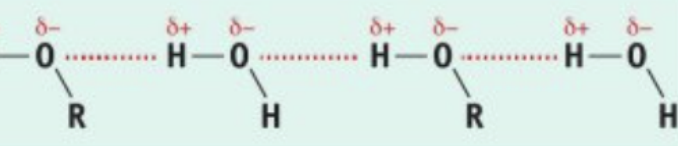
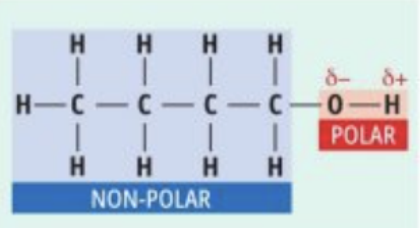
However, as the carbon chain length increases, solubility in water decreases. This occurs because alcohols have both polar and non-polar regions.
Note
The -OH group is polar and can hydrogen bond with water, whilst the carbon chain is non-polar and cannot interact favourably with water. As the carbon chain gets longer, the non-polar region dominates, reducing water solubility.
Applications of alcohols
Ethanol is widely used in alcoholic beverages, as a solvent, and as a fuel additive. It's also used in perfumes, aftershave lotions, deodorants, hairsprays, polishes, varnishes, and dyes. The ability of ethanol to dissolve both water-soluble and some oil-soluble substances makes it valuable in many commercial applications.
Methanol is used as a fuel and solvent but is highly toxic. Other alcohols serve various industrial purposes depending on their specific properties.
Summary
Key Points to Remember:
- Tetrahedral carbon compounds maintain the characteristic four-bond arrangement around carbon atoms even when functional groups are present
- Chloroalkanes are formed by replacing hydrogen atoms in alkanes with chlorine atoms, resulting in compounds that are liquid at room temperature and soluble in organic solvents but not water
- Alcohols contain the hydroxyl (-OH) functional group and are classified as primary, secondary, or tertiary based on carbon attachments to the -OH bearing carbon
- Hydrogen bonding in alcohols leads to higher boiling points compared to alkanes and enables solubility in water for smaller alcohol molecules
- The polarity of functional groups significantly affects physical properties like boiling point and solubility patterns in organic compounds