Reaction Schemes (Leaving Cert Chemistry): Revision Notes
📚Revision Notes
Reaction Schemes
What are reaction schemes?
A reaction scheme in organic chemistry provides a visual map showing how different organic compounds can be transformed into one another through various chemical reactions. Think of it as a roadmap that guides you through the complex world of organic chemistry, showing you how to get from one compound to another through a series of chemical steps.
These schemes are particularly valuable because they help you see the "big picture" of organic chemistry. Rather than learning isolated reactions, you can understand how all the different functional groups and compound types connect and relate to each other.
Note
Understanding reaction schemes is essential because they show the interconnected nature of organic chemistry. Instead of memorising hundreds of isolated reactions, you learn how different compound classes relate to each other through systematic transformations.
The master reaction scheme
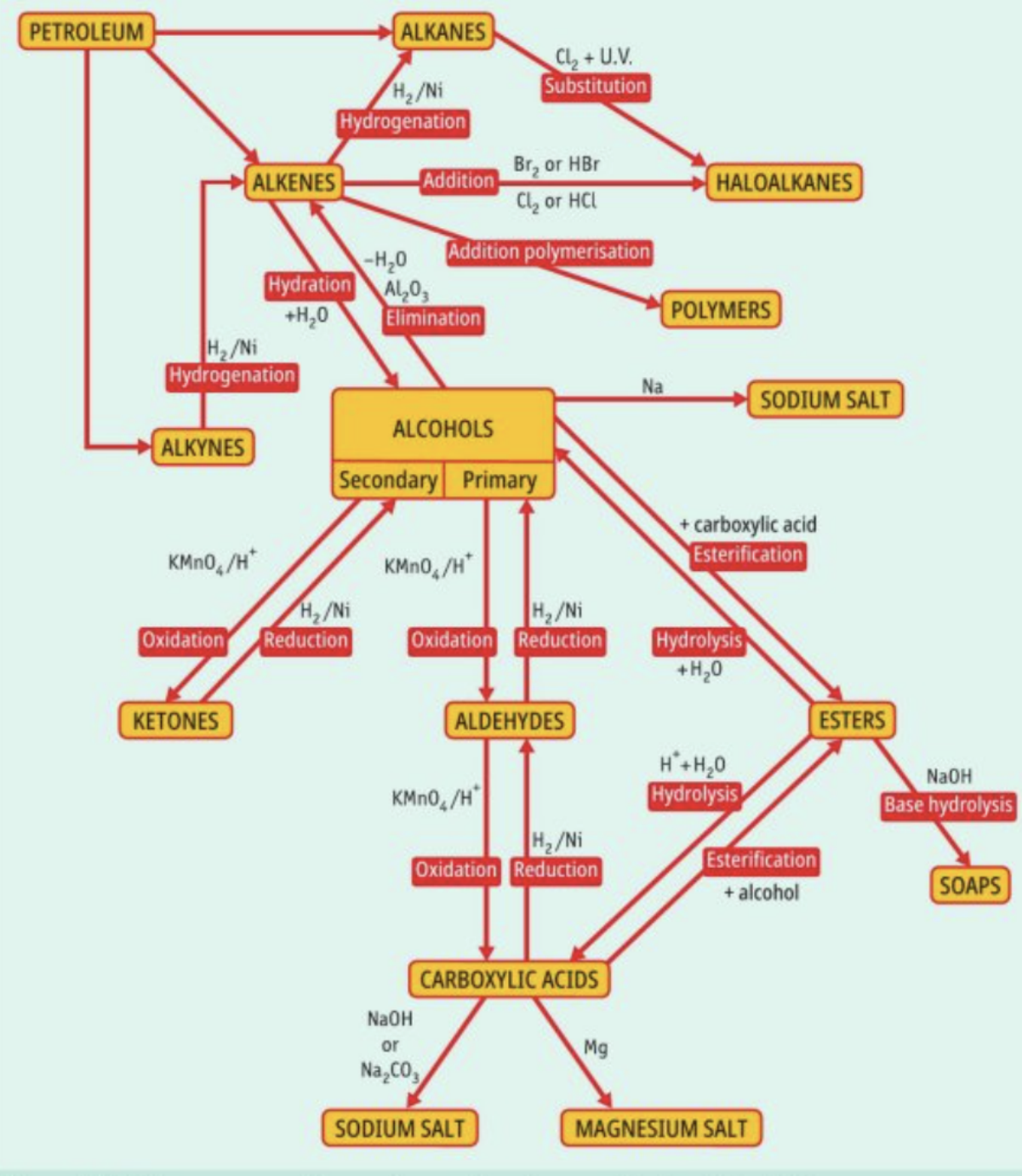
This comprehensive reaction scheme shows the interconnected nature of organic chemistry. Starting with petroleum as our source material, we can see how it leads to alkanes, which then branch out into numerous other compound classes through various chemical transformations.
Key features of the reaction scheme
The scheme demonstrates several important principles:
- Starting point: Petroleum provides our basic alkanes (hydrocarbons)
- Multiple pathways: Each compound class can be converted into several others
- Reversible processes: Many reactions can go both ways under different conditions
- Reagent specifications: Each arrow shows the specific reagents and conditions needed
- End products: The scheme shows various useful products including polymers, soaps, and salts
Important
Pay close attention to the arrows and reagents shown in the scheme. Each arrow represents a specific chemical transformation that requires particular conditions. Using the wrong reagents or conditions will not give you the desired product.
Types of reactions in organic chemistry
The reaction scheme helps us organise the five main types of reactions you'll encounter:
1. Substitution reactions
These involve replacing one atom or group with another. For example, converting alkanes to haloalkanes using chlorine gas and UV light ( + UV).
2. Addition reactions
These occur when two molecules combine to form a single product, typically involving alkenes. Examples include adding hydrogen (/Ni) or halogens () to double bonds.
3. Elimination reactions
These are the opposite of addition reactions, where a small molecule is removed to create a double bond. Dehydration of alcohols using aluminium oxide () is a common example.
4. Redox reactions (oxidation and reduction)
Oxidation reactions often use potassium permanganate (/) to convert alcohols to aldehydes or carboxylic acids. Reduction reactions, like hydrogenation, do the opposite.
5. Acid-base reactions
These include reactions with metals like sodium (Na) or magnesium (Mg), and reactions with bases like sodium hydroxide (NaOH) to form salts.
Example
Worked Example: Multi-step Conversion
Converting an alcohol to a carboxylic acid:
Step 1: Alcohol → Aldehyde (using / under mild conditions) Step 2: Aldehyde → Carboxylic acid (using / under stronger conditions)
This demonstrates how some conversions require multiple sequential reactions.
Reading reaction pathways
When following a pathway through the scheme, pay attention to:
- Starting materials: What compound class are you beginning with?
- Target products: Where do you want to end up?
- Reagents required: What chemicals and conditions are needed for each step?
- Number of steps: Some conversions require multiple reactions in sequence
For instance, to convert an alcohol to a carboxylic acid, you might first oxidise the alcohol to an aldehyde, then further oxidise the aldehyde to the carboxylic acid.
Note
When planning synthetic routes, it's often helpful to work backwards from your target molecule. This approach, called retrosynthetic analysis, helps you identify the most efficient pathway through the reaction scheme.
Important reagents and conditions
The scheme shows many key reagents you need to know:
- /Ni: Hydrogenation (reduction of alkenes to alkanes)
- /: Strong oxidising agent
- : Dehydration catalyst for elimination reactions
- + UV: Free radical substitution in alkanes
- NaOH: Base for hydrolysis reactions
- Na or Mg: Metals that react with carboxylic acids to form salts
Important
Common Mistake to Avoid: Remember that reaction conditions are crucial - the same starting material can give different products under different conditions. Always specify both the reagents and conditions (temperature, pressure, catalysts) when writing reaction equations.
Practical applications
Understanding reaction schemes helps you:
- Plan synthetic routes: Work backwards from your target molecule
- Predict products: Know what happens when specific reagents are used
- Understand industrial processes: See how petroleum becomes plastics, fuels, and other products
- Solve exam problems: Navigate complex multi-step synthesis questions
The scheme shows how modern chemistry transforms simple starting materials like petroleum into the vast array of products we use daily, from plastics and fuels to pharmaceuticals and materials.
Exam tips
Important
Essential Exam Strategies:
- Practice tracing pathways through the reaction scheme regularly
- Learn the key reagents and their specific uses - these are frequently tested
- Understand that some reactions have limitations (like the fact that tertiary alcohols cannot be easily oxidised)
- Remember that reaction conditions are crucial - the same starting material can give different products under different conditions
- Use the scheme to check your answers - if a pathway doesn't exist on the scheme, reconsider your solution
- When asked for multi-step syntheses, show all intermediate steps clearly
Summary
Key Points to Remember:
- Reaction schemes provide a visual map of how organic compounds interconnect through chemical reactions
- The five main reaction types are substitution, addition, elimination, redox, and acid-base reactions
- Petroleum serves as the starting point for most organic compounds in industrial chemistry
- Specific reagents and conditions determine which pathway a reaction will follow
- Understanding these schemes helps you plan synthetic routes and predict reaction products in exams
- Always work systematically through the scheme, checking that each step is chemically valid