Galvanic (Voltaic) Cells (Leaving Cert Chemistry): Revision Notes
📚Revision Notes
Galvanic (Voltaic) Cells
Galvanic cells are fundamental electrochemical devices that demonstrate how chemical reactions can produce electrical energy. These cells are named after scientists Luigi Galvani and Alessandro Volta, who pioneered research into electricity generation through chemical processes.
What is a galvanic cell?
A galvanic cell (also called a voltaic cell) is a device that converts chemical energy into electrical energy through oxidation-reduction reactions. When two different metals are placed in conducting solutions and connected with a wire, an electric current flows between them.
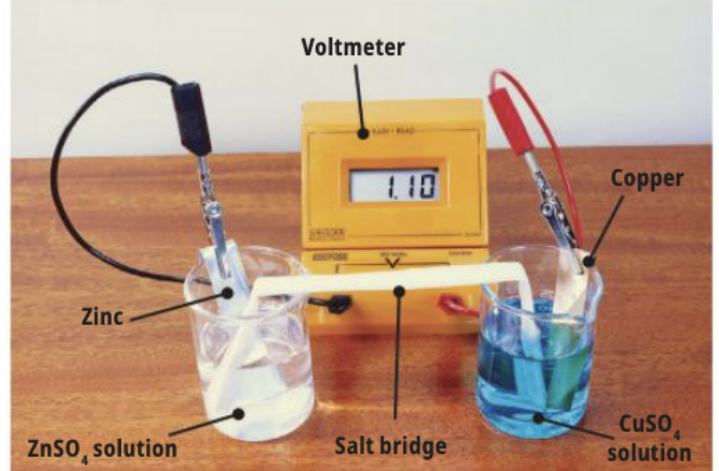
The image above shows a typical galvanic cell setup generating 1.10 volts of electrical potential.
Key terminology
Understanding these essential terms is crucial for mastering galvanic cells:
Note
Electrode: The solid conductor (usually a metal or graphite) that carries electricity into or out of the cell. In the galvanic cell, electrodes are strips of zinc and copper metal.
Note
Electrolyte: The solution that contains ions and can conduct electricity. In our example, the electrolytes are zinc sulphate and copper sulphate solutions.
Note
Half-cell: One part of the galvanic cell where either oxidation or reduction occurs. Each half-cell consists of a metal electrode dipping into a solution containing ions of that metal.
Structure and components of a galvanic cell
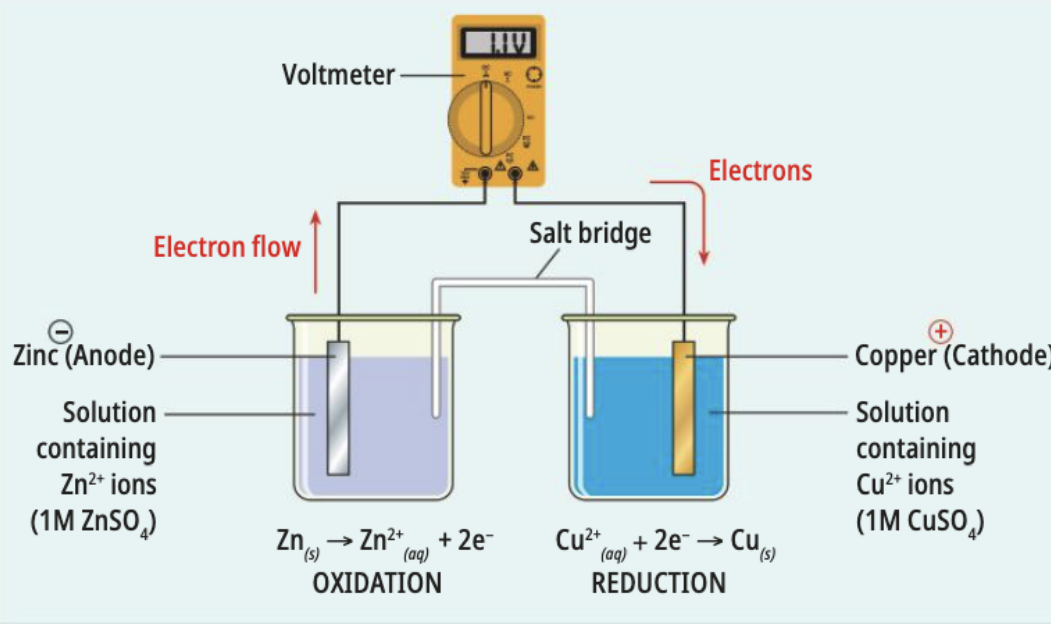
A typical galvanic cell consists of several key components working together:
- Two half-cells: Each containing a metal electrode in a solution of its own metal ions
- Salt bridge: Connects the two solutions and allows ion movement
- External wire: Connects the electrodes and allows electron flow
- Voltmeter: Measures the electrical potential difference (optional)
In the zinc-copper galvanic cell shown, one half-cell contains a zinc electrode in zinc sulphate solution, whilst the other contains a copper electrode in copper sulphate solution.
How galvanic cells work - redox reactions
Galvanic cells operate through redox reactions - simultaneous oxidation and reduction processes occurring at different electrodes.
Oxidation at the anode
At the zinc electrode (the anode), oxidation occurs. Zinc atoms lose electrons and form zinc ions:
Example
Chemical Reaction at the Anode:
This shows zinc atoms losing 2 electrons to become zinc ions.
The anode is negative because it releases electrons into the external circuit.
Important
Remember: "Anode Oxidation" - oxidation always occurs at the anode.
Reduction at the cathode
At the copper electrode (the cathode), reduction occurs. Copper ions gain electrons from the external circuit to become copper atoms:
Example
Chemical Reaction at the Cathode:
This shows copper ions gaining 2 electrons to become copper atoms.
The cathode is positive because it accepts electrons from the external circuit.
Important
Remember: "Reduction Cathode" - reduction always occurs at the cathode.
Overall cell reaction
Combining both half-reactions gives the overall cell reaction:
Example
Overall Cell Reaction:
This reaction shows that zinc metal is converted to zinc ions whilst copper ions are converted to copper metal.
The role of the salt bridge
The salt bridge plays a crucial role in maintaining the cell's operation. Understanding its function is essential for grasping how galvanic cells work continuously.
Important
Critical Functions of the Salt Bridge:
- Allows ions to flow between the two half-cells without the solutions mixing directly
- Maintains electrical neutrality in both half-cells
- Could be a piece of philtre paper soaked in potassium chloride or potassium nitrate solution
Without the salt bridge, the solutions would become charged (one positive, one negative) and the reaction would quickly stop.
Electron flow and current direction
Electrons flow through the external wire from the anode (zinc) to the cathode (copper). This electron movement constitutes the electric current that can power external devices. The electrons cannot travel through the salt bridge - only ions can move through the electrolyte solutions.
Note
The direction of electron flow is always from the negative electrode (anode) to the positive electrode (cathode) through the external circuit, while ions flow through the internal salt bridge to complete the circuit.
Key characteristics of galvanic cells
Galvanic cells have several defining characteristics that distinguish them from other electrochemical devices:
- Converts chemical energy directly into electrical energy
- Consists of two half-cells connected by a salt bridge
- Operates through spontaneous redox reactions
- Produces a measurable voltage (approximately 1.1 volts for Zn-Cu cell)
- The anode is always negative (loses electrons)
- The cathode is always positive (gains electrons)
Exam tips
Important
Essential Exam Strategies:
- Remember "LEO says GER": Lose Electrons Oxidation, Gain Electrons Reduction
- Always identify which electrode is the anode (oxidation) and which is the cathode (reduction)
- Be able to write both half-equations and the overall cell equation
- Understand that electrons flow from anode to cathode through the external circuit
- Know that ions move through the salt bridge to maintain electrical balance
Summary
Key Points to Remember:
-
Galvanic cells convert chemical energy into electrical energy through redox reactions occurring in separate half-cells
-
The anode is negative (oxidation occurs here) and the cathode is positive (reduction occurs here)
-
Electrons flow externally from anode to cathode, whilst ions flow through the salt bridge to maintain electrical neutrality
-
The salt bridge is essential - it allows the cell to continue operating by preventing charge buildup in the solutions
-
Redox reactions drive the process - oxidation at the anode produces electrons that travel to the cathode where reduction occurs