The Electrochemical Series (Leaving Cert Chemistry): Revision Notes
📚Revision Notes
The Electrochemical Series
What is the electrochemical series?
The electrochemical series is a powerful tool in chemistry that ranks elements based on how easily they give up electrons. Think of it as a "league table" of metals, arranged from the most reactive at the top to the least reactive at the bottom.
Note
Key definition: The electrochemical series lists elements in order of their standard electrode potentials. This means it shows the decreasing tendency for each element to be oxidised (lose electrons) under standard conditions.
Elements higher up in the series have a stronger tendency to lose electrons and become positive ions. Elements lower down prefer to stay as neutral atoms or gain electrons.
Understanding the hydrogen half-cell
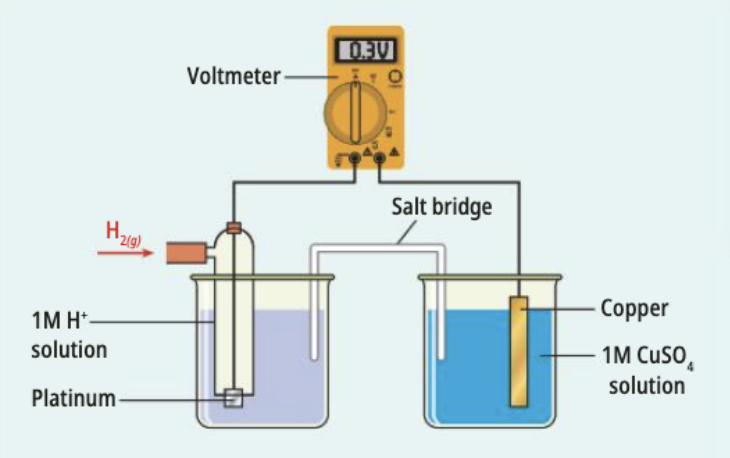
To create this series, chemists needed a reference point - something to compare all other elements against. They chose the hydrogen half-cell as their standard.
Note
The standard hydrogen half-cell consists of:
- A platinum electrode (which doesn't react)
- A 1M solution of H⁺ ions
- Hydrogen gas at atmospheric pressure bubbling over the platinum
This setup is given a standard electrode potential of exactly 0.00 volts. Every other element is then compared to this hydrogen standard to determine where it sits in the electrochemical series.
Order of elements in the electrochemical series
The electrochemical series follows this general pattern (from most reactive to least reactive):
Most reactive (top of series):
- Metals like potassium, sodium, calcium, magnesium, aluminium
- These metals lose electrons very easily
- They are easily oxidised under standard conditions
Middle section:
- Zinc, iron, lead, hydrogen
Least reactive (bottom of series):
- Copper, mercury, silver, gold
- These metals have a very small tendency to lose electrons
- They may even occur in nature as pure metals
Important
Key Principle: Metals near the top of the series have a greater tendency to lose their outer electrons than metals lower down. This explains why some metals corrode easily while others like gold remain unreactive.
Applications of the electrochemical series
Predicting displacement reactions
The electrochemical series allows us to predict which displacement reactions will occur. A metal higher in the series will always displace a metal lower down from a solution of its ions.
Important
Rule: More reactive metal displaces less reactive metal
Example
Worked Example: Copper and Silver Displacement
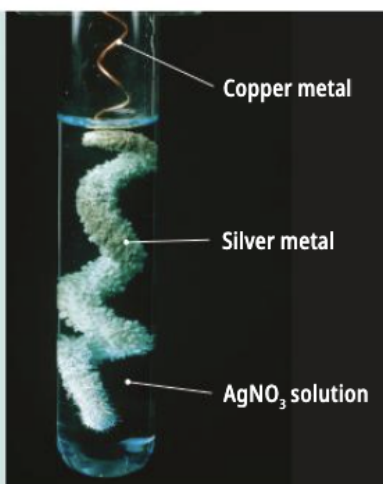
When copper metal is placed in silver nitrate solution:
- Copper is higher than silver in the electrochemical series
- Copper displaces silver from the solution
- Silver metal precipitates out as distinctive crystals
- The copper goes into solution as Cu²⁺ ions
Other examples of displacement reactions:
- Magnesium displaces copper:
- Iron displaces copper:
- Copper displaces silver:
Galvanising and corrosion protection
Understanding the electrochemical series helps explain how we can protect metals from corrosion.
Galvanising involves coating iron or steel with zinc. Since zinc is higher in the electrochemical series than iron:
Note
- Zinc has a greater tendency to lose electrons than iron
- Zinc corrodes preferentially, protecting the iron underneath
- Even if the zinc coating is scratched, it continues to protect the iron
- This is why galvanised items like buckets and wheelbarrows are coated with zinc
Coating with unreactive metals: Sometimes iron or steel is coated with metals lower in the electrochemical series, such as tin or chromium. However, if this coating is damaged and the base metal is exposed to air and water, corrosion will occur rapidly.
Cathodic protection
This method uses the electrochemical series principle to prevent corrosion on a larger scale. A more reactive metal (higher in the series) is placed in contact with the metal that needs protection.
Note
Sacrificial anodes: In this method, blocks of zinc are attached to steel structures like ship hulls or underground pipes. The zinc acts as the anode and corrodes instead of the steel. The zinc needs to be replaced periodically, but this protects the much more expensive steel structure.
This technique is called cathodic protection because the steel becomes the cathode in the electrochemical cell and doesn't corrode.
Key examples and reactions
Most common corrosion example: The rusting of iron and steel occurs when these metals are exposed to oxygen and water. Since iron is relatively high in the electrochemical series, it readily loses electrons to form iron oxide (rust).
Preventing corrosion methods:
- Painting and greasing - creates a barrier preventing oxygen and water from reaching the metal
- Galvanising - coating with zinc (more reactive metal)
- Using sacrificial anodes - attaching more reactive metals like zinc blocks
Example
Industrial Application: Copper Extraction
Scrap iron can be used to extract copper from copper sulphate solutions because iron is higher than copper in the electrochemical series, so iron displaces copper from solution.
Summary
Summary
Key Points to Remember:
-
The electrochemical series ranks elements by their tendency to lose electrons - most reactive at the top, least reactive at the bottom
-
More reactive metals displace less reactive metals from solutions of their ions - this is the key to predicting displacement reactions
-
The hydrogen half-cell is the standard reference point with a potential of 0.00 volts that all other elements are compared against
-
Galvanising works because zinc is more reactive than iron - zinc corrodes preferentially to protect the iron underneath
-
Cathodic protection uses sacrificial anodes - more reactive metals like zinc protect less reactive metals like steel by corroding instead of them