Oxidation Numbers (Leaving Cert Chemistry): Revision Notes
📚Revision Notes
Oxidation Numbers
What are oxidation numbers?
An oxidation number is a value assigned to an atom that represents the charge it would have if electrons were distributed according to specific rules. Think of it as a bookkeeping system that helps us track electrons in chemical compounds and reactions.
Another way to understand oxidation numbers is as the charge an atom appears to have when we assume all bonding is completely ionic (even though most bonding is actually covalent).
Note
Oxidation numbers are also called "oxidation states" - these terms can be used interchangeably in chemistry.
How are oxidation numbers assigned?
When assigning oxidation numbers, electrons are given to the more electronegative element in a bond. This means the atom that attracts electrons more strongly gets assigned the electrons.
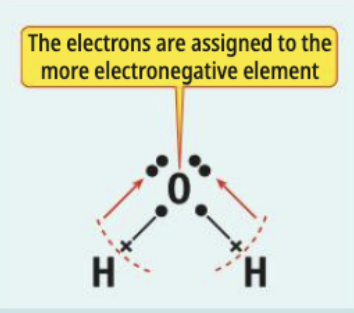
For example, in water (H₂O), oxygen is more electronegative than hydrogen. So we imagine that both electrons in each O-H bond belong entirely to the oxygen atom.
This gives us:
- Each hydrogen atom: +1 oxidation number (lost its electron)
- Oxygen atom: -2 oxidation number (gained two electrons)
- Overall: (neutral compound)
Rules for assigning oxidation numbers
Chemists have developed eight key rules to make assigning oxidation numbers straightforward:
Important
These rules are applied in order of priority. If there's a conflict, the earlier rules take precedence over later ones.
Rule 1: Uncombined elements = 0
Any element that isn't bonded to another type of element has an oxidation number of zero. Examples include Na, Fe, O₂, and Cl₂.
Rule 2: Ion oxidation number = charge
For simple ions, the oxidation number equals the charge on the ion:
- Br⁻ in NaBr: -1
- Fe³⁺ in FeCl₃: +3
- Na⁺ in NaCl: +1
- Mg²⁺ in MgO: +2
Rule 3: Sum in compounds = 0
The sum of all oxidation numbers in a neutral compound must equal zero.
Rule 4: Oxygen rules and exceptions
- Usually: Oxygen has oxidation number -2
- Exception 1: In peroxides (like H₂O₂), oxygen is -1
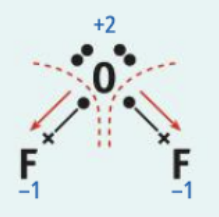
- Exception 2: In OF₂, oxygen is +2 (because fluorine is more electronegative)
Rule 5: Hydrogen rules and exceptions
- Usually: Hydrogen has oxidation number +1
- Exception: In metal hydrides (like NaH), hydrogen is -1
Rule 6: Halogen rules
- Usually: Halogens have oxidation number -1
- Exception: When bonded to more electronegative elements (like in ClO₂, where Cl = +7)
Rule 7: Binary compounds
In compounds with two different elements, electrons go to the more electronegative element, and its oxidation number is calculated by balancing the overall charge.
Rule 8: Polyatomic ions
The sum of oxidation numbers in a polyatomic ion equals the charge on the ion.
For example, in NO₃⁻:
- Overall charge = -1
- Oxygen atoms:
- Therefore nitrogen: +5 (because )
Worked examples
Example
Worked Example: Nitrate ion (NO₃⁻)
Question: What is the oxidation number of nitrogen in NO₃⁻?
Solution:
- Overall charge on ion = -1
- Each oxygen = -2, so three oxygens =
- Let nitrogen oxidation number = x
Answer: Nitrogen has oxidation number +5
Example
Worked Example: Copper sulphate (CuSO₄)
Question: Find the oxidation number of each element in CuSO₄.
Solution:
- Compound is neutral, so sum = 0
- Oxygen:
- For the sulphate ion SO₄²⁻: sulphur + 4(-2) = -2, so sulphur = +6
- Copper: must be +2 to balance (since +2 + (-2) = 0)
Example
Worked Example: Sodium thiosulfate (Na₂S₂O₆)
This example shows that oxidation numbers can be fractional when atoms of the same element have different environments.
Solution:
- Each sodium: +1
- Each oxygen: -2
- For sulphur:
- (but this is an average - the two sulphur atoms actually have different oxidation numbers)
Transition metals and variable oxidation states
Transition metals can have multiple oxidation states, which is why we use Roman numerals in their compound names.
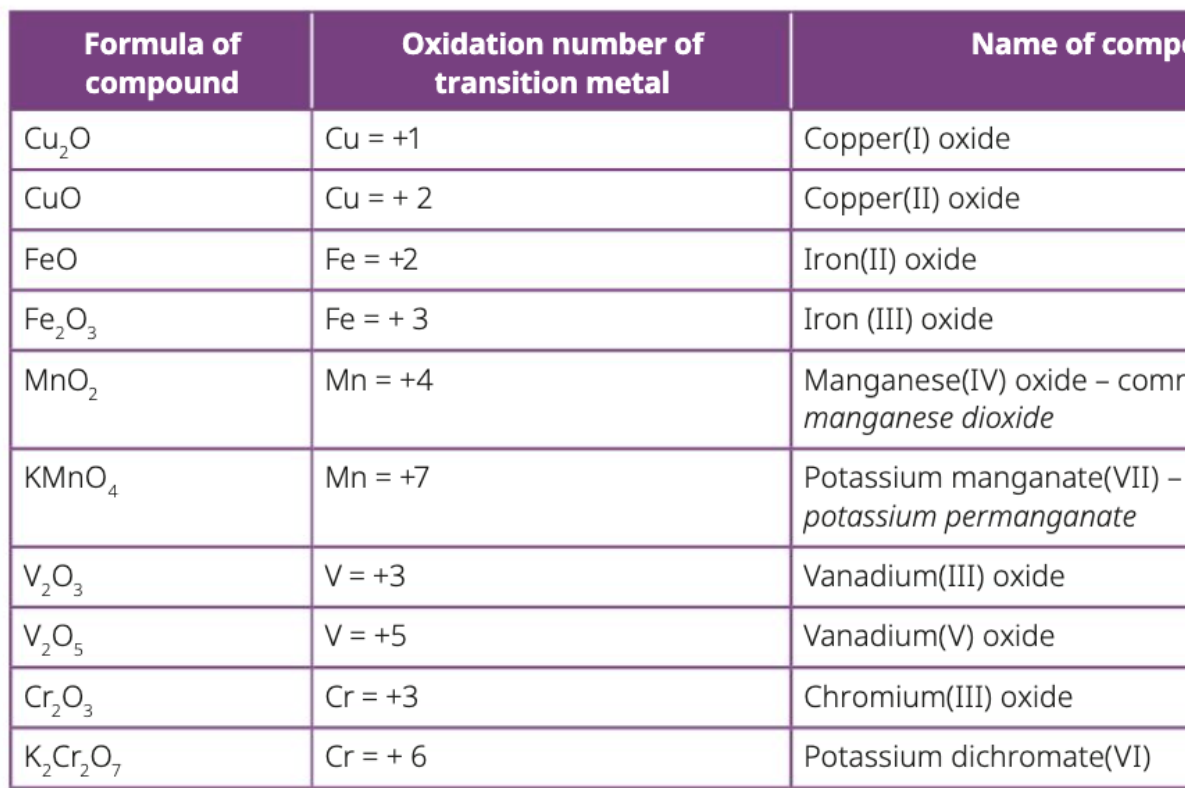
Common examples:
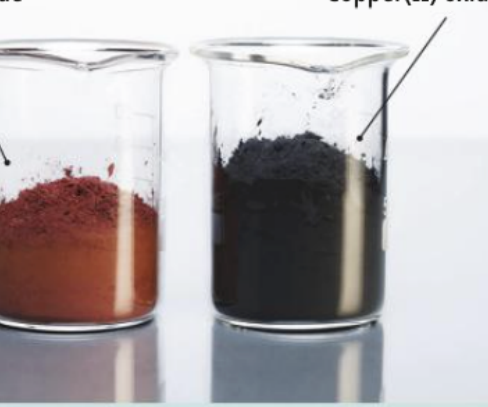
- Copper(I) oxide: Cu₂O (Cu = +1)
- Copper(II) oxide: CuO (Cu = +2)
- Iron(II) oxide: FeO (Fe = +2)
- Iron(III) oxide: Fe₂O₃ (Fe = +3)
- Potassium permanganate: KMnO₄ (Mn = +7)
Note
The Roman numeral tells you the oxidation state of the transition metal in that particular compound. This is essential for correctly naming and identifying transition metal compounds.
Using oxidation numbers for redox reactions
Oxidation numbers are essential for identifying what gets oxidised and what gets reduced in chemical reactions.
Important
Key principle:
- Oxidation = increase in oxidation number
- Reduction = decrease in oxidation number
Example:
Analysis:
- H₂: hydrogen goes from 0 to +1 (increase = oxidation)
- O₂: oxygen goes from 0 to -2 (decrease = reduction)
This confirms that hydrogen is oxidised and oxygen is reduced in this reaction.
Exam tips
- Always clearly state oxidation numbers when asked
- Show your working step by step
- Check that oxidation numbers sum to the correct total charge
- Remember that oxidation numbers can be fractional
- Use Roman numerals correctly in transition metal compound names
Summary
Key Points to Remember:
-
Oxidation numbers track electron "ownership" in compounds and help identify redox reactions
-
Eight key rules govern how oxidation numbers are assigned, with uncombined elements = 0 being the starting point
-
Oxygen is usually -2 and hydrogen is usually +1, but watch out for exceptions like peroxides and metal hydrides
-
In neutral compounds, all oxidation numbers must sum to zero; in ions, they sum to the ion's charge
-
Increase in oxidation number = oxidation; decrease in oxidation number = reduction