Measuring Rates of Reactions (Leaving Cert Chemistry): Revision Notes
📚Revision Notes
Measuring Rates of Reactions
Chemical reactions don't all happen at the same speed. Some reactions occur in fractions of a second, whilst others take years to complete. Understanding how quickly reactions proceed is essential for chemists working in industry, medicine, and research.
Why do reaction rates matter?
Different chemical processes occur over vastly different timescales. This variation affects how we use these reactions in everyday life and industrial processes.
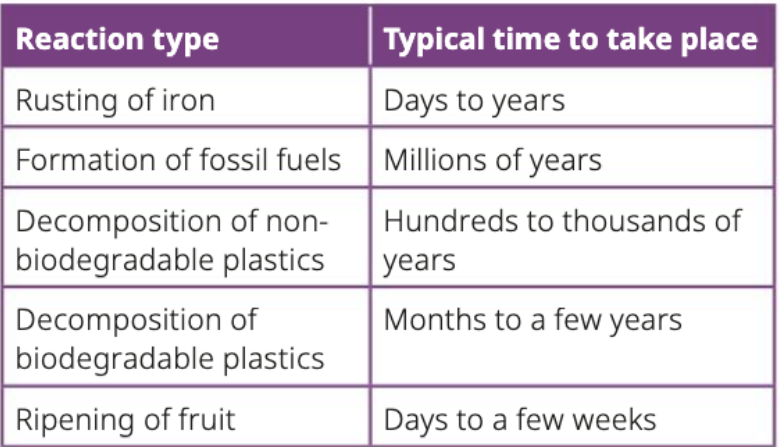
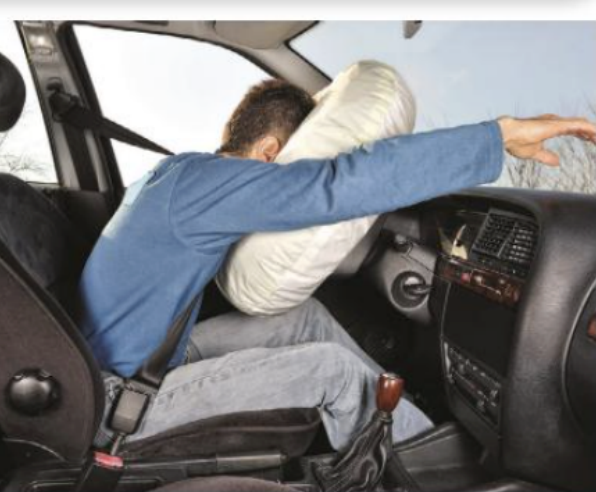
For example, when you need an airbag to deploy during a car crash, the chemical reaction must happen almost instantly to protect passengers. However, processes like the formation of fossil fuels occur over millions of years.
Note
Scientists need to understand reaction speeds because controlling the rate of chemical reactions is fundamental to many applications:
- Industrial processes require optimum reaction rates for efficiency
- Economic problems can arise if reactions are too slow in manufacturing
- Safety considerations depend on controlling reaction speeds
- Medical treatments need precise timing for drug reactions
What is rate of reaction?
The rate of reaction tells us how quickly reactants are used up or how quickly products are formed during a chemical reaction. We use the concept of "rate" in many everyday situations - like measuring the speed of a car or counting heartbeats per minute.
Important
Rate of reaction is defined as the change in concentration per unit time of any one reactant or product.
Scientists measure reaction rates by tracking how the concentration of substances changes over time. For example, if a chemical reaction produces a gas, we can measure how quickly that gas is produced by collecting and measuring its volume at regular time intervals.
Mathematically, we can express this as:
Laboratory methods for measuring reaction rates
A balanced chemical equation cannot tell us how quickly a reaction will occur. To find out the actual speed, we must carry out practical laboratory work and take measurements.
Gas collection method
One of the most common ways to measure reaction rates is by collecting any gas produced during the reaction. This method works well for reactions that produce gases like hydrogen, oxygen, or carbon dioxide.
Experimental setup
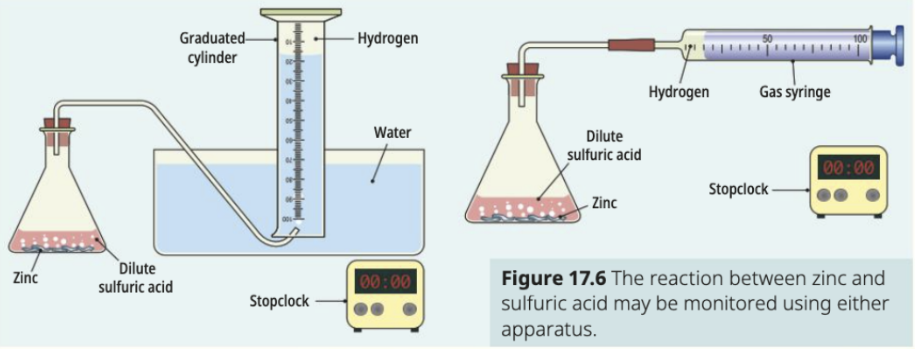
The apparatus shown demonstrates how to measure the rate of hydrogen gas production from the reaction between zinc metal and dilute sulfuric acid. The setup includes:
- Conical flask containing the reactants (zinc + sulfuric acid)
- Delivery tube to transport the gas
- Graduated cylinder filled with water to collect the gas
- Water trough for the water displacement method
- Stopwatch to record time intervals
Taking measurements
During the experiment, hydrogen gas displaces water in the graduated cylinder. By recording the volume of gas collected at regular time intervals, we can track how quickly the reaction proceeds.

This data table shows typical results from a hydrogen gas collection experiment. Notice how the volume increases rapidly at first, then more slowly as the reaction progresses.
Important
Exam Tip: When drawing the apparatus, always remember to show the graduation marks on the graduated cylinder and label all parts clearly.
Plotting and interpreting rate graphs
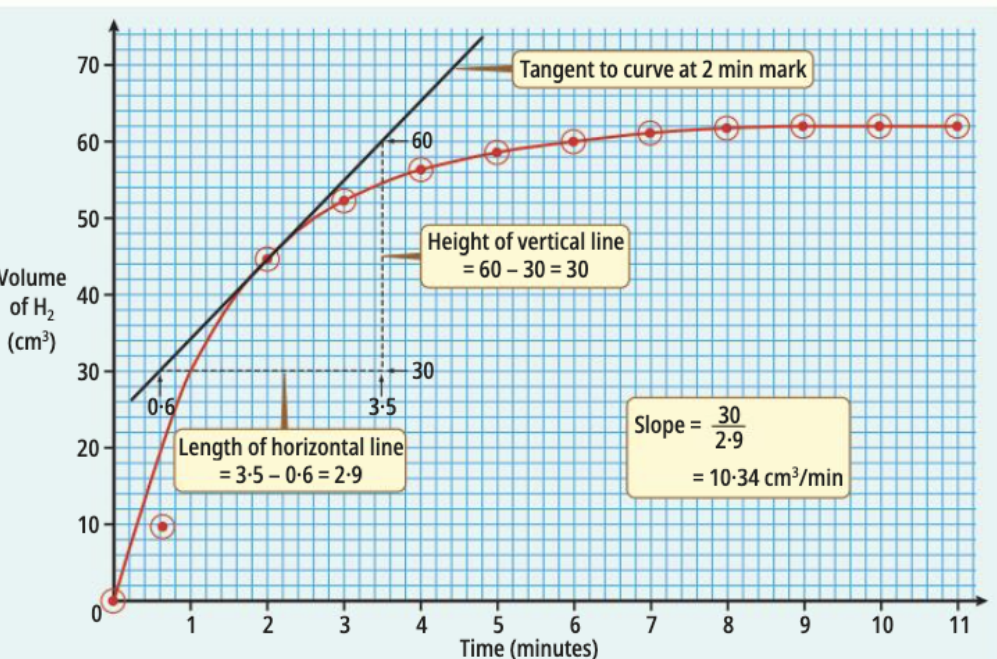
Once we have collected experimental data, we can plot a graph to visualise how the reaction rate changes over time.
Understanding the graph shape
Note
Rate graphs typically show a characteristic curve with three distinct phases:
- Steep initial slope - The reaction starts quickly when reactant concentrations are highest
- Gradually flattening curve - The reaction slows down as reactants are consumed
- Final plateau - The reaction stops when one reactant is completely used up
The shape tells us that reactions are fastest at the beginning when the concentrations of reactants are at their maximum levels.
Calculating rates from graphs
There are two main types of rates we can calculate from experimental graphs:
Average rate
This is calculated by dividing the total change by the total time:
Instantaneous rate
This is the rate at any particular moment during the reaction. To find it, we draw a tangent line to the curve at the specific time point we're interested in.
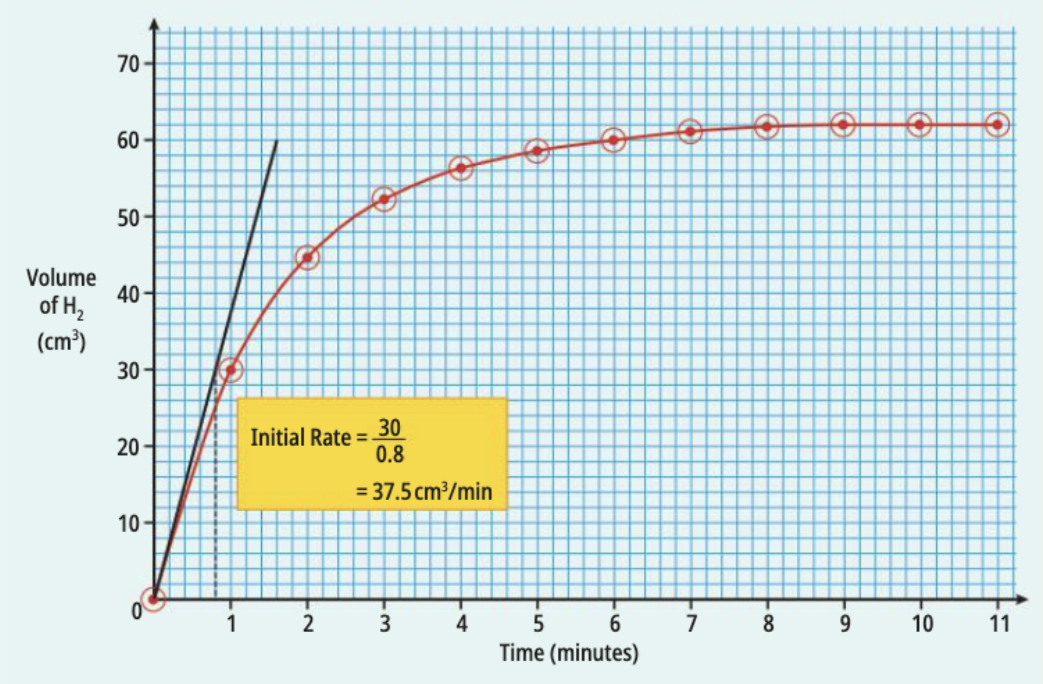
Measuring initial rate
The initial rate is particularly important because it shows how fast the reaction proceeds when the concentrations of reactants are at their maximum. This gives us the truest measure of the reaction's potential speed.
Example
Worked Example: Calculating Initial Rate
To measure the initial rate:
- Draw a tangent line to the curve at the (0,0) point
- Calculate the slope of this tangent line
- Use the formula:
For example:
Drawing tangent lines accurately
The slope of the tangent line equals the instantaneous rate at that specific time. A steeper slope indicates a faster rate, whilst a gentler slope shows a slower rate.
Important
Exam Tip: When drawing tangent lines, choose points that are at least half a unit of time on either side of your target point. This helps ensure accuracy in your slope calculations.
Practical considerations
Understanding reaction rates helps chemists optimise industrial processes, develop new medicines, and solve environmental challenges. The ability to measure and control reaction speeds is fundamental to modern chemistry applications.
Important
When measuring reaction rates in the laboratory:
- Use appropriate safety equipment and follow procedures carefully
- Take measurements at regular, short time intervals for accuracy
- Label all apparatus components clearly in diagrams
- Record data systematically in well-organised tables
- Plot graphs carefully using appropriate scales
Summary
Key Points to Remember:
- Rate of reaction measures how quickly reactants are used up or products are formed
- Gas collection over water is a common method for measuring rates of gas-producing reactions
- Rate graphs typically show fast initial rates that gradually slow down as reactants are consumed
- Tangent lines allow us to calculate instantaneous rates at specific time points
- Initial rate gives the best measure of a reaction's speed when reactant concentrations are highest