Converting Moles to Grams (Leaving Cert Chemistry): Revision Notes
📚Revision Notes
Converting Moles to Grammes
Introduction
Converting moles to grammes is one of the most important calculations in chemistry. This conversion allows you to determine the actual mass of a substance when you know how many moles you have. The key to mastering this skill lies in understanding the relationship between moles, relative atomic masses, and molar masses.
The fundamental principle
Important
The mass of one mole of any element equals its relative atomic mass expressed in grammes. This simple rule forms the foundation for all mole-to-gram conversions.
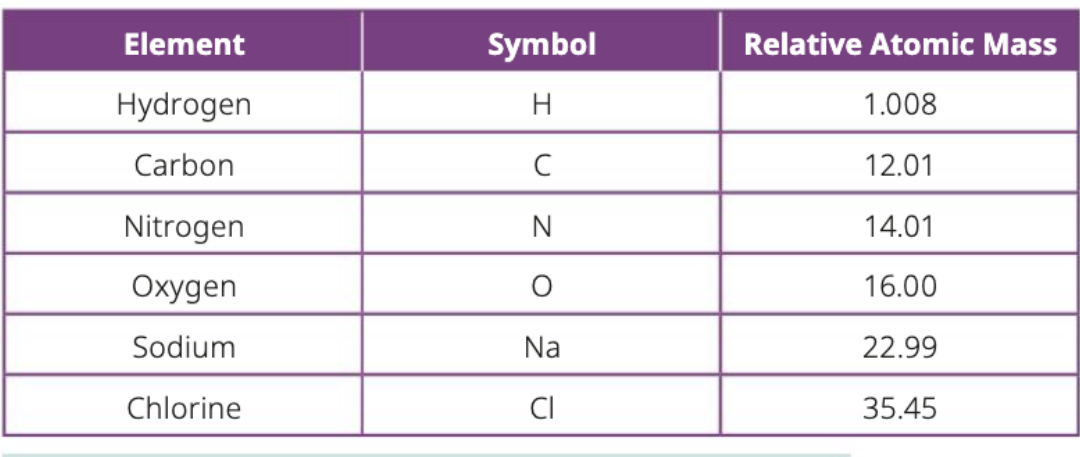
For example, from the table above:
- 1 mole of hydrogen atoms = 1.008 grammes
- 1 mole of carbon atoms = 12.01 grammes
- 1 mole of sodium atoms = 22.99 grammes
Converting moles of elements to grammes
When converting moles of elements to grammes, follow this straightforward method:
Step 1: Find the relative atomic mass of the element from the periodic table
Step 2: Multiply the relative atomic mass by the number of moles
Note
Formula:
This example shows how 3 moles of aluminium converts to 80.94 grammes by multiplying the relative atomic mass (26.98) by 3.
Converting moles of compounds to grammes
For compounds, the process requires an additional step to calculate the relative molecular mass first.
Step 1: Calculate the relative molecular mass (Mr) by adding up the relative atomic masses of all atoms in the compound Step 2: Multiply the relative molecular mass by the number of moles
Note
Formula:
Example calculations
Example
Worked Example: Water (H₂O)
Step 1: Calculate relative molecular mass
- 2 hydrogen atoms:
- 1 oxygen atom:
- Relative molecular mass =
Step 2: Apply the conversion Therefore, 1 mole of water = 18.016 grammes
Example
Worked Example: Calcium chloride (CaCl₂)
Step 1: Calculate relative molecular mass
- 1 calcium atom:
- 2 chlorine atoms:
- Relative molecular mass =
Step 2: Apply the conversion Therefore, 1 mole of calcium chloride = 110.98 grammes
Understanding molar mass
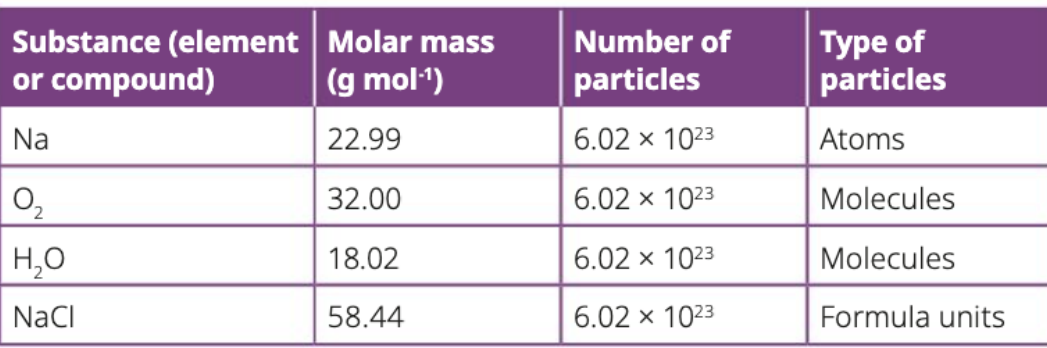
Molar mass is the mass of one mole of any substance, expressed in grammes per mole (g mol⁻¹). It's numerically equal to the relative atomic mass for elements or relative molecular mass for compounds.
Note
This table demonstrates that regardless of the substance, one mole always contains the same number of particles (6.02 × 10²³), but the mass varies depending on the substance.
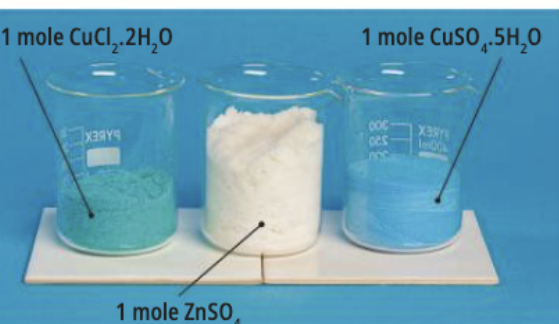
This visual representation shows how different compounds with equal molar amounts (1 mole each) have different masses and appearances, illustrating the concept that molar mass varies between substances.
Key points for calculations
When performing mole-to-gram conversions, remember:
- Elements: Use relative atomic mass directly
- Molecular compounds: Calculate relative molecular mass first
- Ionic compounds: Use relative formula mass (calculated the same way)
- Hydrated compounds: Include the mass of water molecules in your calculation
Example
Advanced Example: Copper(II) sulphate pentahydrate (CuSO₄·5H₂O)
Step 1: Calculate all component masses
- Copper:
- Sulphur:
- 4 oxygen atoms (in sulphate):
- 5 water molecules:
Step 2: Sum all masses Total relative molecular mass =
Step 3: Apply conversion Therefore, 1 mole = 249.67 grammes
Practical applications
Note
This conversion is essential for:
- Calculating quantities needed in chemical reactions
- Determining yields in industrial processes
- Laboratory preparation of solutions
- Quality control in manufacturing
Summary
Key Points to Remember:
- The mass of one mole of any element equals its relative atomic mass in grammes
- For compounds, first calculate the relative molecular mass by adding all atomic masses
- Use the formula:
- One mole always contains 6.02 × 10²³ particles, regardless of the substance
- Practice with different types of compounds - elements, molecular compounds, and ionic compounds all follow the same principle