The Alkali Metals (Leaving Cert Chemistry): Revision Notes
📚Revision Notes
The Alkali Metals
What are the alkali metals?
The alkali metals are the elements found in Group 1 of the Periodic Table. This group includes lithium (Li), sodium (Na), potassium (K), rubidium (Rb), caesium (Cs), and francium (Fr). In your Leaving Certificate Chemistry course, you'll focus primarily on the first three: lithium, sodium, and potassium.
Note
These elements are called "alkali" metals because they form alkaline (basic) solutions when they react with water. This property gives them their distinctive name and helps explain their chemical behaviour.
They're located in the first column of the Periodic Table, which gives us an important clue about their properties.
Key properties of alkali metals
Physical properties
All alkali metals share several important characteristics that make them unique among metals:
- They are soft metals that can be cut with a knife
- They have low density - lithium even floats on water
- They have shiny, silvery surfaces when freshly cut
- They are good conductors of heat and electricity
- They have low melting and boiling points compared to other metals
Chemical properties
The chemical behaviour of alkali metals is determined by their electron structure. Each alkali metal has exactly one electron in its outer energy level. This single outer electron is easily lost, making these elements extremely reactive.
Important
The Key to Understanding Alkali Metals: The single outer electron is the most important factor determining all their chemical properties. This electron is easily removed because it's far from the nucleus and experiences weak attraction.
Because they readily lose their outer electron, alkali metals:
- Form ionic compounds by transferring electrons to other atoms
- Always have a +1 charge when they form ions
- React vigorously with water and oxygen
- Must be stored carefully to prevent unwanted reactions
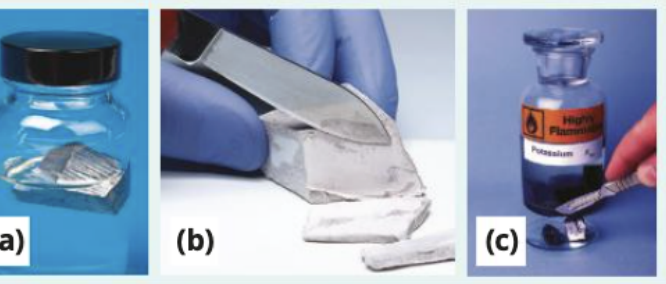
The image above shows proper laboratory handling of alkali metals, including storage under oil and the use of protective gloves due to their reactive nature.
Reactivity patterns and trends
Reactions with oxygen
All alkali metals react readily with oxygen in the air to form metal oxides. The general pattern is:
Metal + Oxygen → Metal Oxide
Example
Worked Example: Alkali Metal Reactions with Oxygen
The specific reactions are:
- Lithium: (lithium oxide)
- Sodium: (sodium oxide)
- Potassium: (potassium oxide)
Notice how all reactions follow the same pattern, with the metal combining with oxygen to form the metal oxide.
Reactions with water
The reaction with water is particularly important and demonstrates the increasing reactivity down the group. This is one of the most spectacular demonstrations in chemistry.
Metal + Water → Metal Hydroxide + Hydrogen gas
Example
Worked Example: Alkali Metal Reactions with Water
The specific reactions are:
- Lithium:
- Sodium:
- Potassium:
The ↑ symbol indicates that hydrogen gas is released during the reaction.
The reactivity trend
Reactivity increases as you go down Group 1. This is one of the most important trends to remember:
- Lithium reacts quite vigorously with water
- Sodium reacts more vigorously than lithium
- Potassium reacts even more vigorously than sodium
Important
Why Reactivity Increases Down the Group: This trend occurs because as you move down the group, the outer electron becomes easier to remove. The electron is further from the nucleus and experiences less attraction, making it easier to lose.
Why do alkali metals behave this way?
The behaviour of alkali metals is explained by their need to achieve a stable electron arrangement. By losing their single outer electron, they achieve the same electron structure as the nearest noble gas, which is very stable (this follows the octet rule).
When an alkali metal loses its outer electron:
- It becomes a positive ion (cation)
- It achieves a stable electron configuration
- It can form ionic bonds with negative ions
Note
This drive for stability explains why alkali metals are so reactive - they're essentially "trying" to achieve the stable electron configuration of noble gases by losing their outer electron.
Storage and safety
Because alkali metals are so reactive, they require special storage and handling procedures:
Important
Critical Safety Requirements:
- They're kept under oil to prevent contact with oxygen and water vapour
- They must be handled with protective equipment
- Even small pieces can react explosively with water
- The reactions produce hydrogen gas, which is flammable
Never attempt to handle alkali metals without proper supervision and safety equipment.
Exam tip: Remember that rubidium and caesium are so reactive that their reactions with water can be explosive - this is why we focus on the safer lithium, sodium, and potassium in school laboratories.
Applications and importance
Despite their reactivity, alkali metals and their compounds have many important uses in everyday life:
Note
Important Applications:
- Sodium chloride (table salt) is essential for life
- Lithium is used in batteries for phones and electric cars
- Sodium compounds are used in street lights and soap making
- Potassium compounds are important fertilisers
Remember!
Summary
Key Points to Remember:
- Alkali metals are Group 1 elements with one electron in their outer shell
- Reactivity increases down the group - potassium is more reactive than sodium, which is more reactive than lithium
- All react with water to produce hydrogen gas and metal hydroxides
- All react with oxygen to form metal oxides
- They must be stored under oilto prevent unwanted reactions with air and moisture