Trends in Ionisation Energy (Leaving Cert Chemistry): Revision Notes
📚Revision Notes
Trends in Ionisation Energy
Ionisation energy is a fundamental atomic property that shows clear patterns across the periodic table. Understanding these trends helps explain why some elements are highly reactive whilst others are very unreactive, such as why sodium and potassium react vigorously with water but noble gases like helium and neon are completely unreactive.
What is ionisation energy?
First ionisation energy is the minimum energy required to completely remove the most loosely bound electron from a neutral gaseous atom in its ground state. This process can be represented by the equation:
For sodium, the first ionisation energy is 496 kJ mol⁻¹, meaning it takes 496 kilojoules of energy to remove one mole of electrons from one mole of gaseous sodium atoms.
Note
The ionisation energy is always measured for gaseous atoms because this eliminates any effects from intermolecular forces that might exist in liquid or solid states. This ensures that measurements only reflect the true attractive force between the nucleus and electrons.
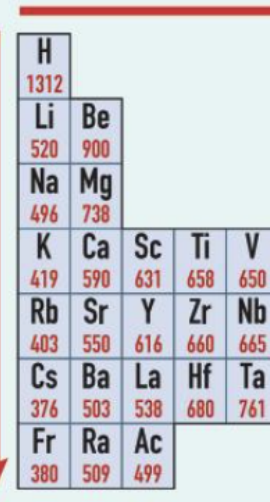
The periodic table shows how ionisation energies vary systematically across different elements, with clear patterns emerging both down groups and across periods.
Trends down a group
As you move down any group in the periodic table, ionisation energy shows a clear decreasing trend due to fundamental changes in atomic structure.
Decreasing atomic radius leads to lower ionisation energy
As you move down any group in the periodic table, the atomic radius increases progressively. This happens because electrons are being added to energy levels that are increasingly further from the nucleus.
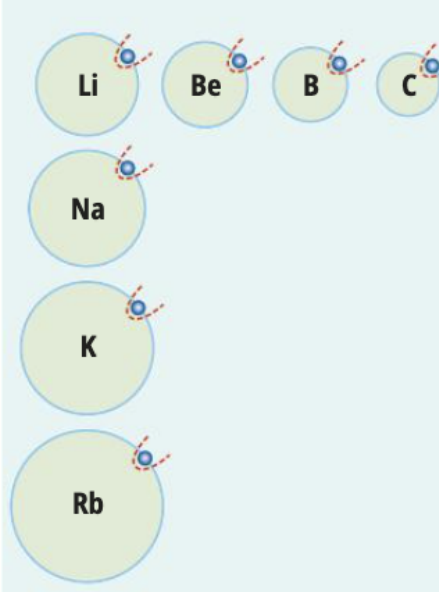
The increasing distance between the outermost electrons and the nucleus has two important consequences:
- Weaker attractive force: The electrostatic attraction between the positively charged nucleus and the outermost electrons becomes weaker as the distance increases
- Easier electron removal: Less energy is required to remove an electron from the outer energy level when it's further from the nucleus
Screening effect of inner electrons
Inner electrons also play a crucial role in reducing ionisation energy down a group. These electrons create a "screening effect" that partially shields the outermost electrons from the full attractive force of the nucleus. As more inner electron shells are present in larger atoms, this screening effect becomes more significant, making it even easier to remove outer electrons.
Important
Key Point: Ionisation energy values decrease as you move down any group in the periodic table due to both increasing atomic radius and increasing screening effect from inner electrons.
Trends across a period
Increasing effective nuclear charge
Moving from left to right across a period, the first ionisation energy generally increases. This trend occurs because of increasing effective nuclear charge - the actual attractive force experienced by the outermost electrons.
As you move across a period:
- Nuclear charge increases: Each successive element has one more proton in its nucleus
- Electrons added to same shell: The additional electrons are being added to the same energy level, so there's no significant increase in distance from the nucleus
- Stronger attraction: The increased positive charge in the nucleus attracts the outer electrons more strongly
- Higher ionisation energy: More energy is required to remove an electron against this stronger attractive force
This explains why elements on the right side of the periodic table (like fluorine and neon) have much higher ionisation energies than those on the left side (like lithium and sodium).
Exceptions to the general trend
Irregularities in the smooth pattern
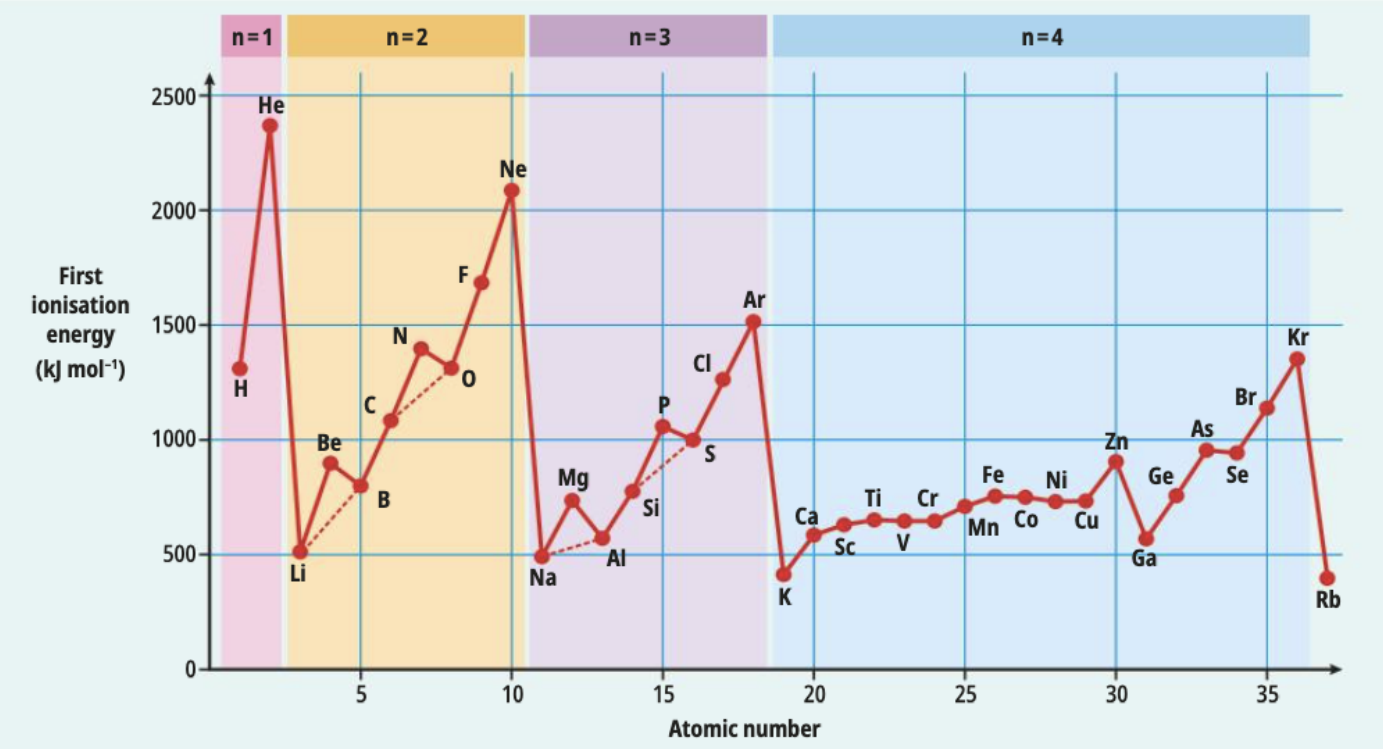
When plotting first ionisation energy against atomic number, the trend doesn't always follow a perfectly smooth increase across periods. Several notable exceptions occur due to electron configuration effects.
Important
Common Misconception: Students often expect ionisation energy to increase smoothly across periods, but several elements show unexpected values due to special electron configuration stability effects.
Sublevel stability effects
Some elements show unexpectedly high or low ionisation energies compared to their neighbours because of special stability associated with:
- Completely filled sublevels: Elements with completely filled s or p sublevels have extra stability, making their ionisation energies higher than expected
- Half-filled sublevels: Elements with exactly half-filled sublevels also show enhanced stability
- Noble gas configurations: Elements that achieve noble gas electron configurations after losing electrons require significantly more energy for further ionisation
For example, beryllium and nitrogen show higher ionisation energies than expected because beryllium has a completely filled 2s sublevel, whilst nitrogen has a half-filled 2p sublevel.
Successive ionisation energies
Successive ionisation energies reveal important information about atomic structure and provide compelling evidence for electron energy levels.
Evidence for electron shell structure
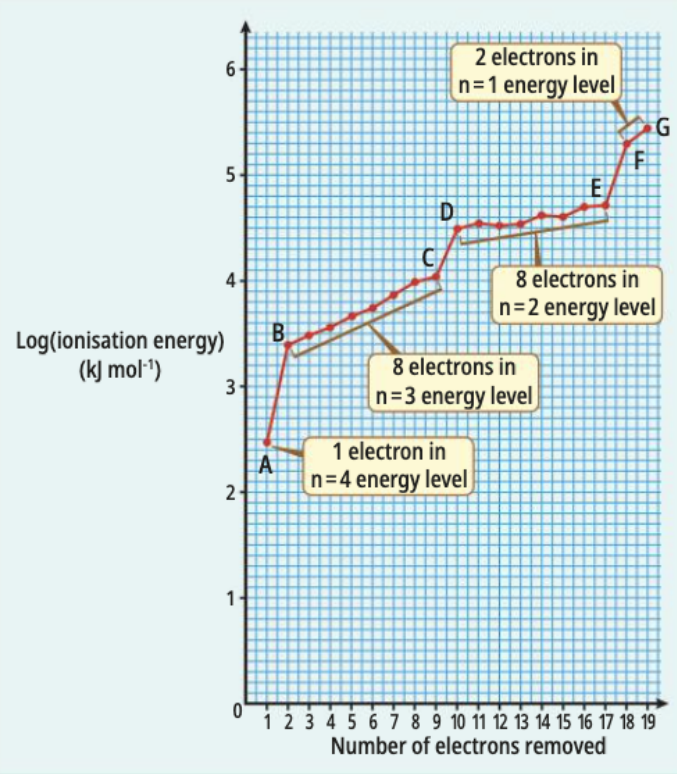
Successive ionisation energies provide compelling evidence for the existence of electron energy levels. When we remove multiple electrons from the same atom, the energy required increases dramatically at certain points.
Pattern of energy increases
Example
Worked Example: Successive Ionisation Energies of Potassium
Consider the successive ionisation energies of potassium:

Analysis:
- The first ionisation energy (418 kJ mol⁻¹) removes the single electron from the outermost 4s orbital
- The second ionisation energy (3050 kJ mol⁻¹) is more than seven times larger because this electron must be removed from the inner 3p sublevel, which is much closer to the nucleus
- This dramatic jump indicates the electron is being removed from a different, inner energy level
Two main reasons for large jumps
Important
Large increases in successive ionisation energies occur for two primary reasons:
-
Removal from inner energy levels: When electrons are removed from energy levels closer to the nucleus, much more energy is required due to the stronger electrostatic attraction
-
Increased effective nuclear charge: After each electron removal, the remaining electrons experience a greater effective nuclear charge, making subsequent electrons harder to remove
This pattern creates characteristic "jumps" in successive ionisation energy graphs that correspond exactly to the electron shell structure of atoms.
Practical applications
Understanding ionisation energy trends helps predict several important chemical properties and behaviours.
Note
Practical Applications of Ionisation Energy Trends:
- Chemical reactivity: Elements with low ionisation energies (like alkali metals) readily lose electrons and are highly reactive
- Ion formation: Elements tend to lose electrons until they reach a stable electron configuration
- Metallic character: Elements with low ionisation energies typically exhibit metallic properties
Summary
Key Points to Remember:
- Ionisation energy decreases down groups due to increasing atomic radius and screening effects
- Ionisation energy generally increases across periods due to increasing effective nuclear charge
- Exceptions to trends occur due to electron sublevel stability effects
- Successive ionisation energies provide evidence for electron shell structure
- Large jumps in successive ionisation energies indicate removal of electrons from different energy levels