Oil Refining and its Products (Leaving Cert Chemistry): Revision Notes
📚Revision Notes
Oil Refining and its Products
Crude oil, a mixture of hydrocarbons, is refined into various useful products through a process called fractional distillation. This separates the components of crude oil based on their boiling points.
Fractionation of Crude Oil
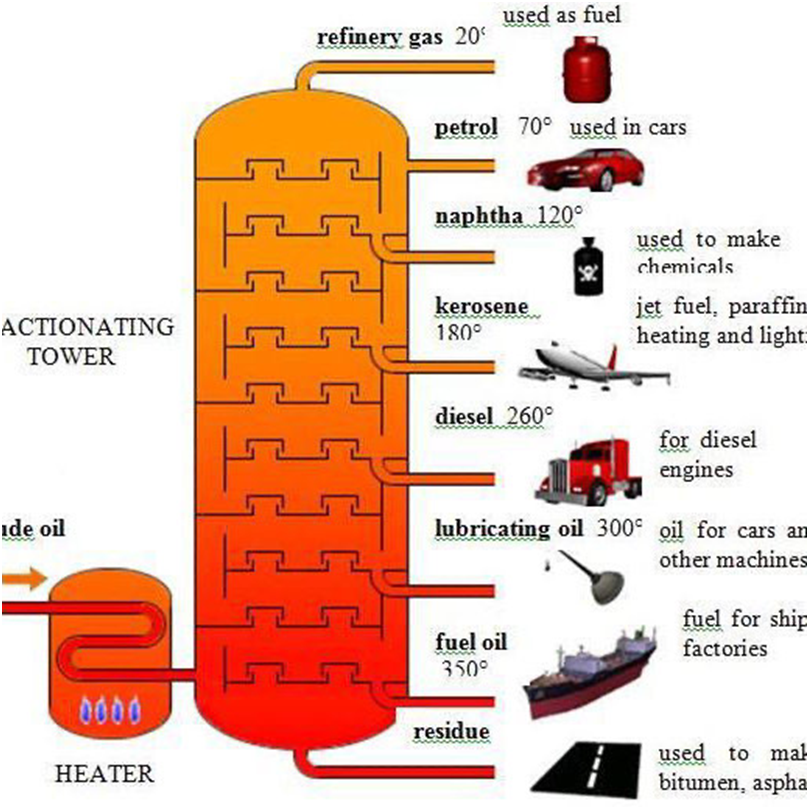
Fractional distillation involves heating crude oil so that different hydrocarbon fractions evaporate and condense at different temperatures. These fractions are collected and used for various purposes.
Major Fractions and Their Uses:
- Refinery gas: Used as a fuel for heating or in the production of chemicals.
- Light gasoline: A component of petrol, used in vehicles.
- Naphtha: Used in the petrochemical industry to produce plastics and other chemicals.
- Kerosene: Used as jet fuel and heating fuel.
- Gas oil: Diesel fuel for trucks and heating.
- Residue: Used to produce bitumen, which is used for road surfacing and roofing.
Composition of Natural Gas and LPG
- Natural gas: Composed mainly of methane (CH₄), with small amounts of ethane, propane, and butane.
- Liquid Petroleum Gas (LPG): Primarily a mixture of propane and butane. It is stored under pressure as a liquid and used as a fuel for heating and vehicles.
- Mercaptans: Added to natural gas and LPG to give them a strong odour, enabling detection in case of leaks (since these gases are odourless).
Composition of Petrol
- Petrol (gasoline) is a mixture of hydrocarbons, including alkanes and aromatics. It typically contains additives to improve performance and reduce engine knocking.
Auto-Ignition and Octane Numbers
- Auto-ignition occurs when the petrol-air mixture in an engine ignites prematurely, causing "knocking" and damaging the engine.
- The octane number is a measure of a fuel's resistance to knocking. Fuels with higher octane numbers resist auto-ignition better, providing smoother engine performance.
Reference Compounds for Octane Number:
- 2,2,4-trimethylpentane (Iso-octane): Assigned an octane number of 100 (excellent resistance to knocking).
- Heptane: Assigned an octane number of 0 (poor resistance to knocking).
Factors Affecting Octane Number
- Chain length: Shorter carbon chains tend to have higher octane numbers.
- Degree of branching: Highly branched hydrocarbons have higher octane numbers.
- Cyclic structure: Cyclic hydrocarbons, such as benzene, also improve the octane number.
Improving Octane Number
To improve the octane rating of fuels, the following methods are used:
- Isomerisation: Converts straight-chain alkanes to branched alkanes, increasing octane number.
- Catalytic cracking: Breaks long-chain hydrocarbons into shorter, more useful molecules.
- Dehydrocyclization (Reforming): Converts straight-chain alkanes into cyclic hydrocarbons, improving octane number.
- Adding oxygenates: Compounds like methyl tert-butyl ether (MTBE) are added to fuel to increase octane number and reduce pollution.
Lead in Petrol and Alternatives
In the past, tetraethyl lead was added to petrol to increase its octane number, but due to health and environmental concerns, it has been phased out in most countries. Alternatives to lead include:
- Isomerisation.
- Dehydrocyclization.
- Catalytic cracking.
- Oxygenates, such as MTBE, which increase octane numbers without the harmful effects of lead.
Note
Exam Tip:
- Understand the fractionation process and know the uses of the different fractions.
- Be familiar with the octane number scale and how it relates to engine performance.
- Know the modern methods of improving fuel octane ratings, especially the environmental reasons for using alternatives to lead additives.