The Time of Caesar (Leaving Cert Classical Studies): Revision Notes
📚Revision Notes
The Time of Caesar
Key historical events of the late Republic
The period leading up to Caesar's rise was marked by significant upheaval and transformation in Roman society. Understanding these events helps explain how Caesar was able to seize power and ultimately transform Rome from a Republic into an Empire.
Note
Caesar's rise to power didn't happen in isolation—it was the culmination of decades of political instability and social change that gradually weakened the traditional Republican system.
Decline of the Roman Republic (2nd-1st century BC)
The Roman Republic experienced tremendous growth through military conquest, but this expansion brought serious internal problems. Whilst Rome's territories grew larger, the state struggled with increasing political instability and social tensions. The traditional Republican system, designed for a city-state, could no longer effectively govern a vast Mediterranean empire.
The Social War (91-88 BC)
This crucial conflict arose between Rome and its Italian allies over the question of citizenship rights. The Italian communities had supported Rome in its conquests but were denied full Roman citizenship. The war ended with Rome granting citizenship to its allies, but this solution created deep divisions within Roman society and established a dangerous precedent of using warfare to resolve political disputes.
Note
The Social War's outcome was a double-edged sword—while it resolved the immediate citizenship crisis, it also demonstrated that military force could be used to achieve political goals, setting a dangerous precedent for future conflicts.
Rise of powerful generals
Two key figures transformed the Roman military system and set the stage for Caesar's later success:
Marius revolutionised the Roman army by introducing professional soldiers who were loyal primarily to their commanding generals rather than to the Roman state. This created private armies that ambitious politicians could use to advance their careers.
Sulla took this concept further by actually marching on Rome twice and establishing himself as dictator from 82-79 BC. His actions normalised the use of violence in politics and demonstrated that military commanders could seize control of the state through force.
Important
Marius and Sulla's military reforms fundamentally changed the nature of Roman politics. By creating armies loyal to individual generals rather than the state, they made civil war almost inevitable and paved the way for Caesar's later success.
First Triumvirate (60 BC)
Caesar formed a secret political alliance with Pompey and Crassus to dominate Roman politics. This arrangement allowed the three most powerful men in Rome to bypass the Senate and pursue their individual ambitions whilst supporting each other's goals.
Gallic Wars (58-50 BC)
Caesar's military campaigns in Gaul (modern France) served multiple purposes. He expanded Roman territory significantly, gained enormous personal wealth from conquest, and built a loyal army devoted to him personally. These achievements enhanced both his military reputation and political power base.
Civil War (49-45 BC)
When the Senate ordered Caesar to disband his armies and return to Rome as a private citizen, he made his famous decision to cross the Rubicon river with his troops. As Suetonius recorded: "He crossed the Rubicon, uttering the words: 'The die is cast.'" This act of defiance launched a civil war that ended with Caesar defeating Pompey and becoming sole ruler of Rome.
Political and social tensions at the time
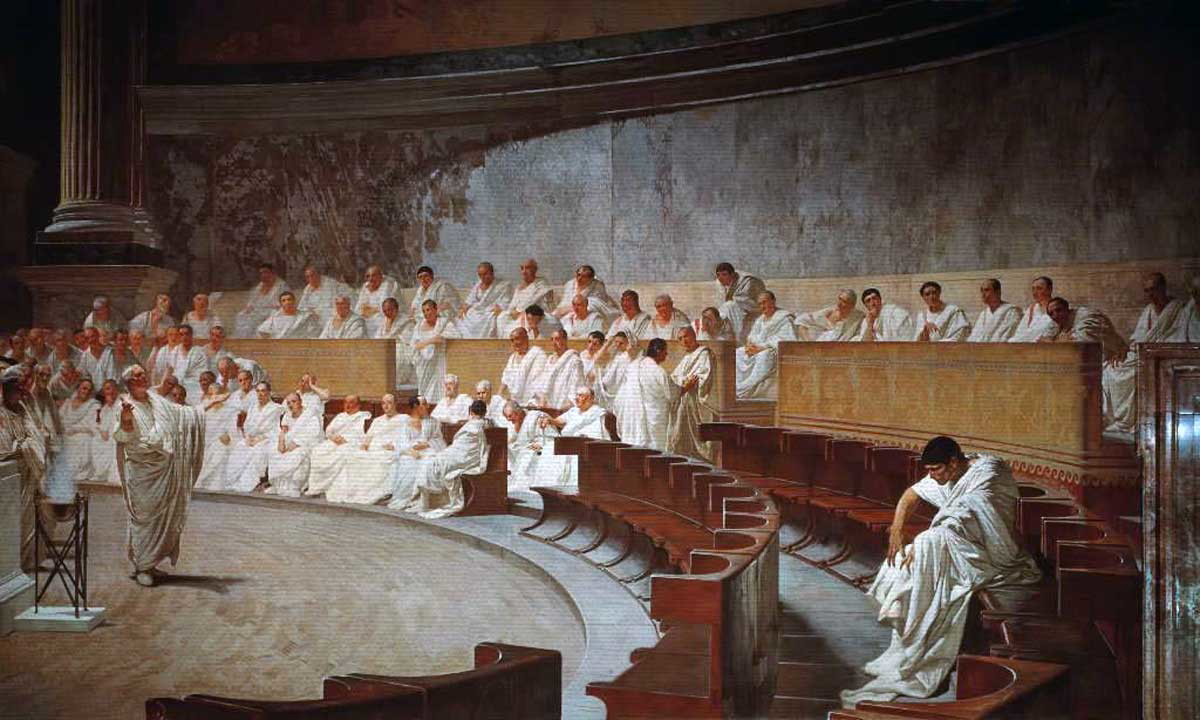
Caesar's rise occurred during a period of intense social and political conflict that had been building for generations. These underlying tensions made the Republic vulnerable to ambitious individuals who promised solutions to Rome's problems.
Optimates vs Populares
Roman politics was increasingly divided between two competing factions:
Optimates represented the conservative senatorial elite who wanted to preserve traditional power structures and maintain aristocratic control over government.
Populares were leaders who appealed to the masses through promised reforms and public benefits. Caesar positioned himself as a champion of the common people, using this popular support to challenge the established order.
Economic inequality
Rome's military conquests had enriched the elite classes, but many ordinary farmers lost their land during long military campaigns. This created widespread urban poverty and dependence on grain distributions. The growing gap between rich and poor fuelled social unrest and made the masses receptive to populist politicians who promised economic relief.
Army loyalty shift
The transformation of Rome's citizen militia into professional armies created a fundamental change in military loyalty. Soldiers now looked to their generals for pay, land grants, and career advancement rather than serving the state out of civic duty. This gave successful commanders like Caesar tremendous political leverage.
Senate's weakness
The Roman Senate proved unable to control ambitious individuals like Pompey or Caesar. Traditional institutions and customs were no longer sufficient to maintain order or prevent powerful men from pursuing personal dominance over collective governance.
Important
The Senate's inability to adapt to Rome's changing circumstances was perhaps the most critical factor in the Republic's collapse. Their failure to address economic inequality, military reforms, and territorial expansion created the perfect conditions for ambitious generals to seize power.
Dictatorship of Sulla (82-79 BC)
Sulla's earlier dictatorship established a dangerous precedent by normalising political violence, proscriptions (death lists), and purges of political opponents. This legacy of brutality in politics created an atmosphere where extreme measures seemed acceptable.
Caesar's rise
Caesar's combination of personal ambition, charisma, and military success made him both beloved and feared. As Plutarch observed: "His ambition was boundless and desired no less a prize than absolute power." His ability to appeal to both his soldiers and the common people whilst building alliances with other powerful figures positioned him perfectly to exploit the Republic's weaknesses.
Political geography before and after Caesar
Caesar's conquests fundamentally transformed the territorial scope and political structure of the Roman world, creating lasting changes that would define the later Empire.
Before Caesar (c. 60 BC)
Prior to Caesar's major campaigns, the Roman Republic controlled Italy, much of Spain, Greece, and parts of Asia Minor. However, significant territories remained outside Roman control:
Gaul remained largely independent, with various Celtic tribes maintaining their traditional territories and political systems. The eastern Mediterranean was dominated by client kingdoms that maintained nominal independence whilst acknowledging Roman supremacy. Roman politics remained unstable, with control contested between competing aristocratic families and their supporters.
After Caesar (c. 44 BC)
Caesar's achievements completely reshaped the Roman world:
Gaul was fully annexed following Caesar's systematic conquest campaigns, bringing enormous new territories, wealth, and manpower under direct Roman control. More significantly, Rome itself had been transformed from a Republic governed by collective institutions into a state effectively under Caesar's personal rule as dictator for life.

Example
Transformation Example: From Republic to Personal Rule
Before Caesar (60 BC):
- Government: Collective rule by Senate and consuls
- Territory: Italy, established provinces
- Army: Citizen militias with divided loyalties
After Caesar (44 BC):
- Government: Personal dictatorship under Caesar
- Territory: Expanded to include all of Gaul
- Army: Professional forces loyal to Caesar personally
These changes established the foundations for the end of the Republican system and the eventual rise of the Imperial system under Augustus. Caesar's assassination in 44 BC plunged Rome into further civil wars, but his precedent of personal rule could not be reversed. As Appian noted: "Rome was no longer governed by the Senate and people, but by one man alone."
Study tips for success
When preparing for Leaving Cert Classical Studies, focus on connecting Caesar's rise to the broader structural problems that weakened the Roman Republic. Demonstrate understanding of how factors like weak senatorial control, shifted army loyalties, and economic inequality created opportunities for ambitious leaders.
Show how Caesar effectively combined popular support with military power to challenge traditional elites. This combination of mass appeal and force became the model for later Roman emperors.
Be prepared to compare territorial maps showing Rome before Caesar (limited to Italy and established provinces) versus after Caesar (expanded across Gaul, with Caesar as dominant ruler). This visual comparison effectively illustrates both geographical and political transformation.
Use key quotations to support your analysis:
- Suetonius: "The die is cast" (illustrates Caesar's decisive moment)
- Plutarch: "His ambition was boundless..." (explains Caesar's motivation)
- Appian: "Rome was no longer governed... but by one man alone" (describes the political transformation)
Focus on major themes including personal ambition versus collective governance, the collapse of traditional Republican values, and the tension between populares and optimates. These concepts frequently appear in examination questions and demonstrate sophisticated understanding of the period.
Summary
Key Points to Remember:
- The Republic was already weakening before Caesar due to territorial expansion, economic inequality, and the rise of professional armies loyal to generals rather than the state
- Caesar exploited existing tensions by positioning himself as a popularis champion whilst building military power through the Gallic Wars
- Key turning point was crossing the Rubicon in 49 BC, which launched the civil war that destroyed the Republic
- Territorial expansion was crucial—Caesar's conquest of Gaul provided both the wealth and loyal troops needed to challenge the Senate
- Caesar's assassination didn't restore the Republic—instead, it led to further civil wars and eventually Augustus's establishment of the Empire
Remember!
- The Republic was already weakening before Caesar due to territorial expansion, economic inequality, and the rise of professional armies loyal to generals rather than the state
- Caesar exploited existing tensions by positioning himself as a popularis champion whilst building military power through the Gallic Wars
- Key turning point was crossing the Rubicon in 49 BC, which launched the civil war that destroyed the Republic
- Territorial expansion was crucial - Caesar's conquest of Gaul provided both the wealth and loyal troops needed to challenge the Senate
- Caesar's assassination didn't restore the Republic - instead, it led to further civil wars and eventually Augustus's establishment of the Empire