The Pantheon (Leaving Cert Classical Studies): Revision Notes
📚Revision Notes
The Pantheon
Historical background and dedication
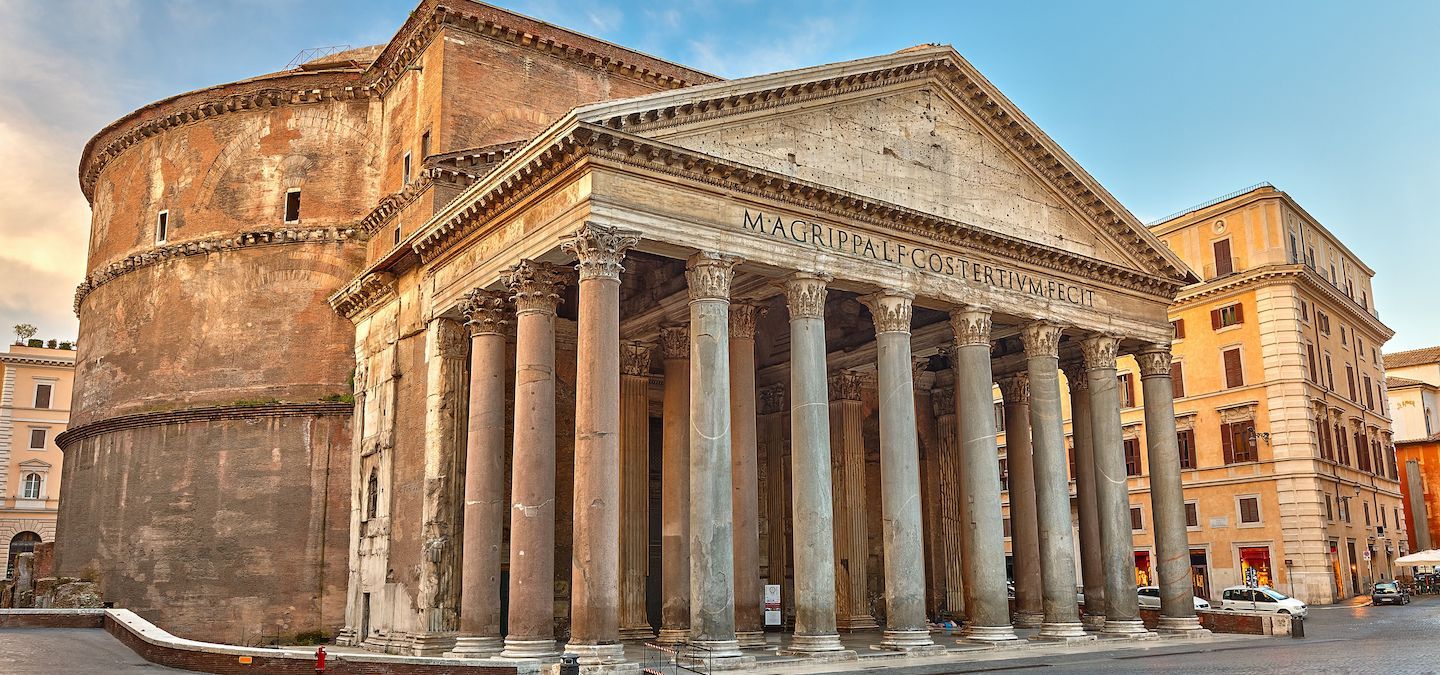
The Pantheon stands as one of Rome's most remarkable architectural achievements, with a fascinating construction history spanning different imperial periods. Initially built under Agrippa in 27 BC, the structure we see today was completely reconstructed by Emperor Hadrian between c. 118-125 AD. This rebuilding reflects the ambitions of Hadrian's reign and his commitment to architectural excellence.
Note
The temple's name reveals its unique purpose - pantheon literally means "all divine beings" in Greek. Unlike most Roman temples dedicated to specific deities, this building served as a sacred space honouring the entire Roman pantheon of gods, making it a truly inclusive religious centre.
Architectural features and innovation
The Pantheon represents a masterful fusion of traditional Greek architectural elements with revolutionary Roman engineering techniques. This combination created a building that was both familiar and groundbreaking for ancient visitors.
The portico
The building's entrance features a traditional Greek-style portico with sixteen massive Corinthian columns. This façade deliberately connected the new structure to established temple architecture, providing visual continuity with earlier religious buildings that Romans would recognise and respect.
The rotunda and dome
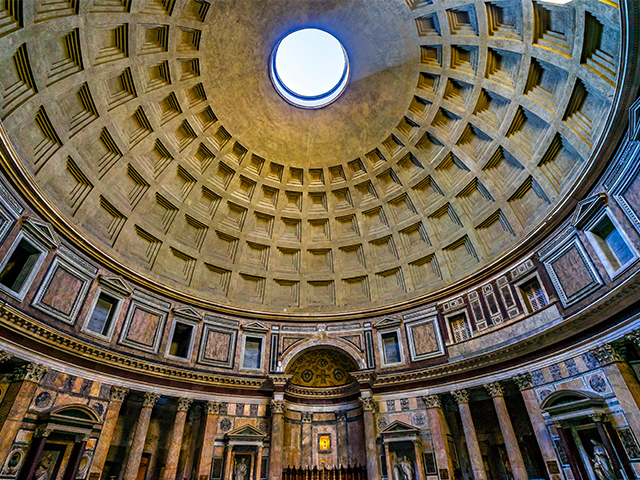
Behind this classical entrance lies the building's most innovative feature - a massive circular rotunda measuring 43 metres in diameter. Rising above this cylindrical structure sits the famous coffered concrete dome, which held the record as the world's largest dome for over a thousand years.
Important
The dome's concrete construction, lightened with pumice in the upper levels, demonstrates revolutionary Roman engineering skills that wouldn't be matched for centuries.
The oculus
At the dome's apex sits the oculus - a circular opening 9 metres wide that serves as the building's only source of natural light. This opening creates a powerful symbolic connection between the earthly temple and the heavens above, whilst allowing dramatic shafts of sunlight to move across the interior throughout the day.
Visual impact and visitor experience
The Pantheon was designed to create an overwhelming sense of awe and divine presence in all who entered. The building's impact on visitors operated on multiple sensory and emotional levels.
The monumental portico initially suggested a traditional temple experience, but stepping into the rotunda revealed the building's breathtaking scale and innovation. The vast circular space, topped by the coffered dome, created an immediate sense of being enclosed within a cosmic sphere representing the heavens themselves.
Example
Visitor Experience: The Dramatic Transition
Step 1: Approach through the traditional Greek portico
- Visitors expected a familiar temple layout
- Sixteen massive columns created anticipation
Step 2: Enter the rotunda
- Sudden revelation of the enormous circular space
- Immediate sense of being within a "cosmic sphere"
Step 3: Experience the oculus effect
- Natural light moves across interior walls throughout the day
- Creates constantly changing divine atmosphere
The dome and oculus combination produced a unique experience of "cosmic awe". As natural light moved across the richly decorated interior walls, visitors witnessed a constantly changing display that reinforced their sense of divine presence within the space. The interior decoration featured marble surfaces, niches containing statues of various gods, and geometric patterns that created visual harmony throughout the immense sacred space.
Unlike Greek temples where rituals typically occurred outside the building, the Pantheon actively invited interior experience. Visitors were drawn into the cosmic symbolism of Rome's empire operating under divine order, making the building a powerful tool of imperial propaganda.
Roles and religious functions
The Pantheon served multiple groups within Roman society, each with distinct roles and expectations within the religious and political framework the building represented.
Priests conducted the various sacrifices and rituals necessary to honour the multiple gods housed within the temple. Given the building's dedication to "all gods", this required extensive knowledge of different divine requirements and ceremonial procedures.
The Emperor held central importance in the Pantheon's religious system. The building symbolised his connection to the gods and reinforced the unity of the empire under divine sanction. Imperial visits to the temple demonstrated the ruler's piety and his role as intermediary between the divine and earthly realms.
Roman citizens could attend ceremonies, offer their own sacrifices, and admire the divine images housed within the building. This participation reinforced their connection to both the gods and the imperial system that claimed divine approval.
Foreigners and visitors were welcomed into the Pantheon as Rome claimed universality over all peoples. The building expressed Rome's domination not only of earthly territories but also of all divine beings, making it a powerful statement of imperial ideology.
Note
All visitors were expected to participate appropriately in rituals, show proper reverence for the imperial cult, and acknowledge Rome's divine destiny as master of the known world.
Political and civic significance
Beyond its religious functions, the Pantheon served crucial political purposes that reinforced Roman imperial ideology and civic unity.
The building embodied imperial ideology by physically demonstrating Rome's position as the centre of the world and home to all gods. By housing deities from across the empire, the Pantheon suggested that Rome had not conquered these peoples but rather united them under a divinely approved universal order.
Hadrian's rebuilding project served as a powerful display of Roman wealth, technical mastery, and imperial ambition. The revolutionary engineering techniques and massive scale demonstrated Roman superiority over all previous civilisations, including the Greeks whose architectural forms were incorporated but surpassed.
The temple promoted civic unity by providing a space where the empire's diverse peoples could worship their various gods within a Roman framework. This inclusive approach helped maintain stability across the vast territories by accommodating local religious traditions within imperial structures.
Important
The building's political symbolism reinforced imperial authority by suggesting that emperors ruled with divine sanction. By honouring "all gods", rulers could claim universal approval for their earthly dominion.
The Pantheon's architectural legacy continued long after the fall of the Roman Empire, inspiring later monumental religious buildings including Byzantine churches and Renaissance domes such as St Peter's Basilica in Vatican City.
As Cassius Dio observed: "It has its name from the fact that it contains images of many gods." Pliny the Elder praised the building as "remarkable for its vaulted roof and for the magnificence of its decoration."
Key exam points
When studying the Pantheon for examinations, focus on demonstrating your understanding of precise architectural terminology. Use terms like portico, rotunda, dome, oculus, and Corinthian columns correctly to show detailed knowledge.
Emphasise the difference in religious experience between Greek and Roman temples. Greek temples focused on external rituals and sculptural decoration, whilst the Roman Pantheon created an interior experience of awe and divine presence.
Always link architectural features to political significance. The Parthenon represented Athenian democracy and empire, but the Pantheon symbolised Rome's universal imperial authority and divine sanction.
Note
Remember these important quotations for examinations:
- Cassius Dio: "It contains images of many gods"
- Pliny: "Remarkable for its vaulted roof and magnificence"
Summary
Key Points to Remember:
-
The Pantheon combined Greek aesthetic traditions with revolutionary Roman concrete engineering to create an entirely new type of religious experience
-
The building's dedication to "all gods" reflected Rome's inclusive imperial ideology and helped maintain unity across diverse territories
-
Hadrian's reconstruction (118-125 AD) demonstrated Roman technical superiority whilst the oculus created a powerful symbol of divine connection
-
Unlike Greek temples, the Pantheon invited visitors inside to experience cosmic awe and recognise Rome's divine authority
-
The building served both religious and political functions, reinforcing imperial ideology through architectural innovation and inclusive worship practices