Structural Forces (Leaving Cert Construction Studies): Revision Notes
📚Revision Notes
Structural forces
Structural engineering examines buildings and the forces that act within their complex structural systems. Engineers calculate whether structures can withstand both their own weight and external forces acting upon them.
A force is any pushing, pulling, twisting or shearing action that has both direction and intensity. On Earth, gravity constantly pulls objects towards the planet's centre, creating forces that buildings must resist.
Isaac Newton's research into force and gravity established the fundamental relationship:
This formula shows that heavier objects require greater force to move them. Due to Newton's work, force is measured in newtons:
Note
Isaac Newton's groundbreaking work on force and gravity laid the foundation for all modern structural engineering calculations. His laws of motion remain fundamental to understanding how buildings resist forces today.
Understanding stress and strain
Materials testing helps us determine which materials work best in different construction applications. This involves analysing how materials respond when forces act upon them through stress and strain analysis.
What is stress?
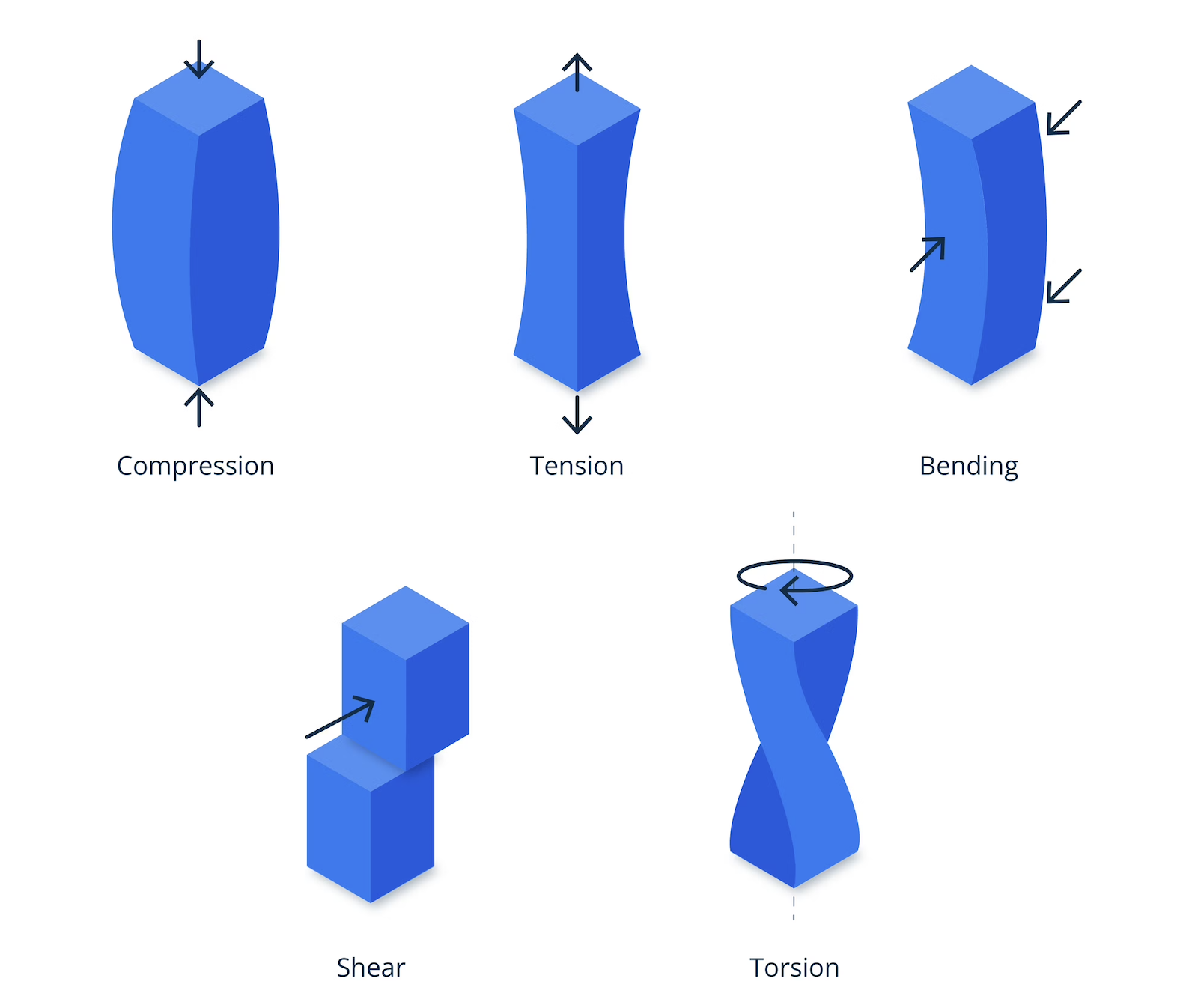
Forces can act on materials in four distinct ways:
- Push force (compression)
- Pull force (tension)
- Twist force (torsion)
- Sliding force (shear)
These forces create what physicists call stress. Stress represents the force applied per unit area of material:
Example
Worked Example: Understanding Load Distribution
Consider a brick wall example. Upper bricks place stress on lower bricks through their weight. However, this load distributes evenly throughout the wall structure. The foundation spreads this load distribution, which explains why bricks are offset in bonded patterns.
Load distribution works similarly to a weightlifter distributing weight through their body structure to the ground. The force spreads downwards through the structural system.
What is strain?
Strain describes the internal displacement that occurs within a material when stress is applied. Materials resist applied forces through their internal structure. However, sufficient stress will alter the material's structure or shape - this is how materials react to force.
Important
Each material has a threshold of forces it can withstand without permanent deformation. Forces exceeding this threshold will permanently change the material's shape.
Stress and strain relationship
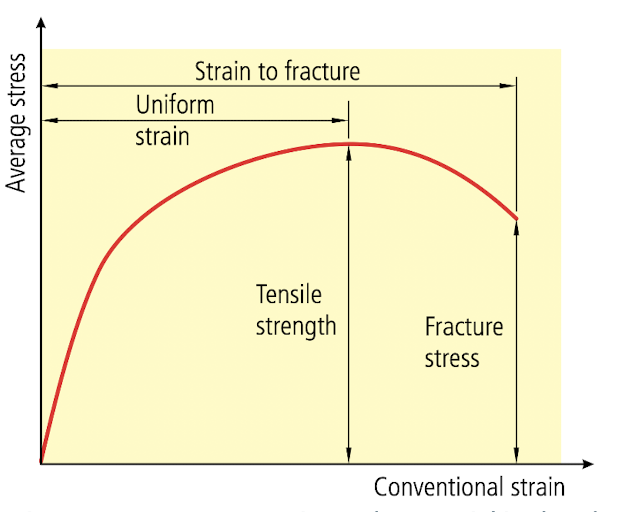
Greater stress applied to materials produces greater deformation. This relationship can be shown graphically through a stress-strain curve.
Note
The stress-strain curve demonstrates that strain increases as stress increases. Maximum strain occurs when materials can no longer resist the applied stress and begin to deform. Beyond this point, materials lose strength and eventually break. The stress at breaking point is called fracture stress.
Types of material stress
Stress can act in multiple directions within building materials. Understanding each type helps engineers select appropriate materials for specific structural roles.
Compression
Compression is a pushing force that presses towards the centre of a structural member. Shorter structural members can undergo more compression than longer ones. Compression in longer elements can cause deflexion.
Example
Compression Example: The Sponge Test
Squeezing a sponge demonstrates compression - the hand closes around the sponge, compressing the material towards its centre.
In buildings, beams illustrate how compression works. A beam is a horizontal structural member that is longer than it is wide or deep. Most beams are supported at each end. Compression on such beams can cause them to bend in the direction of gravity. The distance a beam moves from horizontal position once compression load is applied is called deflexion.
Note
In building construction, a structural member under compression is called a strut.
Tension
Tension is a pulling force that acts in opposite directions along a member's length. It attempts to stretch the material away from its centre. Tension is the opposite of compression.
Construction uses guide wires and cables in tension to support structural features.
Note
A structural member placed in tension is called a tie. Ties can be either cables or solid beams.
Shear
Shear results from two forces pressing in opposite directions on one point of a member. Sufficient shear force will cause the member to fracture at that point. The fractured parts will then move in the direction of each applied force.
Example
Shear Force Example: Sheet Material Fastening
When sheet material is fastened to a wall, screws or bolts holding the sheets are pulled down by the sheet's weight but kept from moving by the wall connection. This creates shear forces in the fasteners.
Torsion
Torsion is a twisting force applied to a member along its longitudinal axis (longest span). It is caused by two equal forces creating opposite rotation.
Example
Torsion Example: Wringing Cloth
This resembles wringing water from cloth by twisting in opposite directions - the same twisting motion occurs in structural members under torsional stress.
Eccentric force
An eccentric force is applied parallel to a member's longest axis but off-centre from its axis. This creates uneven load distribution on the member, causing deflexion.
Summary
Key Points to Remember:
- Forces in construction: All structures must resist four types of forces - compression (push), tension (pull), shear (slide), and torsion (twist)
- Stress calculation: Stress equals force divided by area (), helping engineers determine material suitability
- Material behaviour: Each material has a threshold - forces below this cause temporary deformation, whilst forces above cause permanent damage
- Structural members: Compression members are called struts, tension members are called ties, and both are essential in building design
- Elasticity matters: Materials that can return to their original shape after force removal are crucial for structural integrity and safety