Above-Ground Drainage (Leaving Cert Construction Studies): Revision Notes
📚Revision Notes
Above-ground drainage
Above-ground drainage systems handle wastewater that flows from domestic appliances before entering the main drainage network. These systems primarily focus on kitchen and bathroom facilities, managing water discharge from dishwashers, washing machines, sinks, showers, and toilets.
The system must efficiently transfer wastewater from various appliances into the drainage network whilst preventing blockages and maintaining hygiene standards. Proper design ensures effective waste removal with minimal risk of system failure.
Note
Above-ground drainage is the first line of defence in wastewater management, handling all domestic water discharge before it reaches the main sewer system. Proper system design is crucial for preventing costly blockages and maintaining public health standards.
Grease management
Grease and oils from kitchen sinks can accumulate in drainage pipes, leading to significant blockages. A grease trap provides an effective solution to this problem by intercepting these substances before they enter the main drainage system.
The grease trap operates through a simple but effective mechanism. As wastewater flows through the device, grease and oils naturally rise to the surface due to their lower density. Meanwhile, heavier solids settle in a collection bucket at the bottom of the unit. The trap includes perforated holes that allow clean water to pass through freely whilst retaining waste materials.
A removable filtering bucket extends above the water level for hygiene purposes and can be emptied at regular intervals. This maintenance approach prevents the accumulated grease from continuing downstream and causing system blockages.
Important
Regular maintenance of grease traps is essential for system performance. Failure to empty the filtering bucket at appropriate intervals will result in grease overflow, defeating the purpose of the trap and potentially causing severe downstream blockages.
Drainage system configurations
Above-ground drainage can be designed using either a two-pipe arrangement or a single-stack configuration. The chosen method must ensure efficient waste transport with minimal blockage risk.
Two-pipe system
The two-pipe arrangement is typically found in older properties and is not commonly installed in new constructions. This system separates toilet waste from other appliance discharge through distinct pathways.
Toilet waste flows directly into the main stack, which is a vertical pipe of 100mm diameter mounted on the external wall. This stack includes ventilation to prevent water from being drawn out of the toilet trap through syphoning action. The stack ultimately connects to either the main sewer or a septic tank system.
Other bathroom and kitchen appliances discharge into an open hopper through branch pipes measuring 32-40mm in diameter. These branch pipes have a maximum permitted length of 1.7m and must maintain a slope between 18mm and 90mm per metre to ensure adequate flow.
Note
The two-pipe system's separation of waste streams provides excellent flexibility for appliance positioning, making it ideal for renovations where existing plumbing layouts need to accommodate new appliances without major structural changes.
The hopper collects this water and directs it into a gully, where kitchen wastewater also enters the drainage network. From the gully, all water flows to the sewer or septic tank. The system includes inspection chambers positioned to allow cleaning access if blockages develop.
This configuration offers greater flexibility for appliance positioning but requires more extensive pipework, making installation more expensive than alternative systems.
Single-stack system
The single-stack arrangement is more commonly used than the two-pipe system in modern installations. All appliances connect through branch pipes to a single 100mm diameter stack, simplifying the overall system design.
Two ventilation methods are available for the stack. Individual vent pipes can be attached to each appliance, positioned as close as possible to the appliance trap for optimal performance. Alternatively, the stack can extend above the roof eaves with an open top, preventing foul air from escaping into the dwelling whilst allowing proper ventilation. A cap must be fitted to the stack top to prevent debris entry.
Careful design is essential for single-stack systems to operate efficiently. Building regulations specify the dimensions, positions, and slopes of pipework connecting to dwellings. These regulations also determine appliance positioning and govern branch pipe connections to prevent siphonage, gas build-up, and other operational difficulties.
Design requirements and building regulations
Single-stack systems must comply with specific dimensional requirements to ensure proper operation. Building regulations control all aspects of the pipework design, from pipe dimensions to connection methods.
Branch pipes connecting to the main stack require specific dimensional parameters. Wastewater branch discharge pipes typically measure 40mm diameter with a maximum length of 3m and maintain a slope of 18-90mm per metre. Soil water branch discharge requires 100mm diameter pipes with a 6m maximum length and 9mm per metre slope.
Important
Critical Dimensional Requirements:
- Wastewater branches: 40mm diameter, 3m max length, 18-90mm/m slope
- Soil branches: 100mm diameter, 6m max length, 9mm/m slope
- Offset zones must be maintained to prevent system interference
The main stack must include offset zones where no connections are permitted. A 100mm offset zone exists near the roof level, whilst a 200mm offset zone is positioned at ground floor level. These offset zones prevent interference with the main flow and maintain system integrity.
Stack positioning relative to windows requires careful consideration. If the stack terminates within 3m of a window, it must extend at least 900mm above the window level to prevent odours entering the building through the window opening.
The system includes minimum centre line radius requirements of 200mm at ground floor level to ensure smooth flow transitions and prevent blockages at directional changes.
Traps and odour prevention
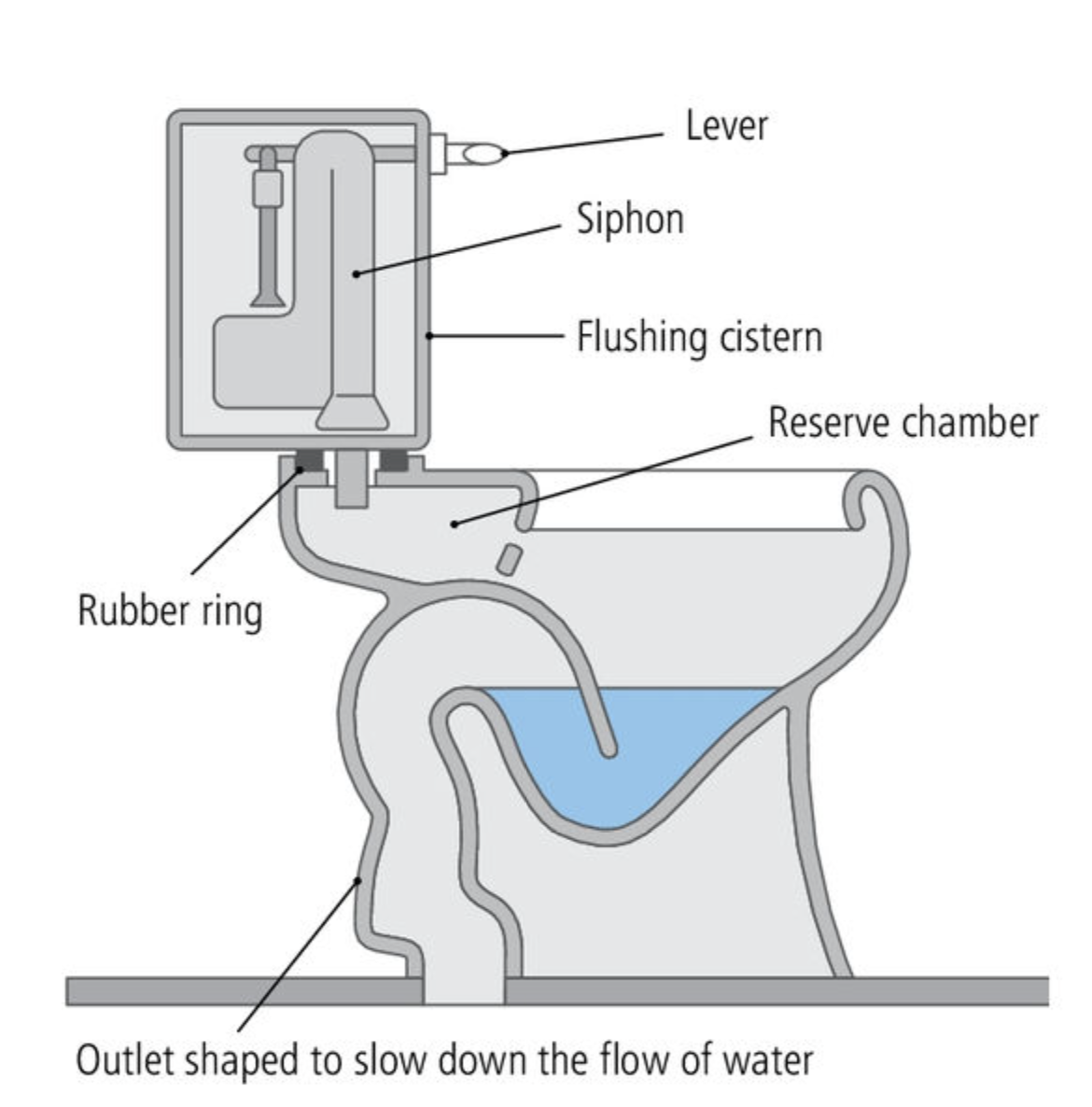
Traps form a critical component of domestic drainage systems by creating a water seal that prevents gases and odours from escaping into living spaces. Every appliance that drains water requires a trap either built into the appliance itself or installed in the plumbing directly beneath it.
The water retained in traps blocks air passage, preventing unpleasant odours from travelling back through the drainage system into the dwelling. For effective operation, traps must be positioned directly beneath appliances and must be self-cleaning to prevent waste accumulation.
Note
The water seal in traps typically maintains a depth of 75mm, providing an effective barrier against gas transmission whilst allowing normal drainage flow. This simple but effective mechanism is fundamental to maintaining healthy indoor air quality.
Traps are essential regardless of the piping system used in the building. A typical bathroom fitting includes a water trap that maintains a constant water level to provide the necessary seal against gas and odour transmission.
Siphonage problems and prevention
The water seal in appliance traps can be compromised through three main mechanisms: self-siphonage, induced siphonage, and back pressure. These conditions must be prevented to maintain effective odour control.
Self-siphonage
Important
Self-siphonage Warning: This occurs when waste pipes operate at full capacity, creating negative pressure that draws water from traps, compromising the essential water seal that prevents odour transmission.
Self-siphonage occurs when the waste pipe beneath an appliance operates at full capacity across its entire diameter when connecting to the main stack. This creates reduced pressure within the waste pipe, causing syphoning action that draws water from the trap.
The process begins when water fills the pipe completely, causing negative pressure that pulls water out of the trap, compromising the water seal that prevents odour transmission.
Induced siphonage
Important
Induced siphonage Warning: This problem affects multiple appliances simultaneously when water flowing down the main stack creates suction in connected waste pipes, potentially breaking water seals in several traps at once.
Induced siphonage happens when water flowing down through the main stack passes the connection point of a waste pipe. The main flow creates suction within the waste pipe, pulling water from the trap and breaking the water seal.
This problem typically affects appliances connected to the same stack when one appliance empties whilst others retain water in their traps.
Back pressure
Important
Back pressure Warning: Develops at stack base where pipes change direction, creating hydraulic pressure that can force out water seals and allow compressed air to escape through appliances.
Back pressure develops at the stack base, usually where the pipe changes direction. Water flow slowdown through the stack increases pressure, which accumulates in waste pipes and can force out the water seal in connected appliances.
This hydraulic pressure can overcome the trap seal, allowing compressed air to escape through appliances and permitting odours to enter the dwelling.
Proper system design following building regulations prevents these siphonage problems through correct pipe sizing, positioning, and ventilation arrangements.
Summary
Key Points to Remember:
- Above-ground drainage handles all wastewater from kitchen and bathroom appliances before it enters the main drainage system
- Grease traps prevent kitchen oils and fats from blocking drainage pipes by allowing them to float to the surface where they can be removed
- Single-stack systems are more common in modern buildings, connecting all appliances to one main stack, whilst two-pipe systems separate toilet waste from other appliances
- Building regulations specify exact dimensions and slopes for all pipes, with 40mm branch pipes limited to 3m length and 100mm soil pipes limited to 6m length
- Traps create water seals to prevent odours and gases entering the dwelling, but can fail through self-siphonage, induced siphonage, or back pressure if not properly designed