Floors (Leaving Cert Construction Studies): Revision Notes
📚Revision Notes
Ground floors
Ground floors sit at the level of the soil surrounding a house. These floors must meet several critical performance requirements to ensure the building remains comfortable, safe, and structurally sound.
Ground floor requirements
Ground floors must satisfy six essential criteria:
- Resist damp - prevent moisture from the ground entering the building
- Prevent heat loss - stop warmth escaping from inside to outside
- Be hard-wearing - withstand daily traffic and use
- Be level - provide a flat, even surface
- Be durable - last for the building's lifetime
- Be maintenance-free - require minimal ongoing upkeep
Damp resistance
Water naturally rises from soil through building materials via capillary action. Capillary action allows liquids to flow through narrow spaces without being affected by gravity. The smaller the gaps in a material, the higher water can climb.
Important
Understanding Capillary Action
This process explains why damp can travel upwards through concrete blocks and other porous building materials. If large air gaps exist in materials like hardcore filling, moisture cannot climb as effectively. However, materials with many small gaps allow water to rise much higher, potentially causing damp problems inside buildings.
Ground floors must include effective damp-proofing measures to prevent this moisture transfer from soil to the interior of the building.
Heat loss prevention
Heating buildings costs significant money, so designing floors that prevent heat escaping to the ground below saves money long-term. Insulation gets used in floors (and other building locations) to reduce heat loss. Proper floor insulation forms a crucial part of a building's overall thermal performance.
Hard wearing properties
Ground floors experience substantial daily traffic, making durability essential. Kitchens typically receive particularly heavy use and need suitable hard finishes like tiles. Living areas require comfortable surfaces and experience less traffic, making softer finishes like carpet appropriate.
Construction of ground floors
Ground floors require construction on solid bases consisting of several layers and materials. The specific features depend on whether you're building a solid floor or suspended floor.
Solid floors
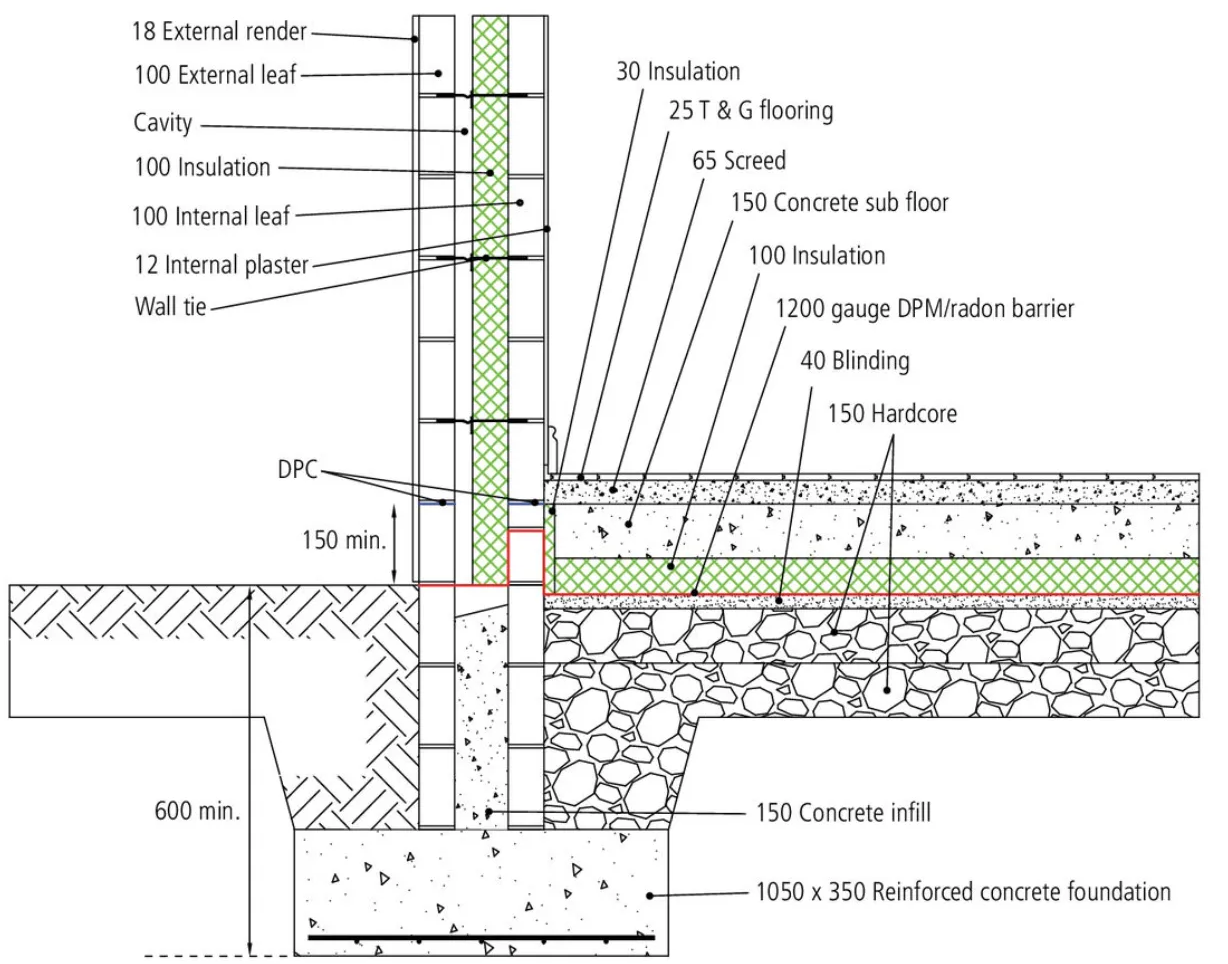
Solid floors get cast on site and finished with smooth concrete surfaces. These floors consist of multiple layers built up from the ground.
Example
Construction Sequence: Solid Floor Layers
The layers are built in this specific order from bottom to top:
- Hardcore (150mm minimum thickness)
- Blinding (40mm sand layer)
- Radon barrier/DPM (4μm gauge polythene)
- Insulation (100mm minimum rigid insulation)
- Sub floor (150mm concrete)
- Screed (optional finishing layer)
Hardcore
Hardcore forms the foundation layer, sitting directly on top of soil. It consists of compacted stones of uniform size (grade). Hardcore must be clean and free from gravel, clay, and mud. This layer requires a minimum thickness of 150mm. For deeper sections, you build layers with a maximum thickness of 225mm, compacting each layer thoroughly.
Important
Critical Compaction Rule
Individual layers cannot exceed 225mm thickness or the bottom sections won't compact properly, compromising the floor's structural integrity.
Blinding
Blinding provides a 40mm deep sand layer placed on top of hardcore. It fills surface voids in the hardcore and prevents sharp stones from damaging the radon barrier or damp proof membrane (DPM).
Radon barrier and damp proof membrane
A radon barrier prevents radon gas entering the building. The damp proof membrane (DPM) stops moisture seeping up from foundations to the floors. Both functions can use the same 4μm gauge polythene sheet, which must be completely airtight and watertight.
Important
Membrane Integrity is Critical
Any rips or tears compromise the system's effectiveness. The membrane gets laid on the blinding and extends over walls, creating overlap with the damp proof course (DPC) built into the blockwork.
This prevents moisture climbing to inner wall leaves and stops radon building up within wall cavities. The DPC must extend minimum 150mm above ground level around the building.
Insulation
Rigid insulation sits on top of the radon barrier/DPM. This prevents heat escaping through the finished floor into the ground. Current building regulations require at least 100mm of rigid insulation in solid concrete ground floors. Insulation also gets placed vertically along internal leaves of cavity walls to prevent heat loss through blockwork.
Sub floor
The sub floor consists of 150mm thick concrete poured over the insulation and levelled. This layer provides the structural base for the final floor finish.
Screed
Screed forms the optional final layer of ground floors. Some builders use the sub floor as the final layer instead. The finished surface (tiles, wooden floor, etc.) gets laid on top of this layer. Screed typically uses thin concrete, often reinforced with steel mesh due to its minimal thickness. The mix ratio is 1:3 cement to dry sand.
Note
Underfloor Heating Considerations
For underfloor heating systems, pipes get clipped to rigid insulation and screed pours directly over the pipes without reinforcement. Screed requires minimum 50mm thickness where it meets walls. Where screed floats and meets insulation lining walls, minimum thickness increases to 65mm.
Suspended floors
Suspended floors get used when solid floor construction proves impractical. This might occur when too much fill is needed, when solid floors risk cracking due to inadequate fill compaction, or when excessive fill costs become prohibitive.
Suspended floors get supported by dwarf walls, hangers, or cavity wall inner leaves. These floors simplify service installation since services don't get encased in concrete.
Suspended timber floors
Suspended timber ground floors use joists (200 x 50mm timber lengths) spanning the building's ground floor width. Traditionally, joists got supported at 2m intervals by dwarf walls. Modern construction more commonly uses metal hangers built into cavity wall inner leaves at appropriate heights.
Note
Modern vs Traditional Support Methods
Hangers provide cheaper and quicker installation than supporting walls, making them the preferred choice in contemporary construction.
Construction layers for dwarf wall support:
Example
Dwarf Wall Construction Sequence
Step 1: Hardcore Foundation
- Follows solid floor specifications with maximum 900mm depth for suspended floors
- Hardcore must be well compacted
Step 2: Radon Barrier Installation
- Required to prevent radon gas build-up beneath floors
- Uses identical specifications to solid floors
Step 3: Concrete Slab Base
- 150mm thick concrete slab pours over compacted hardcore
- Provides level surfaces for dwarf wall construction
- Slab top must sit higher than surrounding ground level
Dwarf walls: These support joists spanning the dwelling width. Sometimes called sleeper or tassel walls, they prevent joist sagging and allow air circulation beneath floors. Walls get built in honeycomb fashion, leaving spaces between blocks for ventilation. Floor areas require ventilation to prevent timber rot. Dwarf walls need minimum 150mm height.
Damp proof course: Similar to DPM but supplied in thin rolls slightly wider than blocks. Serves the same moisture prevention purpose as DPM. Gets rolled across dwarf wall tops with additional layers built into outer cavity block leaves.
Wall plate: Timber piece (75 x 100mm) skew nailed into dwarf walls at angles. Floor joists rest on wall plates.
Joists: Rest on wall plates at perpendicular angles, not built into cavity wall inner leaves. Ends get cut at angles to prevent damage and treated with preservative. Spacing uses 400mm centres (distance from one joist centre to the next joist centre).
Vents: Allow air circulation underneath floors. Positioned strategically around buildings for maximum airflow. Typically use 100mm diameter pipes or plastic grids across inner and outer leaves.
Insulation: Two methods exist for suspended timber floor insulation. First method holds quilted insulation using netting. Second method fixes battens to joist sides supporting rigid insulation boards. Both methods must comply with current building regulations.
Floorboards: 25mm tongue-and-groove floorboards fit directly onto joists.
Carpet: For carpet installation on suspended timber floors, manufactured boards first get fitted to provide even, level surfaces.
Suspended concrete slab floors
Suspended concrete slab ground floors prove much heavier than suspended timber floors. The weights and stresses involved in supporting concrete slabs require reinforced supporting members. Rising walls (blockwork between foundation and ground level) need reinforcement, with inner leaves experiencing greater pressure than with lighter floors.
Important
Structural Considerations for Concrete Slabs
Inner leaf construction uses blocks lying flat, giving suspended slabs more surface area for contact and spreading downward pressure. This is critical for managing the increased structural loads.
Suspended concrete slab construction follows identical layers to solid floors up to insulation level. Insulation gets laid directly on slab tops with infill pieces against internal cavity leaves. Reinforcement gets positioned where slab bottoms will be, with additional reinforcement at tops and bottoms preventing cracking and failure.
Precast concrete suspended floors
Precast concrete suspended ground floors cost more than suspended timber floors but offer several advantages:
- Will not decay over time
- Allow less noise through (traffic rumble reduction)
- Exclude draughts
These floors leave voids underneath houses requiring ventilation as described for timber floors. Insulation typically gets placed on, between, or around supporting beams.
Linked floors
Sites with different levels sometimes use both suspended timber floors and suspended concrete slabs linked together. During construction, 100mm-diameter pipes get installed in solid concrete floor sections to allow cross-ventilation of suspended floors. Finished floors must achieve the same level. Floor layer thickness gets planned before construction ensuring flush completion when built.
Summary
Key Points to Remember:
- Ground floors must resist damp, prevent heat loss, be hard-wearing, level, durable, and maintenance-free
- Capillary action causes water to rise through narrow spaces in building materials
- Solid floors consist of layers: hardcore (150mm min), blinding (40mm), radon barrier/DPM, insulation (100mm min), sub floor (150mm), and optional screed
- Suspended floors use timber joists or concrete slabs supported by dwarf walls or hangers
- Ventilation is important to prevent moisture problems and timber rot