Upper Floors (Leaving Cert Construction Studies): Revision Notes
📚Revision Notes
Upper floors
Upper floors serve the same purpose as ground floors but with additional considerations. They must be durable, level, and hard-wearing whilst also limiting sound transmission between upper and lower rooms. Traditionally, timber construction was the standard approach, but concrete and steel alternatives are becoming increasingly popular when the foundation can support the additional weight.
Note
The choice between timber, concrete, and steel upper floors often depends on the building's structural capacity, acoustic requirements, and the intended use of the spaces above and below.
Timber upper floors
Basic joist construction
Timber upper floors use joists to distribute the floor's weight effectively. These structural members typically measure 200 x 50mm and are positioned at 400mm centres across the span. Both ends of each joist must rest on load-bearing walls for proper support.
To prevent decay, the ends of joists receive preservative treatment before installation. The joists span the shortest distance between supporting walls or other structural supports. They can be fitted in two main ways: either built directly into the blockwork during construction, or secured to the wall using galvanised steel joist hangers.
Important
Critical Installation Requirement
Both ends of each joist must rest on load-bearing walls for proper support. Failure to ensure adequate support can lead to structural failure and floor collapse.
Bridging techniques
Due to their length, timber joists naturally tend to move or twist over time. Bridging prevents this movement and maintains the floor's stability. Two main bridging methods are commonly used:
Solid bridging
Solid bridging uses short vertical boards called struts that are fixed between adjacent joists. These struts can be arranged either in a straight line or in a staggered pattern, depending on the carpenter's preference and site conditions.
When struts are aligned in a straight line, they must be skew-nailed to stay secure. Staggered struts are easier for workers to nail in place since they provide better access. The struts are typically positioned halfway along the joist span, or more frequently for wider spans.
Note
Packing material is placed between the joists and walls to prevent any movement between the wall and floor structure, ensuring long-term stability.
Herringbone strutting
Herringbone strutting offers several advantages over solid bridging. This method uses struts that measure at least 36 x 36mm, with two struts placed in the space between each pair of joists. One strut connects to the bottom of one joist and the top of the adjacent joist, whilst the second strut runs in the opposite direction.
Example
Worked Example: Herringbone Strutting Pattern
Step 1: Position first strut from bottom of Joist A to top of Joist B
Step 2: Position second strut from top of Joist A to bottom of Joist B
Step 3: Repeat pattern between each pair of joists
Step 4: Ensure all connections are securely nailed
This creates an "X" pattern between each pair of joists.
This technique remains effective even if the joists shrink, as the herringbone pattern maintains contact and support. It uses less timber than solid bridging and allows easy passage of electrical cables and plumbing between joists. The main disadvantage is the additional time and labour required for installation.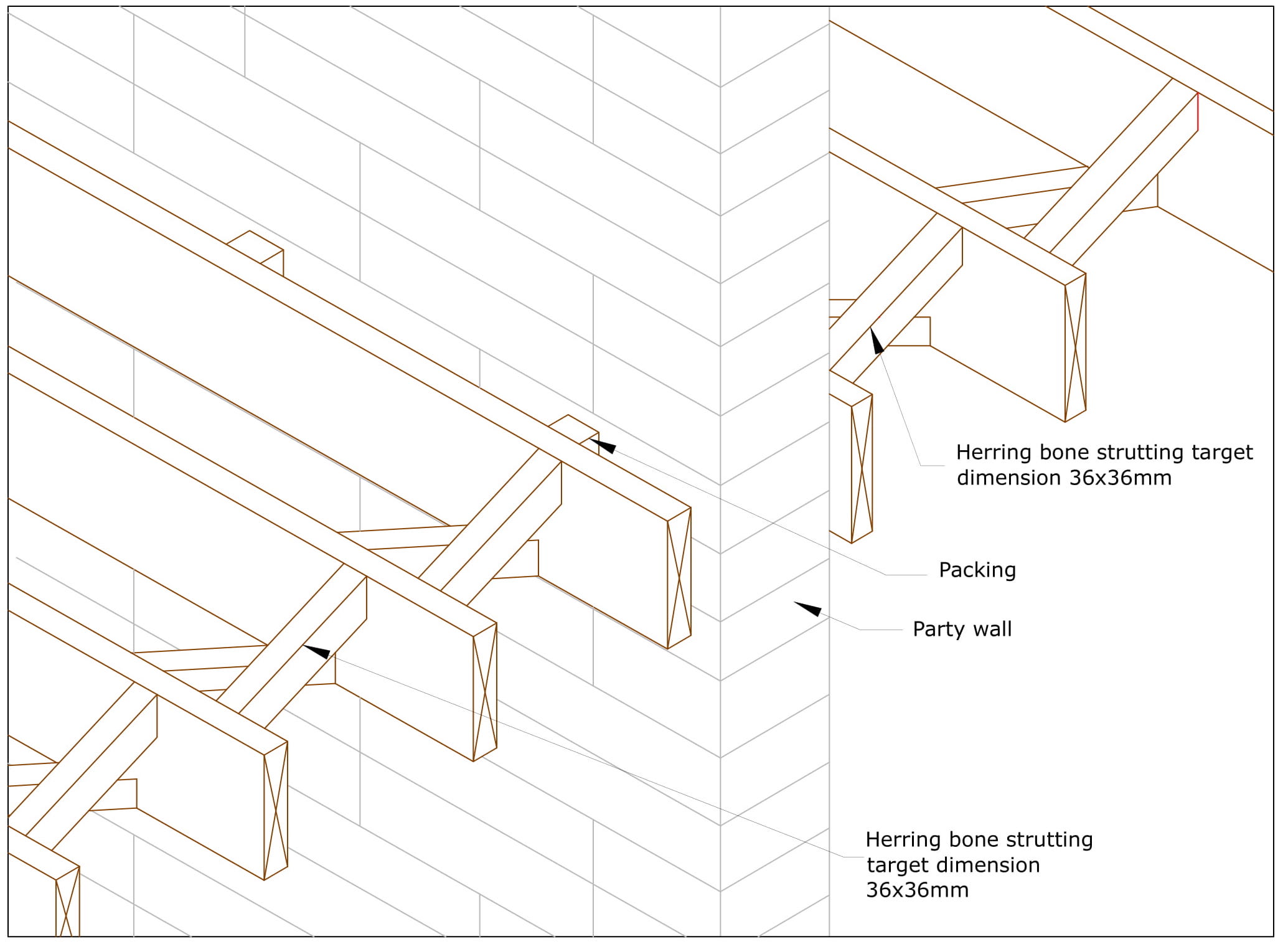
I joists
I joists represent an engineered alternative to traditional timber joisting. These components consist of two solid timber or laminated veneered lumber (LVL) members forming the top and bottom flanges. Between these flanges sits a panel of orientated strand board (OSB) that acts as the web.
Like traditional joists, I joists can be built into walls internally or suspended from wall-mounted hangers. The web design allows easy accommodation of services, and any gaps between the I joists and walls must be completely sealed.
Open web joists
Open web joists provide a lightweight alternative to steel trusses. They typically consist of two timber members (similar to I joist flanges) connected by a triangular web structure. This open web design makes it particularly convenient to run services through the beam.
These joists require appropriate hangers for wall mounting, and gaps between the joists and walls must be properly sealed. They offer good structural performance whilst maintaining easy access for building services.
Concrete and steel upper floors
Benefits and applications
Concrete and steel upper floors offer several advantages over timber construction. They significantly reduce noise transmission between floors and simplify the installation of services. These materials can be used individually or in combination depending on project requirements.
The sound insulation properties of concrete and steel floors have made them increasingly popular. They also facilitate underfloor heating installation in upper rooms, making them attractive for modern construction.
Note
While concrete and steel floors offer superior acoustic performance, they require the building's foundation and structure to support significantly more weight than timber alternatives.
Construction methods
Various methods exist for creating concrete and steel upper floors. Open web joist framing uses steel structural elements to support concrete floor sections. Precast concrete slabs can span between supporting walls, offering quick installation and consistent quality.
The combination of different materials allows designers to optimise both structural performance and practical considerations like service integration.
Timber frame upper floors
In timber frame construction, upper floor joists are integrated differently compared to traditional masonry buildings. The upper joists are built into the interior leaf of the cavity wall rather than resting on top of it.
This construction method requires careful coordination between the structural frame and the floor system. The details and typical dimensions must follow manufacturer specifications and building regulations.
Important
Timber Frame Integration
In timber frame construction, precise coordination between the structural frame and floor system is essential. Always follow manufacturer specifications and building regulations to ensure structural integrity.
Summary
Key Points to Remember:
- Upper floors must be durable, level, hard-wearing, and limit sound transmission between rooms
- Timber joists (200 x 50mm at 400mm centres) require bridging to prevent movement - either solid bridging or herringbone strutting
- I joists and open web joists offer engineered alternatives with easier service integration
- Concrete and steel floors provide better sound insulation and facilitate underfloor heating installation