Foundation Types (Leaving Cert Construction Studies): Revision Notes
📚Revision Notes
Foundation types
Foundations are the structural elements that transfer loads from buildings to the ground. The choice of foundation type depends on soil conditions, building loads, and ground bearing capacity.
In Irish construction, three primary foundation types are commonly used. Each system distributes building loads differently through the soil. Understanding how loads interact with soil is fundamental to foundation design.
Note
When loads spread through soil, they create pressure bulbs - zones where the soil experiences stress. Wider foundations create larger, deeper pressure bulbs with lower stress levels, while narrower foundations generate more concentrated pressure zones. This concept is crucial for understanding why foundation width affects performance.
Strip foundations
What are strip foundations
Strip foundations consist of continuous concrete strips that support load-bearing walls. They work best where soil has average to good bearing capacity and are particularly suited to house construction due to relatively low structural loads. This foundation type offers the most economical solution for typical residential buildings.
The continuous nature of strip foundations allows them to distribute loads evenly along their length, making them ideal for traditional construction methods where walls carry the primary structural loads.
Design requirements
Strip foundations follow specific dimensional rules based on load distribution principles. These requirements prevent structural failure and ensure adequate load transfer.
Important
Critical Design Rules for Strip Foundations:
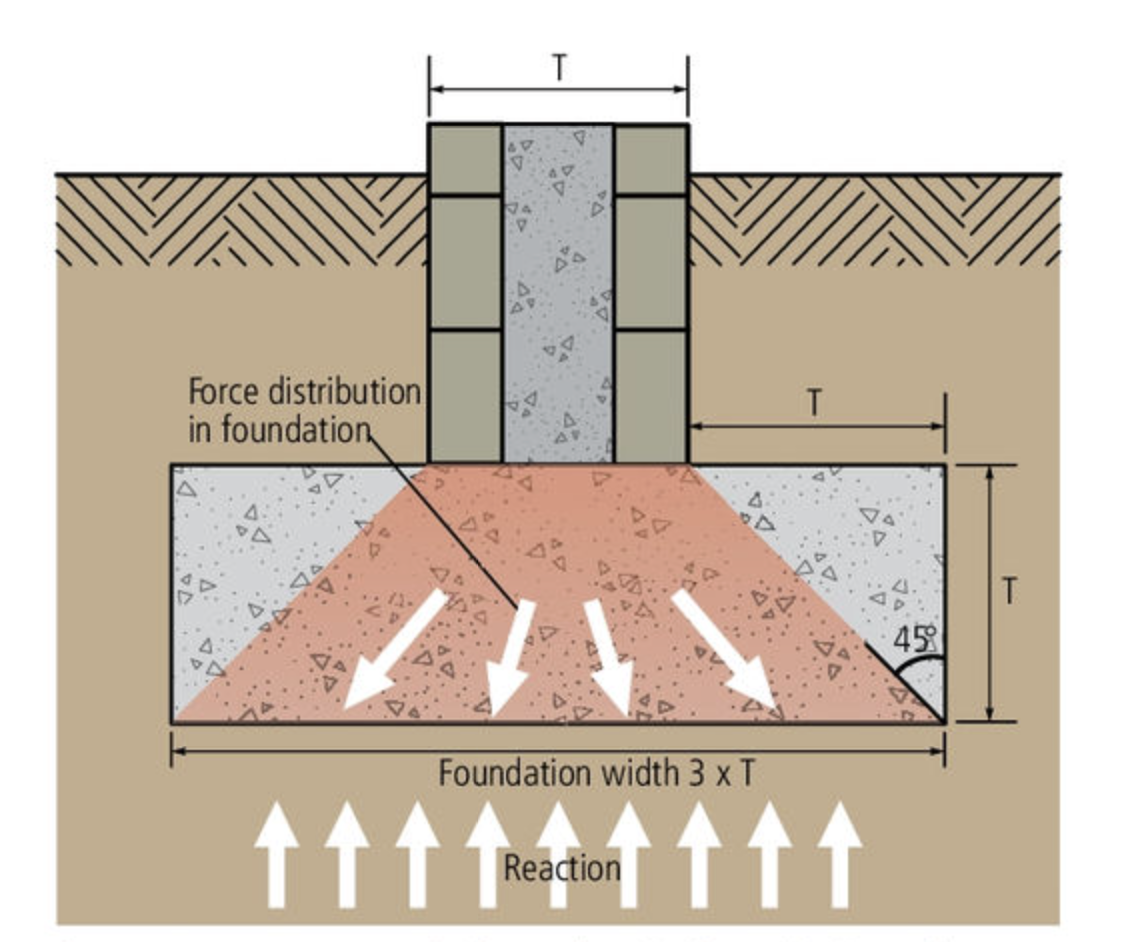
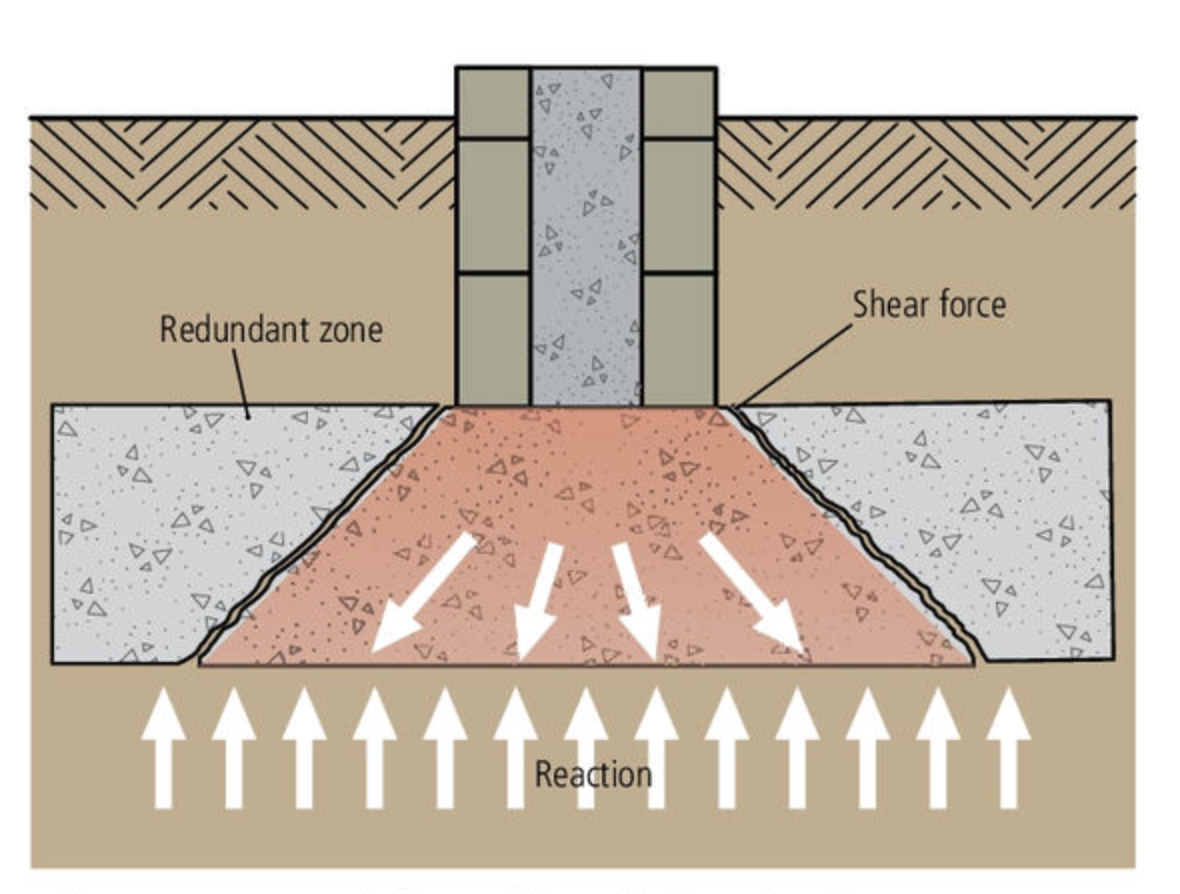
Width rule: The foundation width must be three times the wall thickness. For example, if the wall is 100mm thick, the foundation must be 300mm wide.
Depth rule: Foundation depth must equal or exceed the wall thickness. This ensures proper load distribution and prevents shallow foundation problems.
These rules exist because building loads spread through foundations at a 45-degree angle. Understanding this load distribution pattern is essential for proper foundation design.
Note
Note
Types of strip foundations
Traditional strip foundations
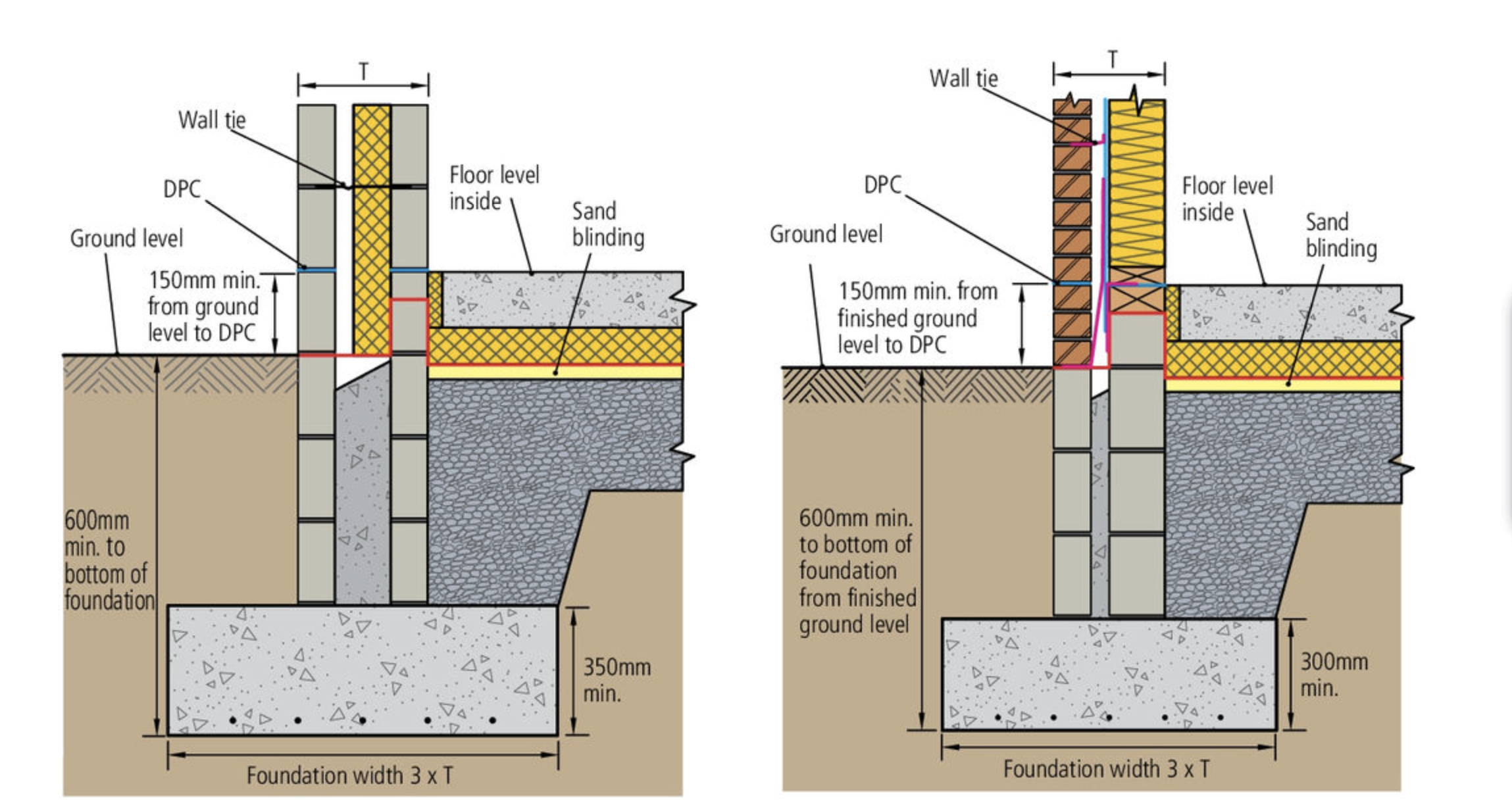
Traditional strip foundations represent the most widely used type in residential construction. However, they're unsuitable for soft clay, silt, or peat soils due to inadequate bearing capacity.
Note
Key Construction Details:
- Minimum 600mm depth below ground level
- 150mm minimum distance from ground level to damp proof course (DPC)
- Concrete infill around foundation
- Reinforcement as required
Stepped strip foundations
Stepped foundations suit sloping sites where ground levels change. This design allows the foundation to follow the natural ground contours while maintaining structural integrity.
Example
Design Requirements for Stepped Foundations:
Step depth: Usually matches the height of wall blocks being used
Horizontal overlap: Must be twice the step height, foundation width, or 300mm - whichever is greatest
Minimum step length: 1 metre minimum for each step section
Wide strip foundations
Wide strip foundations address sites with lower soil bearing capacity. They use the same depth as traditional strips but increase width to spread loads over larger areas. Steel reinforcement runs across the width to prevent the foundation from cracking under its own weight.
This approach allows construction on weaker soils without moving to more expensive foundation systems.
Deep strip foundations
Deep strip foundations apply when good bearing strata lie 900mm or deeper below surface level. The increased depth allows for narrower width since loads transfer to stronger soil layers. The foundation top must sit at least 150mm below ground surface level for frost protection.
Raft foundations
When to use raft foundations
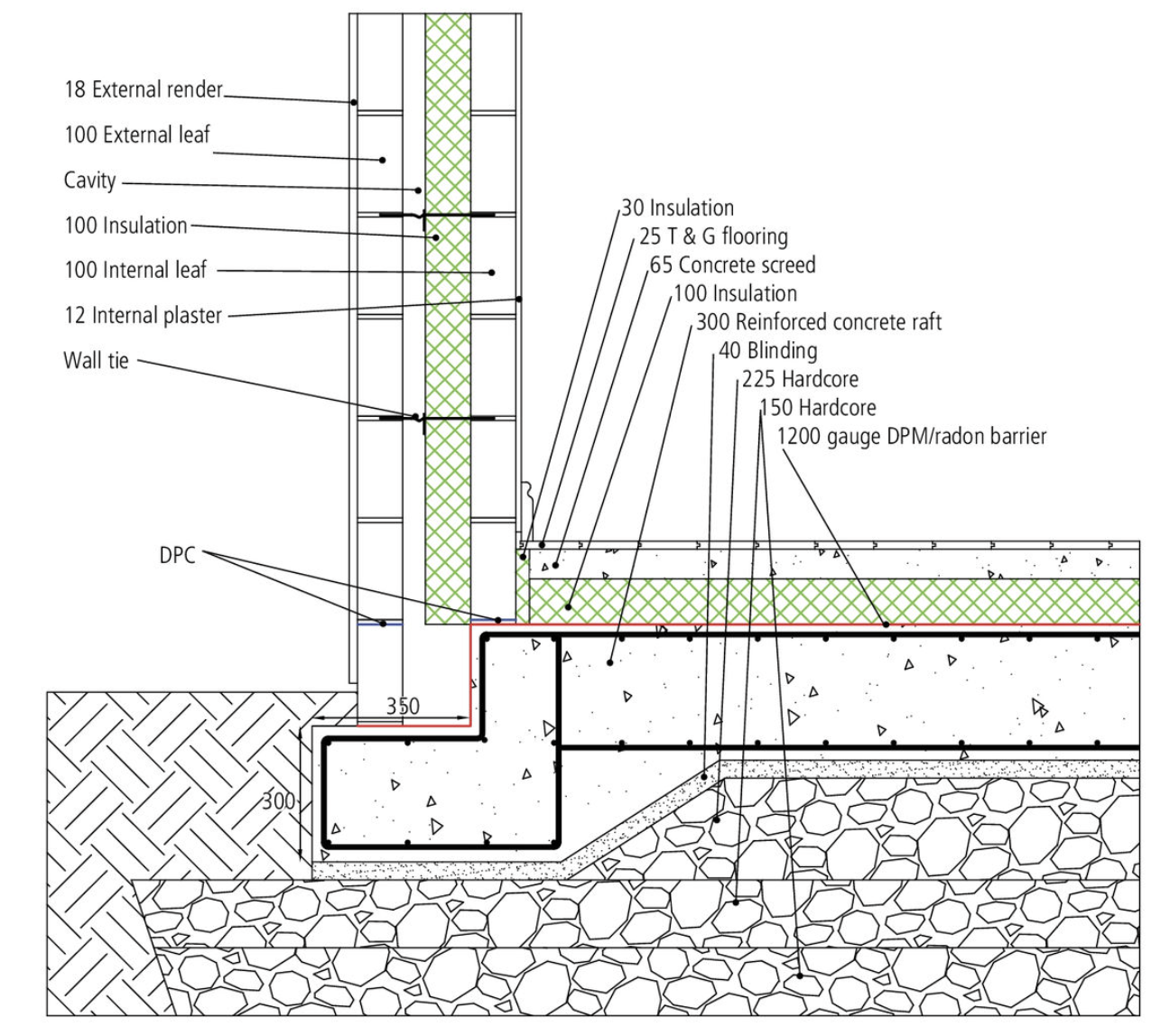
Raft foundations consist of large concrete slabs covering the entire building footprint. They suit sites with poor soil bearing capacity where other foundation types would be inadequate.
When soil has low bearing capacity, significant settlement often occurs. The key advantage of raft foundations lies in their unified response to ground movement.
Note
By using a raft foundation, the entire building moves as one unit, preventing differential settlement that could damage the structure. This unified movement eliminates cracks and structural problems associated with uneven ground movement.
Construction characteristics
Raft foundations incorporate several important features that distinguish them from other foundation types:
Note
Essential Raft Foundation Features:
- Reinforcement: Steel rebar provides structural integrity throughout the slab
- Thickness: Typically up to 300mm thick, with increased thickness under load-bearing walls
- Integration: The raft connects directly to ground floor construction
- Coverage: Extends under the complete building area
While raft foundations can work on better soils, this practice is uncommon due to higher costs and construction time compared to strip alternatives.
Pile foundations
Application and purpose
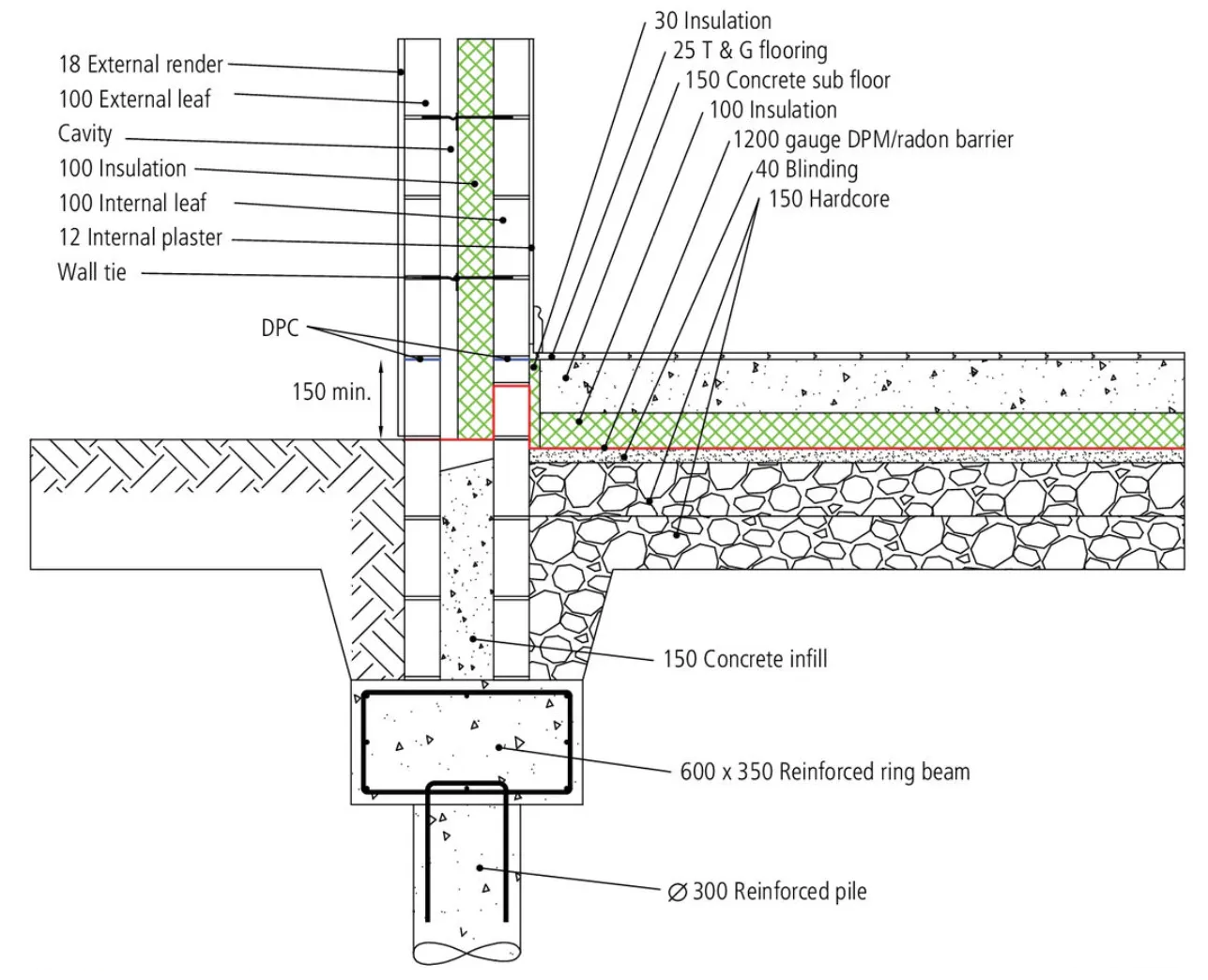
Pile foundations suit locations where surface soil has poor bearing capacity, or where good bearing strata exist beneath weaker soil layers. Unlike strip foundations that rely on soil surface support, pile foundations transfer loads through deep elements driven or cast into the ground.
The system uses a ground beam (similar to a strip foundation) connected to pile tops. Since piles carry the loads, ground beams don't need the width requirements of traditional strip foundations. This creates an efficient load transfer system for challenging ground conditions.
Pile foundation types
End-bearing piles
End-bearing piles are driven down until they reach solid, high-capacity soil layers. The pile tip bears directly on the strong stratum, transferring building loads through the pile length to reliable ground. A ground beam connects pile tops to create the foundation system.
Friction piles
Friction piles work differently - they're driven until friction between the pile surface and surrounding soil provides adequate resistance. Rather than reaching a bearing layer, these piles rely on skin friction along their length. Each pile length varies depending on soil conditions. After installation, pile tops are cut to level and connected with a ground beam.
Short-bored piles
Short-bored piles are constructed on-site with a maximum depth of 4.5 metres. This method offers flexibility and suits smaller residential projects.
Example
Short-Bored Pile Construction Process:
Step 1: Drilling - A hole is drilled through the ground
Step 2: Concrete placement - Concrete is poured into the hole
Step 3: Reinforcement - Steel bars are pushed through wet concrete
Step 4: Connection - Protruding reinforcement connects to the ground beam
This pile type suits house construction as loads aren't as large as commercial buildings. Advantages include quick construction, minimal material waste, and ability to work in poor weather conditions.
Installation considerations
Pile placement requires careful planning to maintain structural integrity throughout the building.
Important
Critical Pile Positioning Rule:
Piles cannot be positioned under window or door openings as this would create structural weak points. Instead, piles must be located on either side of planned openings to maintain structural integrity.
Both end-bearing and friction piles use precast concrete elements driven by heavy machinery. Steel caps protect pile tops during driving to prevent damage from impact forces.
Summary
Key Points to Remember:
- Three main types: Strip foundations (most economical), raft foundations (poor soil), and pile foundations (very poor soil or deep good strata)
- Strip foundation rule: Width must be three times wall thickness to prevent shear failure and avoid redundant zones
- Foundation selection: Always depends on soil bearing capacity - better soil allows simpler, cheaper foundations
- Pile positioning: Never place piles under door or window openings - always position on either side of planned openings