Internal Walls (Leaving Cert Construction Studies): Revision Notes
📚Revision Notes
Internal walls
Internal walls form the interior structure of buildings and serve several important purposes. These walls can be constructed using different materials and methods depending on their intended function within the building.
Types of internal walls
Internal walls fall into two main categories based on their structural role:
Load-bearing walls support the weight of floors and roofs above them. These walls transfer loads from upper levels down to the foundation and must be built to specific structural standards.
Non-load-bearing walls (also called partitions) do not carry structural loads from above. Their primary job is to divide interior space and provide other functional benefits.
Important
Understanding the difference between load-bearing and non-load-bearing walls is crucial for any construction work, as modifications to load-bearing walls require structural engineering considerations.

Functions of partition walls
Partition walls serve several key purposes in building design:
- Space division: Create separate rooms and functional areas within the building
- Fire safety: Prevent fire spread for a minimum of 30 minutes, giving occupants time to evacuate
- Service integration: House electrical wiring, plumbing pipes and other building services
- Sound control: Reduce noise transmission between different rooms
Note
The 30-minute fire resistance requirement is a minimum standard in most building codes, though some applications may require longer fire resistance periods depending on building type and occupancy.
Internal block walls
Block walls inside buildings use similar construction methods to external walls. The main difference is that internal walls are typically built at the same time as external walls, allowing them to be properly integrated.
Construction and bonding
Internal block walls connect to external walls through a bonding process that increases stability. This connection is achieved using wall ties that link the internal wall to the inner leaf of the external wall. The bonding pattern alternates at each course level to create a strong mechanical connection.
Supporting upper floors
When internal block walls need to support floor joists above, a timber wall plate is fixed to the top of the wall. This horizontal timber member spreads the load from the floor across the width of the wall and provides a secure fixing point for the floor structure.
Accommodating services
Building services like electrical cables require special consideration in block walls. The process involves:
Example
Worked Example: Installing Electrical Services in Block Walls
Step 1: Chasing - Cutting a groove into the wall surface where cables need to run
Step 2: Conduit installation - Placing a protective plastic tube in the groove
Step 3: Cable threading - Running electrical wires through the conduit
Step 4: Plastering - Covering the groove so services become invisible once the wall is finished
This method protects cables from damage and maintains the wall's structural integrity.
Internal timber walls
Timber construction offers flexibility for both load-bearing and partition applications. The construction method varies significantly depending on whether the wall carries structural loads.
Load-bearing timber walls
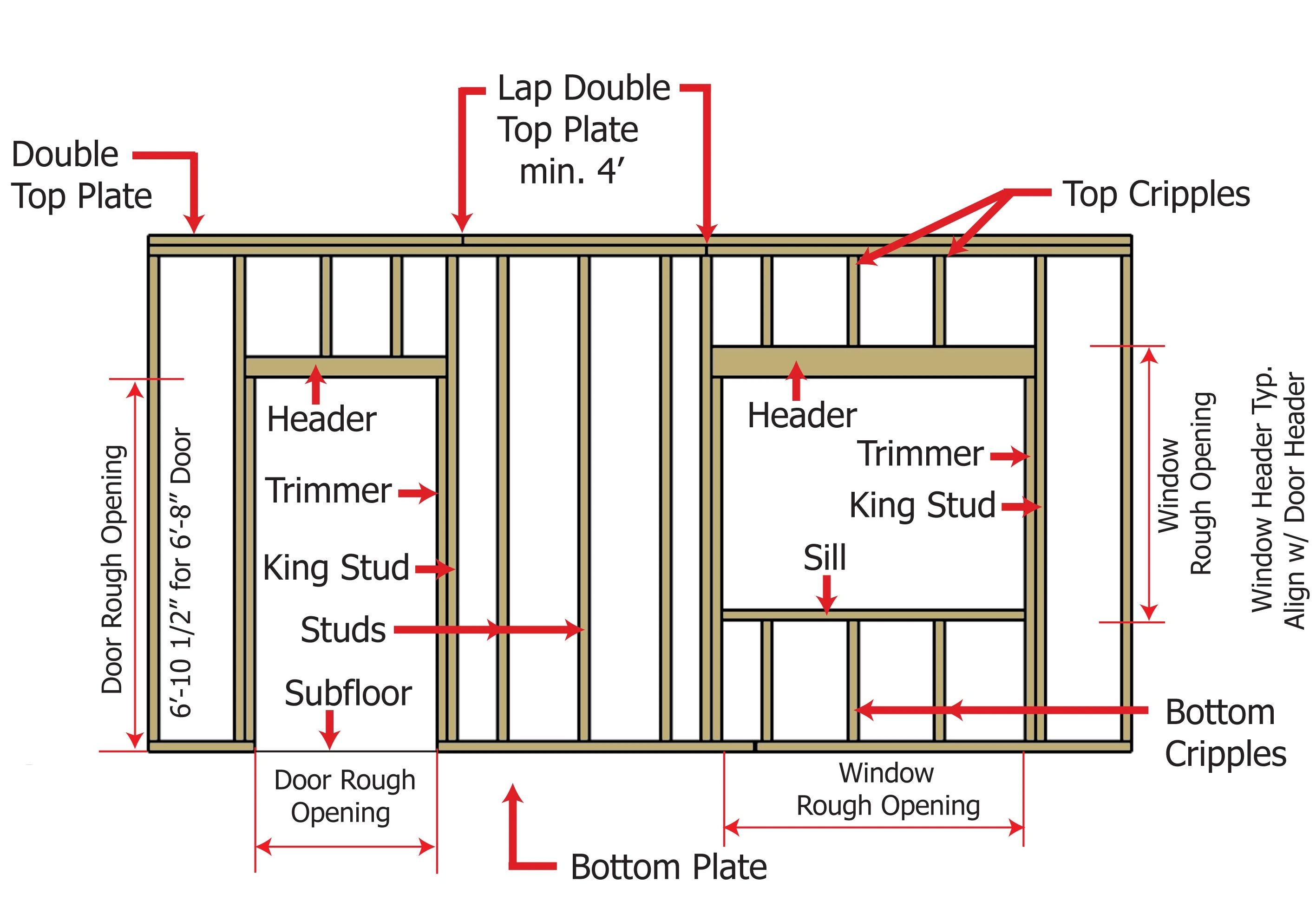
These walls require proper foundation support and include several key components:
- Double soleplate: Horizontal timber at the base, providing stability and load distribution
- Double headplate: Horizontal timber at the top, supporting floor joists above
- Studs: Vertical timber members spaced at 400mm centres
- Noggins: Horizontal bracing pieces between studs (double row for load-bearing walls)
- King studs: Full-height vertical members at openings
- Trimmer studs: Shorter vertical members supporting lintels
- Groundings: Horizontal fixings for electrical outlets and switches
Non-load-bearing timber walls
Partition walls have simpler requirements since they don't carry structural loads:
- Built directly on the floor surface without foundation support
- Single headplate and soleplate (not doubled like load-bearing walls)
- Single row of noggins between studs
- No damp-proof course required since moisture cannot reach the base
- Studs still spaced at 400mm centres for stability
Important
Never assume a timber wall is non-load-bearing without proper structural assessment. Removing or modifying load-bearing walls without appropriate support can cause serious structural damage.
Service accommodation in timber walls
Running services through timber frame walls requires careful consideration of structural integrity. Drilling holes for cables and pipes must follow strict guidelines:
Important
Critical Guidelines for Drilling Timber Studs:
- Holes can only be drilled along the centre line (neutral axis) of studs
- Maximum hole size is limited to maintain structural strength
- Holes must be positioned within specific height zones on the stud
- Notching outside these parameters can weaken the timber structure
Wall finishing
Both load-bearing and partition timber walls typically use plasterboard as the internal finish. Plasterboard consists of gypsum plaster sandwiched between paper sheets. This material offers several advantages:
- Fire-resistant properties suitable for internal walls
- Smooth surface requiring only one coat of plaster
- Easy to cut and fix with nails or screws
- Movement joints between sheets accommodate natural timber movement
Special moisture-resistant versions with foil backing are available for ceiling applications.
Summary
Key Points to Remember:
- Internal walls can be either load-bearing (supporting floors above) or non-load-bearing (partitions for space division)
- Block internal walls connect to external walls using wall ties and require chasing for electrical services
- Timber walls use different construction methods depending on whether they carry structural loads
- Service accommodation in timber walls must follow strict drilling guidelines to maintain structural integrity