Health and Safety on Site (Leaving Cert Construction Studies): Revision Notes
📚Revision Notes
Specific risk areas
Understanding and managing specific risk areas on construction sites is essential for maintaining safe working conditions. These areas require particular attention due to their higher potential for accidents and injuries.
Tools, machinery and equipment
Training and competency requirements
Only workers who have received proper training should operate tools, machinery and equipment on site. This training teaches safe operating procedures and significantly reduces accident risks during operation. For certain plant machinery, workers must possess construction skills certification before they can operate the equipment.
Common site equipment
Construction sites utilise various power tools, machinery and equipment for different purposes, including:
- Drills and saws
- Generators and pneumatic tools
- Excavators and cranes
- Loaders and paints
- Cleaning chemicals
Electrical safety considerations
Battery-powered tools offer portability but have shorter power and usage time. Whilst they reduce electric shock risk, they remain potentially dangerous and require careful handling.
Mains-powered tools operate at 110 volts, stepped down from the standard 240-volt mains supply. This voltage reduction uses a step-down transformer, which includes a safety device that splits the 110 volts between two wires to the tool. This centre-tapped earth connection further reduces fatal shock likelihood by ensuring only 55 volts reaches each wire.
Important
The voltage reduction system in mains-powered tools is a critical safety feature. Never attempt to bypass or modify these systems, as they are designed to prevent fatal electrical accidents on construction sites.
Safety standards and inspections
Power tools must meet several important safety standards:
- Insulation protection to prevent operator shock
- Quality standards compliance
- Weather restrictions - tools cannot be used in wet conditions
- Regular lead inspection for kinks, splits and damage
- Double insulation ensuring no live parts touch the outer casing
- CE marking showing compliance with European health, safety and environmental protection legislation
Cordless tools are preferred on site where possible to prevent trailing cables causing accidents. All equipment must only be operated by skilled, properly trained workers.
Overhead cables
Planning and identification
When planning construction work, it's vital to identify services crossing the site, including sewerage, electricity, gas and telecommunications. These services may run above or below ground level.
Vehicle access management
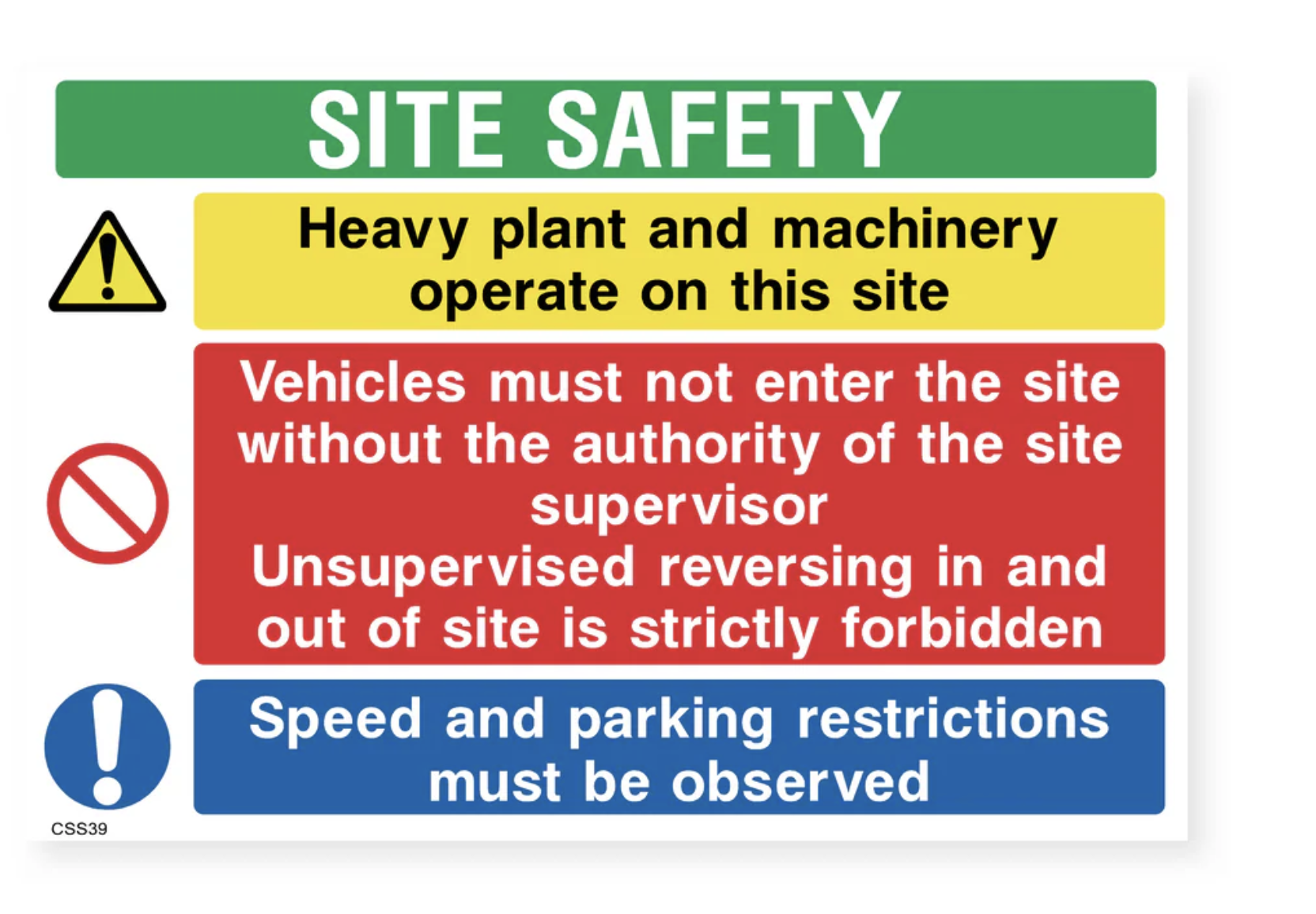
Large construction machinery requires clear overhead access routes. Sites implement several safety measures:
- Gates direct vehicle access under overhead services like power lines
- Warning bunting hung at 3-4.2m height for easy visibility by tall machinery operators
- Restricted access to essential personnel only near power lines
- Hazard zones of 10m either side of power lines to reduce accident likelihood
Note
Warning bunting serves as a visual reminder for operators of tall machinery, helping them gauge clearance distances before potentially dangerous contact with overhead power lines.


Excavations
Underground service identification
Identifying underground hazards presents greater difficulty than overhead services. Underground services include telecommunications, electricity, gas, water mains and sewers using cables and pipes. Whilst some plans may show underground service locations, they're not always accurate or complete, and other services or objects may not appear on plans at all.
Important
Underground services pose significant risks because they are hidden from view and service plans are often incomplete or inaccurate. Never assume an area is clear based solely on existing documentation.
Pre-excavation procedures
Before beginning excavations, builders must:
- Scan the ground to identify what lies beneath the surface
- Mark findings on the surface before digging begins
- Contact service providers who will provide safe excavation information
- Obtain location maps - for example, Bord Gais provides free gas line location maps
- Arrange service disconnection before excavation begins
Trench safety measures
Progressive excavation: Trenches should be dug in layers rather than large sections to reduce side wall collapse risk.
Support requirements: Any trench deeper than 1.25m must have supported sides for stability and subsidence prevention. Support methods include:
- Sheeting systems - closed wall sheeting placed along trench walls with vertical and horizontal supports
- Battering back - sloping trench sides to a safe angle for stability
Worker safety: Workers in or near trenches must wear protective footwear, headgear and high-visibility jackets. Vehicles must stay back from dig edges to prevent side wall compromise. Eye contact with machinery drivers is essential before workers move across work areas.
Important
Trench Collapse Danger
Trenches are among the most dangerous excavations on construction sites. Side walls can collapse without warning, potentially trapping or crushing workers. Never enter an unsupported trench deeper than 1.25m.
Management and coordination
Excavation work carries one of the highest incident rates in construction, making proper management, coordination and safe execution vital. These activities should link back to the Site-Specific Written Plan (SSWP) prepared by the site manager.
Scaffolding
Purpose and requirements
Scaffolding provides temporary working platforms around building perimeters at convenient heights. It's required for work above 1.5m height, though scaffolding can extend much higher. Working at height is dangerous, requiring multiple safety precautions during erection.
Ground preparation and stability
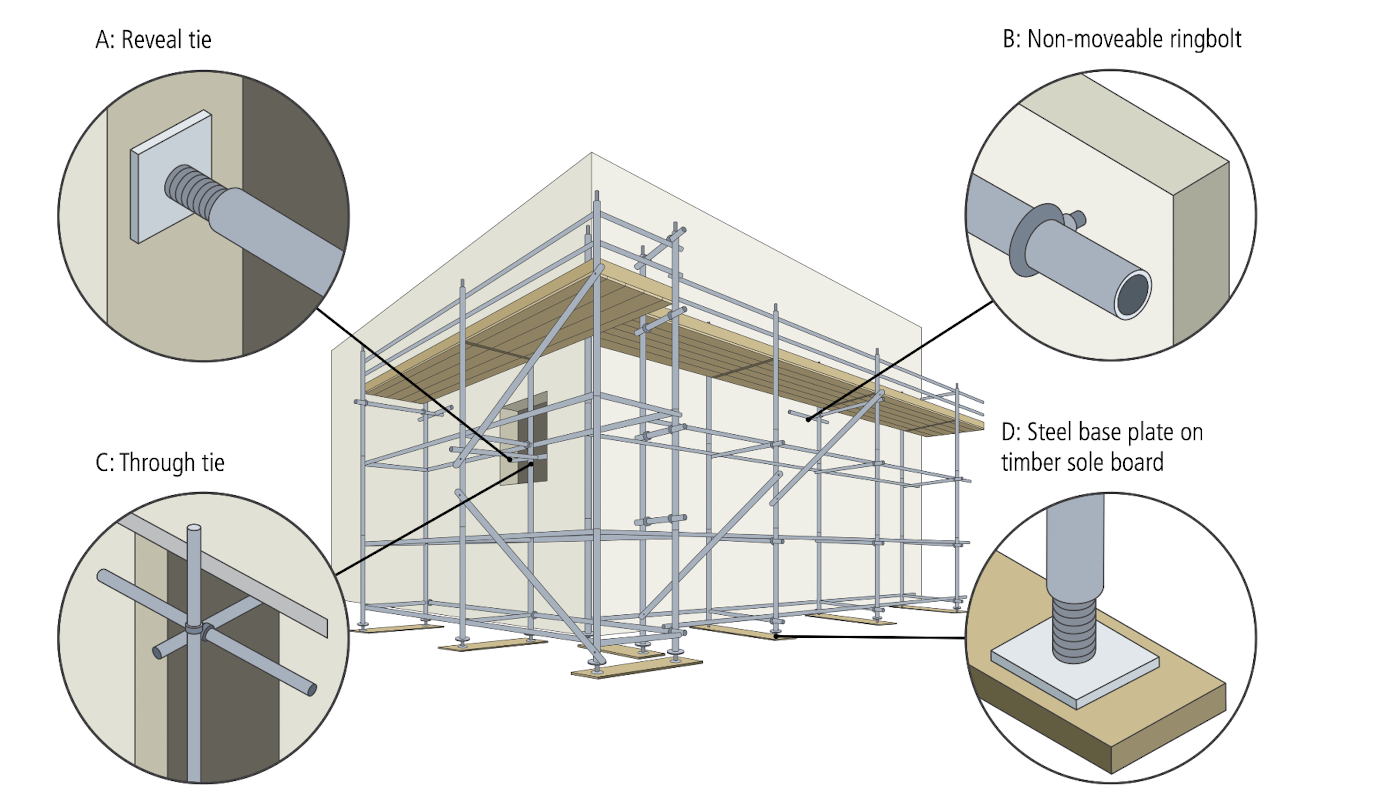
Scaffolding must not sink or slip during use. Before erection, ground conditions must be checked to ensure they're firm, solid and capable of supporting the structure and any imposed loads.
Levelling: Spirit levels and adjustable jacks ensure scaffolding is level - unlevel parts won't fit together firmly or correctly.
Load distribution: Timber spreads loads evenly under each scaffolding leg because soil has poor impact load-bearing ability.
Note
Ground preparation is often overlooked but is fundamental to scaffolding safety. Uneven or unstable ground can lead to catastrophic scaffold failure, even if the structure itself is properly assembled.
Assembly and structural integrity
Framework creation: Braces and ties create rigid frameworks preventing scaffolding collapse.
Building attachment: Scaffolding must be tied to buildings at various points to prevent movement away from the structure. Ties can attach at window or door openings, or to special ringbolts fixed to walls.
Safety features
Walkways and platforms:
- Must be fully boarded for uninterrupted access
- Minimise accident risk for workers
- Guard rails and toe boards required for scaffolding above 2m height
- Guard rails prevent workers falling and are fixed at 950-1200mm height
- Toe boards prevent loose material falling and must be minimum 150mm high
- Walkways must be unobstructed
Access provision:
- Ladders provide access to different scaffolding levels
- Must be properly secured at both ends to prevent movement
- Ladder tops must extend at least 1m above platforms
- Should be positioned at 1:4 slope for optimum safety
Structural reinforcement: Diagonal bracing and triangulation strengthen overall scaffolding structure. Triangular shapes provide stability, and triangulation uses triangular structures to improve rigidity.
Example
Worked Example: Scaffold Safety Setup
For a 3m high scaffold platform:
- Guard rails required (above 2m height)
- Guard rail height: 950-1200mm from platform
- Toe board height: minimum 150mm
- Ladder extension: 1m above the 3m platform = 4m total ladder length
- Ladder angle: 1:4 slope (for every 4m vertical, 1m horizontal distance from wall)
Scaffolding system types
Fabricated frame scaffold: Uses prefabricated sections allowing users to connect pieces forming complete scaffold systems.
Tube and coupler scaffold: Offers flexibility for creating customised scaffolds suited to specific builds.
Young workers
Risk factors
Ireland has a strong tradition of young people working on construction sites, both domestically and abroad. From a health and safety perspective, several risk factors affect young workers:
- Inexperience leading to higher accident proneness
- Risk-taking tendencies and advice-ignoring behaviour
- Enthusiasm sometimes leading to safety oversight
- Training gaps and unfamiliarity with tools and plant machinery
Important
Young Worker Safety Priority
Studies show that workers under 25 have significantly higher accident rates in construction. This demographic requires enhanced supervision and targeted safety training to prevent workplace injuries.
Safety improvement strategies
Several approaches can reduce young worker accident rates:
- Buddy systems pairing young workers with experienced workers for supervision and mentoring
- Regular safety meetings to maintain awareness
- Work appraisal to monitor performance and identify issues
- Comprehensive training provision to address knowledge gaps
Summary
Key Points to Remember:
- Only trained workers should operate tools and machinery - proper training significantly reduces accident risks
- All electrical tools must have CE marking and double insulation for safety compliance
- Trenches deeper than 1.25m require side support systems to prevent dangerous collapses
- Scaffolding above 2m height needs guard rails (950-1200mm) and toe boards (minimum 150mm) for worker protection
- Young workers need extra supervision through buddy systems and regular safety meetings due to higher accident risks