Layout and Landscaping (Leaving Cert Construction Studies): Revision Notes
📚Revision Notes
Layout and landscaping
Understanding site layout planning
Layout and landscaping considerations are crucial elements in the early stages of site development. When examining a potential building site, it's essential to evaluate the space surrounding the proposed home early in the planning process. This area can be developed to provide both shelter and privacy for the future occupants.
The approach to landscaping should be tailored to the site's location and existing environment. In rural settings, the most effective strategy involves using natural landscaping techniques that allow the building to blend seamlessly with the local surroundings.
Note
Early evaluation of landscaping potential is essential for successful site development. The surrounding space is just as important as the building footprint itself in creating a harmonious and functional living environment.
Natural landscaping principles
Respecting existing features
Effective landscaping design should work with, rather than against, the site's natural characteristics. This fundamental approach ensures sustainable and harmonious development that enhances rather than disrupts the existing environment.
Note
The key to successful natural landscaping lies in understanding and respecting what nature has already established on the site. This approach typically requires less maintenance and creates more sustainable outcomes.
Key principles include:
- Preserve wildlife habitats: Existing wildlife areas should be maintained and protected during development
- Maintain natural features: Wildflower meadows and small woodland areas deserve respect and preservation
- Use native species: When replanting or landscaping work is required, selecting native plants and trees helps maintain harmony with the natural rural environment
Rural versus urban approaches
The landscaping approach varies significantly depending on the site location, with each requiring distinctly different strategies:
Rural areas: Natural, organic approaches work best, using indigenous plants and maintaining existing landscape patterns.
Urban areas: More structured approaches are acceptable, including clean-cut hedge lines and formal lawn areas.
Timing of landscaping work
Although landscaping planning occurs early in the development process, the actual landscaping work typically doesn't commence until after the main structure is completed. This strategic timing approach ensures optimal results and prevents costly damage.
Important
Never begin landscaping work before construction is complete. This timing strategy prevents damage and allows construction teams to work efficiently without restrictions.
This timing strategy ensures that:
- Construction machinery and vehicles can operate freely without damaging landscaped areas
- Workers can complete their tasks without being hindered by landscaping features
- The landscaping won't be damaged by ongoing construction activities
Site entrance requirements
Safety considerations
Creating a safe site entrance is a critical safety requirement that cannot be compromised. The entranceway must provide adequate visibility in both directions to ensure safe vehicle access for all users.
Sightline requirements: A clear sightline of 45 metres must be maintained in each direction from the entrance point.
In some situations, hedgerows may need partial removal to create these required sightlines. However, hedgerow disturbance should be kept to the absolute minimum necessary for safety compliance.
Important
The 45-metre sightline requirement is non-negotiable for safety reasons. Any entrance that cannot meet this standard must be redesigned or relocated, regardless of aesthetic preferences.
Entrance design flexibility
While safety requirements are non-negotiable, the original site entrance can often be retained if it meets safety standards. When the existing entrance proves unsafe, a new access point must be created. This flexibility allows for creative solutions that balance safety with aesthetic considerations.
Types of entranceways
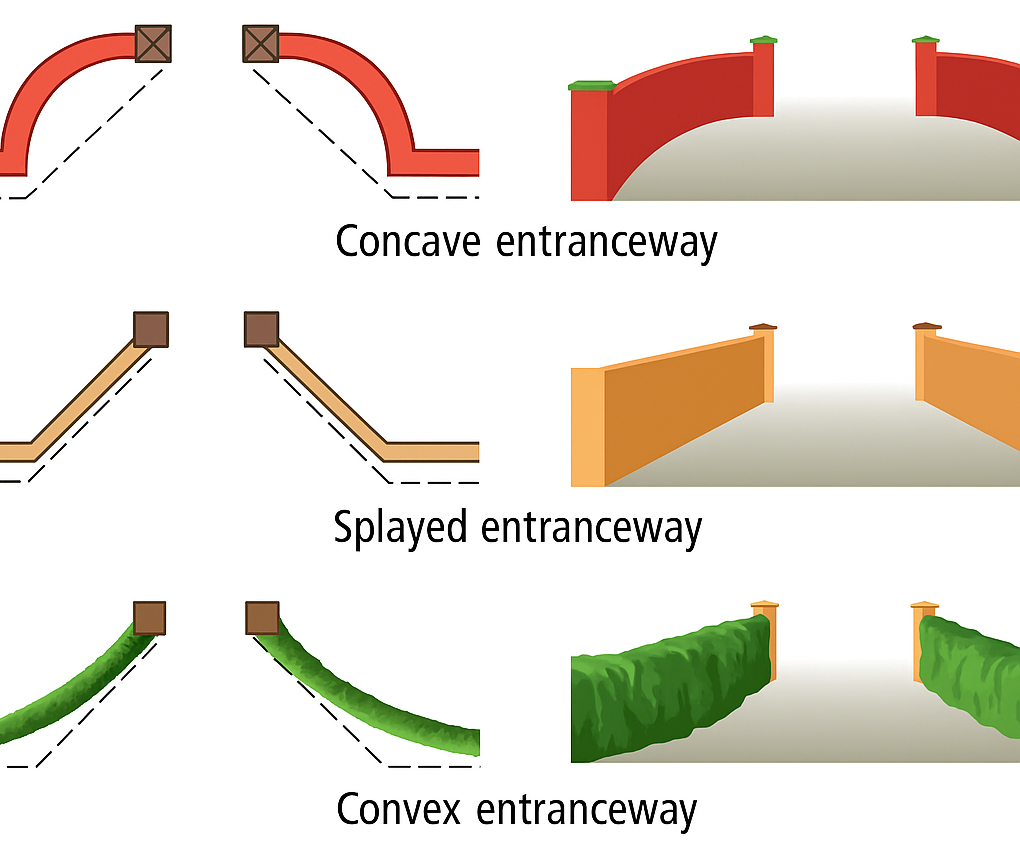
Three main entranceway design types can meet safety requirements while offering different aesthetic approaches that complement various site characteristics:
Concave entranceway
- Curves inward from the road
- Provides good visibility whilst maintaining a softer appearance
Splayed entranceway
- Features angled sides that widen from the road
- Offers excellent sightlines and clear access
Convex entranceway
- Curves outward towards the road
- Can work well with existing landscape features
Design specifications
Note
Standard Entranceway Requirements
All entranceways must meet these basic design specifications to ensure safety and functionality:
- 45-degree splay angle for optimal visibility
- Minimum 5-metre distance from the main road
- 3-metre minimum width at the narrowest point
These requirements ensure safety without mandating identical appearance across all entranceways.
Integration with surroundings
Maintaining boundaries
Preserving existing roadsides and site boundaries helps integrate new developments into their surroundings. This approach proves particularly important in rural locations where maintaining the natural character of the area is essential for community acceptance and environmental sustainability.
Boundary treatment effects
The treatment of roadside boundaries significantly impacts how well a development integrates with its environment, affecting both visual appeal and community acceptance:
Important
Poor vs Good Integration
Poor integration: Removing natural hedgerows creates stark, imposing buildings that disrupt the natural roadside line and stand out harshly against the landscape.
Good integration: Maintaining natural cover provides a buffering effect from the road while incorporating additional planting where appropriate, helping buildings settle naturally into their environment.
This careful approach to boundary treatment ensures new developments enhance rather than detract from their surroundings, creating lasting value for both occupants and the wider community.
Summary
Key Points to Remember:
- Plan landscaping early but execute it after construction completion to avoid damage
- Use natural approaches in rural areas, respecting existing wildlife habitats and native species
- Ensure 45-metre sightlines in each direction from any site entrance for safety
- Choose appropriate entranceway designs (concave, splayed, or convex) that meet safety requirements while fitting the site
- Preserve existing boundaries and natural features to help integrate developments into their surroundings