Shade and Shadow (Leaving Cert DCG): Revision Notes
📚Revision Notes
Shade and Shadow
Understanding shade and shadow is essential for creating realistic and professional freehand drawings. These techniques add depth, dimension and visual interest to your sketches, making them easier to read and more attractive to the viewer.
Why use shading?
Most sketches benefit from some form of shading, as it helps communicate the three-dimensional nature of objects. The amount of effort you put into shading depends on several factors:
- Purpose of the sketch - What are you trying to communicate?
- Subject being drawn - Complex objects may need more detailed shading
- Type of drawing - Presentation drawings typically require more shading than working sketches
- Clarity needs - Shading helps distinguish between different surfaces and edges
When working with orthographic or working drawings, pictorial sketches are regularly shaded to make them easier to understand and more visually appealing.
Key principle of rendering
Important
There is one fundamental rule to remember when adding shade and shadow to your drawings: the rendering must always make the drawing either clearer or more attractive. If shading fails to achieve either of these goals, it's better to leave it out. Only add shading if your basic drawing construction is already correct.
Essential terminology
Before diving into techniques, you need to understand these key terms, as they describe different but related concepts:
Shadow
Note
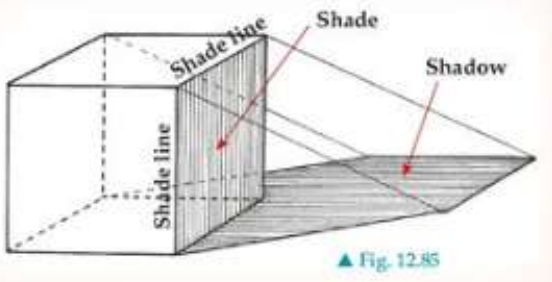
A shadow is a relatively dark shape that appears when an opaque object blocks light rays from reaching a surface. Think of it as the dark area cast onto another surface - like the shadow your hand makes on a table when you hold it under a lamp.
Key characteristics of shadows:
- They are cast on surfaces (like floors, walls, or other objects)
- They are caused by objects blocking light from a source
- Their shape and size depend on the light source position and the object creating them
Shade
Note
Shade refers to how much light is reflected back to your eye from different surfaces of an object. It's about the varying brightness you see on the object itself, not what it casts onto other surfaces.
Understanding shade helps you show:
- Which surfaces face towards or away from the light
- The three-dimensional form of objects
- Surface textures and materials
Shade line
The shade line (also called the casting line) is the boundary on an object that separates illuminated surfaces from those in shade. This line helps you determine which parts of your object should appear lighter or darker.
Shadow line
The shadow line is the edge or outline of the shadow that an object casts on a receiving surface. This helps define where shadows begin and end.
Light source considerations
The position of your light source dramatically affects how shadows and shading appear in your drawings. When you haven't specified a particular light source, you can assume it comes from above and slightly to one side - similar to natural lighting conditions.
Note
Key points about light sources:
- Parallel light rays - For most drawing purposes, treat light rays as parallel (like sunlight)
- Consistent direction - All shadows in your drawing should relate to the same light source position
- Above and to one side - This creates natural-looking results that people expect to see
- Flexibility - You can position your light source anywhere, but be consistent throughout the drawing
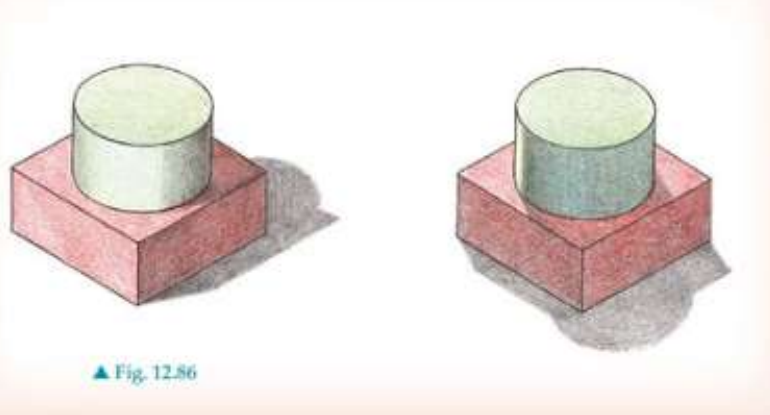
The examples above show how the same objects appear with consistent lighting. Notice how the cylindrical tops and cubic bases both receive light from the same direction, creating realistic and believable shading patterns.
Practical application tips
Note
When applying shade and shadow to your drawings:
- Start simple - Begin with basic geometric forms before attempting complex objects
- Observe real objects - Look at how light affects actual objects around you
- Be consistent - All elements in your drawing should share the same light source
- Practice regularly - Shading skills improve significantly with regular practice
- Study examples - Analyse well-executed technical drawings to understand effective shading techniques
Summary
Key Terms to Remember:
- Shadow = dark area cast onto a surface by a blocking object
- Shade = varying amounts of light reflected from an object's surfaces
- Shade line = boundary between lit and unlit areas on an object
- Shadow line = edge of the shadow cast on receiving surfaces
- Only add shading if it makes your drawing clearer or more attractive - never just for decoration!