Method One: Limits Method (Leaving Cert DCG): Revision Notes
📚Revision Notes
Method One: Limits Method
What is the limits method?
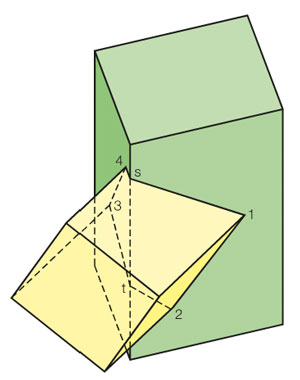
The limits method is a technique used to find the intersection lines when two solids penetrate each other. This method works particularly well for simpler intersections where the solids have plane surfaces (flat faces). When these types of solids intersect, they create intersection lines that are perfectly straight, making them easier to draw and understand.
Think of it like finding where the edges of two boxes would meet if they passed through each other - the meeting lines are always straight because boxes have flat faces.
Note
The key advantage of the limits method is its predictability - when working with plane surfaces, you can always expect straight-line intersections, which makes the drawing process much more manageable.
When should you use this method?
The limits method is your go-to choice when dealing with:
- Less complex interpenetrations between geometric solids
- Solids that have plane surfaces (like prisms, pyramids, and cubes)
- Situations where the intersection will create straight lines
- Cases where you need to find clear start and end points of intersections
This method won't work as well with curved surfaces like cylinders or spheres, which require different approaches.
Important
Remember that the limits method is specifically designed for plane surfaces. Attempting to use it with curved surfaces will lead to inaccurate results and should be avoided.
Key characteristics of the method
The limits method has several important features that make it effective:
- Straight line intersections: Because you're working with plane surfaces, all intersection lines will be perfectly straight
- Clear boundaries: You can easily identify where intersections start and stop
- Bend points: These are key points where the intersection line changes direction
- Systematic approach: You follow a logical sequence to find all intersection points
Understanding the process
The core idea behind the limits method is finding three crucial elements for each intersection line:
- Start point - Where the intersection begins
- Bend points - Where the intersection changes direction
- Finish point - Where the intersection ends
Once you identify these key points, you can connect them with straight lines to show the complete intersection. This systematic approach ensures you don't miss any part of where the solids meet.
Note
The beauty of this three-point system is its simplicity - by focusing on just the start, bend points, and finish, you can tackle even complex-looking intersections with confidence.
Working with orthographic projections
The limits method relies heavily on using multiple orthographic views to understand the intersection fully. You'll typically work with:
- Front elevation - Shows the intersection from the front
- End elevation - Shows the intersection from the side
- Plan view - Shows the intersection from above
Each view provides different information about where and how the solids intersect. By combining information from all views, you can build a complete picture of the intersection.
Step-by-step approach
When applying the limits method, follow this systematic process:
Example
Worked Example: Applying the Limits Method
Step 1: Draw the given views Complete both plan and elevation views of the intersecting solids, ensuring all necessary information is included for the front elevation.
Step 2: Identify bend points Look for points where the intersection line will change direction. These often occur at edges or corners of the solids.
Step 3: Project points between views Use projection lines to transfer key points from one view to another. This helps you locate intersection points accurately in all views.
Step 4: Connect the points Join the identified points with straight lines to show the complete intersection. Remember that edges should not make contact with triangular prisms in certain configurations.
Practical examples and applications
The method works particularly well with common geometric combinations:
- Hexagonal prisms with triangular elements - The flat faces create clear, straight intersection lines
- Square prisms intersecting at angles - The regular geometry makes bend points easy to identify
- Multiple solid intersections - You can apply the same principles to more complex arrangements
When working through examples, always start with the simpler views and build complexity gradually. The plan view often provides the clearest starting point for identifying intersection boundaries.
Note
Starting with the plan view is often the most effective approach because it typically shows the clearest outline of how the solids intersect, giving you a solid foundation for the other views.
Key tips for success
Summary
Essential Tips for Mastering the Limits Method:
- Take your time with projection - Accurate projection between views is essential for correct results
- Mark bend points clearly - These critical points determine the shape of your intersection lines
- Check your work - Verify that intersection lines make geometric sense in all views
- Keep lines straight - Remember that plane surface intersections always create straight lines
- Use construction lines - Light construction lines help you project points accurately between views
The limits method provides a reliable framework for solving intersection problems systematically. By focusing on finding the start points, bend points, and finish points of intersection lines, you can tackle even complex-looking problems with confidence.
Remember!
Summary
Key Points to Remember:
- The limits method works best with plane surfaces that create straight intersection lines
- Always identify the start, bend points, and finish of each intersection line
- Use multiple orthographic views to get complete information about the intersection
- Project points accurately between views using construction lines
- Check that your intersection lines are geometrically correct in all views