Transformers (Leaving Cert Engineering): Revision Notes
📚Revision Notes
Transformers
What is a transformer?
A transformer is an essential electrical device used in welding equipment to convert the high voltage mains electricity supply into a more suitable voltage for welding operations. Transformers work by changing the voltage level of alternating current (AC) electricity without changing its frequency.
The main purpose of transformers in welding is to take the dangerous high voltage from the mains supply (typically 220-240 volts) and reduce it to a safer, more manageable voltage level for welding applications.
Note
Transformers are passive devices that require no external power source to operate - they rely entirely on the principle of electromagnetic induction to function.
Construction of a transformer
A basic transformer consists of three main components:
- Primary coil - receives the input voltage from the mains supply
- Secondary coil - delivers the output voltage to the welding circuit
- Iron core - provides a path for the magnetic field between the coils
The two coils are made from insulated copper wire and are wrapped around opposite sides of a rectangular iron or steel core. The coils are not electrically connected to each other, but they are linked magnetically through the iron core.
Important
The iron core is essential for transformer operation - without it, there would be very little magnetic coupling between the coils and the transformer would be extremely inefficient.
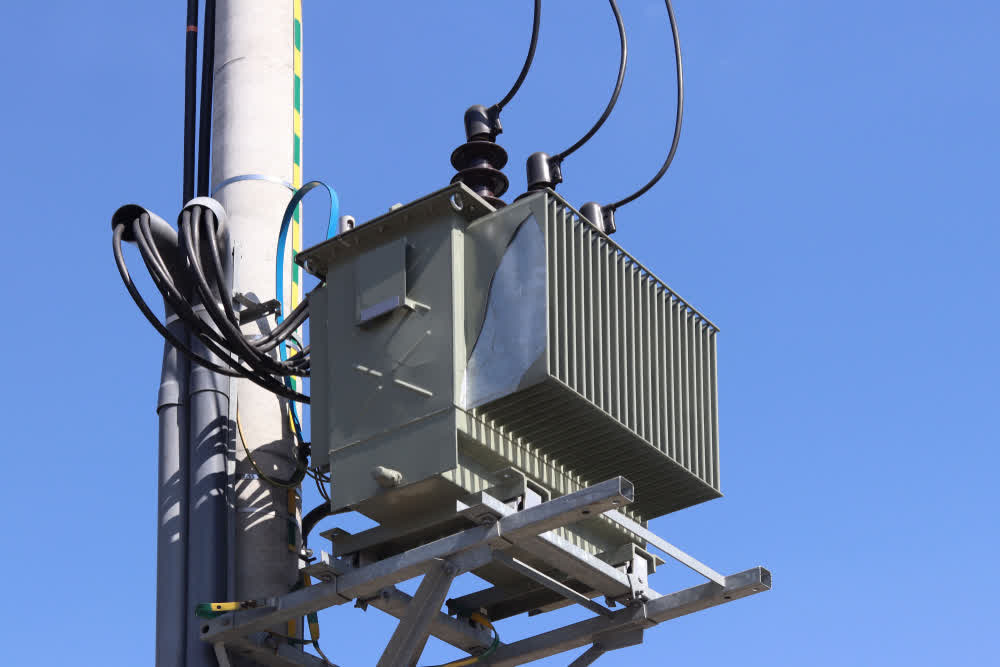
How transformers work
Transformers operate on the principle of electromagnetic induction. Here's how the process works:
- AC input: Alternating current flows through the primary coil, creating a constantly changing magnetic field around it
- Magnetic coupling: This changing magnetic field travels through the iron core to the secondary coil
- Induced current: The changing magnetic field induces an electric current in the secondary coil
- Voltage conversion: The voltage level changes depending on the ratio of windings between the coils
Example
Worked Example: Understanding Winding Ratios
If a transformer has:
- Primary coil: 1000 windings
- Secondary coil: 500 windings
- Input voltage: 240V
The winding ratio is 1000:500 = 2:1 Therefore, output voltage = 240V ÷ 2 = 120V
This demonstrates how more primary windings than secondary windings creates a step-down effect.
Step-down transformers in welding
Most welding applications use step-down transformers, which reduce voltage and increase current. This type of transformer has:
- More windings in the primary coil than the secondary coil
- Higher voltage input (220/240 volts)
- Lower voltage output (110/120 volts)
- Lower current input
- Higher current output
This arrangement is ideal for welding because welding processes require high current at relatively low voltage for safe operation.
Note
The relationship between voltage and current in transformers follows the principle of power conservation - when voltage decreases, current increases proportionally to maintain the same power level (minus losses).
AC input characteristics
The alternating current input to transformers follows a sinusoidal waveform pattern. This means the voltage continuously changes from positive to negative values in a smooth, wave-like pattern.
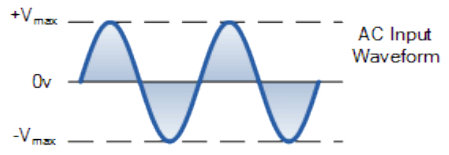
Key features of the AC input waveform:
- Alternates between positive and negative peak values
- Continuous cycles that repeat at 50Hz (50 times per second in the UK)
- Smooth transitions between maximum positive (+Vmax) and maximum negative (-Vmax) values
- Zero crossing points where the voltage momentarily equals zero
Note
The frequency of 50Hz means the AC voltage completes 50 full cycles every second, creating 100 zero crossing points per second where the magnetic field in the transformer core changes direction.
Why transformers are essential in welding
Transformers solve several important problems in welding power control:
- Safety: Reduce dangerous mains voltage to safer working levels
- Efficiency: Provide the high current needed for effective welding
- Control: Allow voltage adjustment for different welding applications
- Isolation: Electrically separate the mains supply from the welding circuit
Without transformers, welding equipment would be both dangerous to operate and ineffective at joining metals.
Important
The electrical isolation provided by transformers is crucial for safety - it means that the welding circuit is completely separated from the mains electrical supply, reducing the risk of electric shock.
Summary
Key Points to Remember:
- Transformers convert AC voltage levels using electromagnetic induction through an iron core
- Step-down transformers reduce voltage and increase current - perfect for welding applications
- Primary coil receives mains input (220/240V) while secondary coil delivers welding output (110/120V)
- More primary windings than secondary windings creates the step-down effect
- AC input follows a sinusoidal waveform that alternates between positive and negative values continuously