Milling (Leaving Cert Engineering): Revision Notes
📚Revision Notes
Milling Cutters
Milling cutters are specialised cutting tools designed to remove material from workpieces during milling operations. Different types of cutters are used depending on the milling machine type and the specific machining task required. Understanding the various cutter types and their applications is essential for successful machining operations.
Chuck-mounted cutters
Chuck-mounted cutters are primarily used on vertical milling machines. These cutters are held directly in the machine's chuck and are designed for precise machining operations on the top and side surfaces of workpieces.
Note
The key distinction to remember is that chuck-mounted cutters are specifically designed for vertical milling machines, where they are held securely in the machine's chuck for precise control during machining operations.
End mills
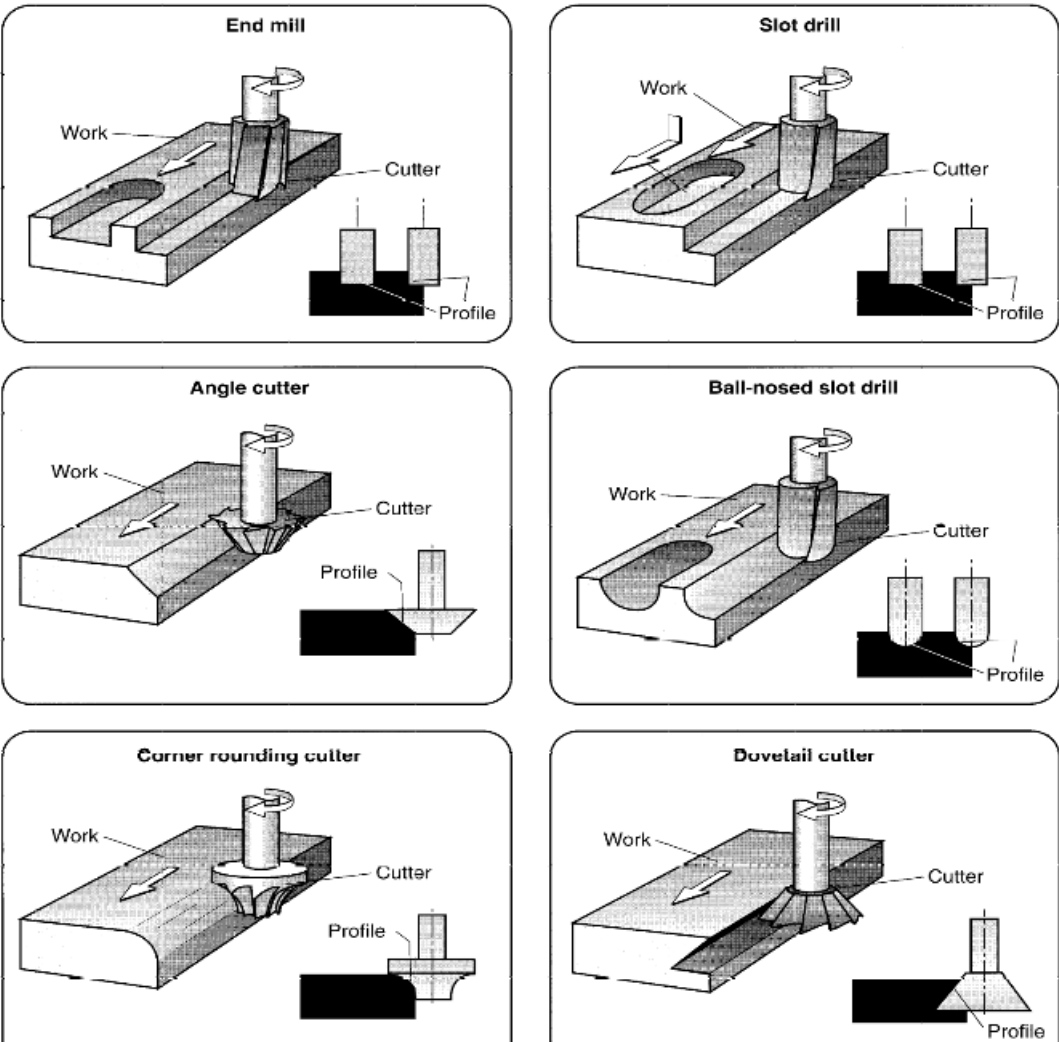
End mills are versatile cutting tools used for general milling operations on both top and side surfaces of workpieces. These cutters typically have 4, 6, 8 or more cutting edges, which makes them highly efficient for material removal. End mills can create slots in materials, but they are limited to producing open-ended slots only. Their multiple cutting edges allow for smooth cutting action and good surface finish.
Slot drills
Slot drills are specifically designed for creating internal slots in workpieces. Unlike end mills, slot drills have only two cutting edges, which makes them less efficient at cutting compared to end mills. However, their design allows them to plunge directly into solid material to create closed slots and internal features that end mills cannot produce.
Important
Remember that slot drills are less efficient than end mills due to having only two cutting edges instead of multiple edges. However, they can do something end mills cannot - create closed internal slots by plunging into solid material.
Angle cutters
Angle cutters are specialised tools designed to create chamfers along the edges of workpieces. These cutters have angled cutting surfaces that produce precise bevelled edges, which are important for both functional and aesthetic purposes in machined components.
Ball-nosed slot drill
Ball-nosed slot drills are used for cutting curved channels and contoured surfaces into materials. They work similarly to standard slot drills but feature a rounded cutting end that creates smooth, curved profiles. These cutters are particularly useful for machining complex three-dimensional shapes and finishing operations.
Corner-rounding cutter
Corner-rounding cutters are designed to mill rounded edges or fillets along workpiece edges. These cutters create smooth, curved transitions between surfaces, which can improve both the appearance and strength of machined components by eliminating sharp corners.
Dovetail cutter
Dovetail cutters are specialised tools used for machining dovetail joints and slots. These cutters create the characteristic angled cuts required for dovetail connections, which are commonly found in precision machinery components such as laith topslides.
Arbour-mounted cutters
Arbour-mounted cutters are used on horizontal milling machines and are mounted on a horizontal arbour (a round steel bar). These cutters are typically larger than chuck-mounted cutters and are designed for heavy-duty machining operations.
Note
Arbour-mounted cutters are generally larger and more robust than chuck-mounted cutters because they're designed for the heavy-duty operations typically performed on horizontal milling machines.
Cylindrical cutters (slab mills)
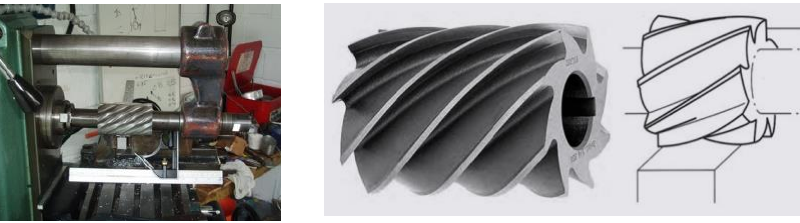
Cylindrical cutters, also known as slab mills, are the most commonly used cutters on horizontal milling machines. These large, cylindrical cutting tools are specifically designed to machine large flat surfaces, known as slabs. Their wide cutting surface allows for efficient material removal over large areas.
Side and face cutters
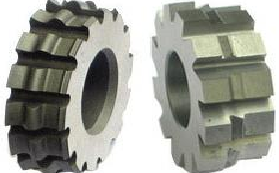
Side and face cutters are versatile tools that have cutting teeth on both the periphery (outer edge) and the side faces. This design allows them to machine stepped surfaces and multiple faces simultaneously. These cutters can be combined with other cutters on the same arbour for gang milling, where multiple operations are performed at once. When spacers are used between cutters to mill both sides of a workpiece simultaneously, this technique is called straddle milling.
Slitting saws
Slitting saws are thin, circular cutting tools that resemble miniature saw blades. They typically range from 1mm to 5mm in thickness and are used for creating deep, narrow slots in components. Their thin profile allows for precise cuts with minimal material waste.
Angle cutters
Angle cutters used on horizontal milling machines serve the same purpose as their chuck-mounted counterparts - they create chamfers along the edges of components. However, these arbour-mounted versions are typically larger and designed for heavier cutting operations.
Form cutters
Form cutters are custom-designed, specialised cutting tools that can be manufactured to create virtually any required profile or shape. These cutters are typically bespoke (specially made) for specific jobs and are not commonly available as standard tools due to their unique forms and specialised applications.
Milling cutting action
Understanding how the cutting action works in milling is crucial for successful machining operations.
Upcut milling (conventional milling)
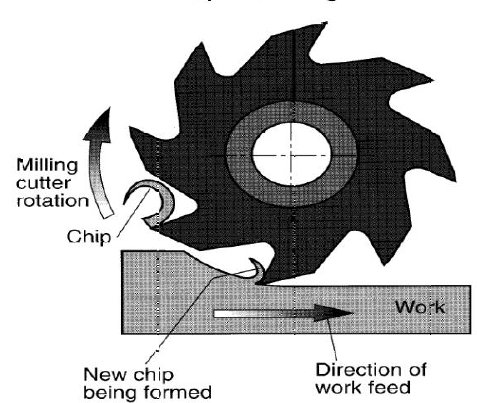
Upcut milling, also known as conventional milling, is the most commonly used milling technique. In this method, the cutter rotates in the opposite direction to the workpiece feed movement. This creates a cutting action where the chip starts small and gradually increases in thickness before being cut away.
Important
Critical Safety Point: Upcut milling creates a lifting effect on the workpiece, which means very secure clamping must be used to prevent the work from moving during machining operations. Inadequate clamping can result in dangerous workpiece movement and poor machining results.
The advantages of upcut milling include smooth cutting action and reduced stress on the machine. However, this method creates a lifting effect on the workpiece, which means very secure clamping must be used to prevent the work from moving during machining operations.
Remember!
Summary
Key Points to Remember:
- Chuck-mounted cutters are used on vertical milling machines, while arbour-mounted cutters are used on horizontal milling machines
- End mills have multiple cutting edges (4, 6, 8 or more) making them more efficient than slot drills which have only two cutting edges
- Upcut milling (conventional milling) is the most common cutting method, but requires secure workpiece clamping due to the lifting effect
- Different cutter types are designed for specific applications - choose the right cutter for the job to achieve the best results
- Form cutters are custom-made for specialised jobs, while standard cutters like end mills and slab mills are used for general machining operations