Work Holding (Leaving Cert Engineering): Revision Notes
📚Revision Notes
Work Holding
What is work holding in milling?
Work holding refers to the methods and devices used to secure workpieces during milling operations. Proper work holding ensures the workpiece remains stable and accurately positioned while cutting tools remove material. This is essential for achieving precise dimensions and maintaining safety during machining.
Important
Inadequate work holding can result in workpiece movement during cutting, leading to poor surface finish, dimensional inaccuracy, and potential safety hazards.
Dividing head
Definition and purpose
A dividing head is a specialised work holding device designed to secure cylindrical workpieces on milling machine tables. This essential piece of equipment allows operators to perform precise angular positioning and indexing operations during milling.
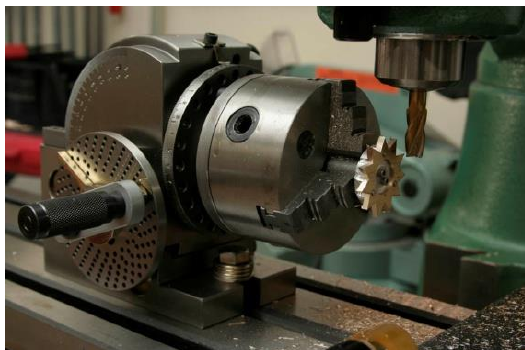
Key components and operation
The dividing head contains an internal worm and wheel mechanism that enables controlled rotation of the workpiece. This system allows the operator to rotate the work through precise angles, making it ideal for creating evenly spaced features such as:
- Gear teeth on cylindrical blanks
- Flats on round bars
- Equally spaced holes or slots
- Splined shafts
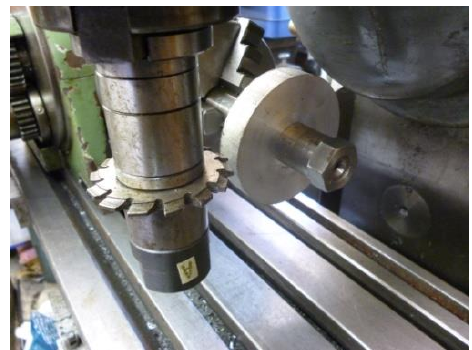
The precision of this mechanism is what makes the dividing head so valuable for repetitive angular operations where accuracy and consistency are paramount.
Versatile configurations
The dividing head offers flexible mounting options to suit different machining requirements:
- Vertical position: Standard configuration for most operations
- Horizontal position: When rotated horizontally, the device functions as a turntable, allowing for different types of indexing operations
Note
This adaptability makes the dividing head particularly valuable when machining complex geometries that require multiple angular positions, as operators can choose the most suitable orientation for each specific task.
Practical applications
The dividing head excels at holding cylindrical materials securely while allowing precise angular adjustments. Common applications include:
- Manufacturing gear blanks with accurate tooth spacing
- Creating keyways and splines on shafts
- Machining polygonal shapes from round stock
- Producing evenly distributed bolt hole patterns
Note
Industrial Applications:
The dividing head is particularly valuable in production environments where repeatability and precision are critical. Many automotive and aerospace components require the exact angular positioning that only a dividing head can provide.
Summary
Key Points to Remember:
- Work holding devices are essential for safe and accurate milling operations
- Dividing heads specialise in holding cylindrical workpieces with precise angular control
- The internal worm and wheel mechanism provides accurate indexing capabilities
- Horizontal positioning converts the dividing head into a turntable for alternative operations
- Proper work holding prevents workpiece movement and ensures dimensional accuracy