Work Holding (Leaving Cert Engineering): Revision Notes
📚Revision Notes
Work Holding
Introduction to work holding
Work holding is a critical aspect of precision grinding operations. The workpiece must be securely positioned and clamped to ensure accurate machining and prevent movement during the grinding process. Various work holding devices are available, with each offering specific advantages for different applications and materials.
Note
The choice of work holding method can significantly impact the accuracy and surface finish of the final machined component. Poor work holding can lead to vibration, workpiece movement, and dimensional inaccuracies.
Magnetic chuck
Magnetic chuck is a specialised work holding device that uses powerful permanent magnets to secure ferrous workpieces during precision grinding operations.
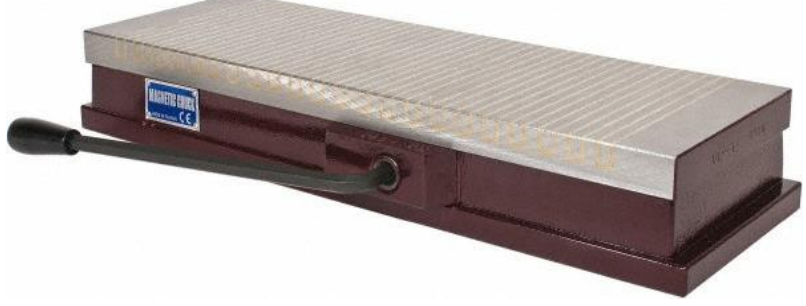
How magnetic chucks operate
The magnetic chuck functions as a large, strong permanent magnet system. It features an activating lever that controls the magnetic field strength. When the lever is operated, it moves two internal plates that align the poles of multiple magnets within the chuck.
Note
The key function of the activating lever is to align the magnetic poles within the chuck. This alignment is essential for creating the strong magnetic field needed to securely hold the workpiece.
When these magnetic poles are properly aligned, the chuck creates an extremely strong magnetic grip that securely holds the workpiece. Once machining is complete, the permanent magnet can be deactivated using the lever, and the component can be simply lifted off the chuck surface.
Advantages of magnetic chucks
Magnetic chucks offer several significant benefits for precision grinding work:
- Quick and simple operation - workpieces can be positioned and secured rapidly
- Versatile holding capability - can accommodate awkwardly shaped materials that would be difficult to clamp conventionally
- Unobstructed access - no protruding vice jaws or clamps that might interfere with cutting tools
- Strong, reliable grip - provides excellent holding force when properly activated
- Smooth surface contact - the flat chuck surface supports the entire workpiece area
Note
The unobstructed access provided by magnetic chucks is particularly valuable in precision grinding, where tool clearance and access to all surfaces of the workpiece are essential for achieving high-quality results.
Limitations of magnetic chucks
Despite their advantages, magnetic chucks have important limitations that must be considered:
Important
Critical Limitation: Material Compatibility
Magnetic chucks only work with ferrous (iron-based) materials that can be magnetised. This is the most significant restriction when selecting this work holding method.
- Material restriction - only suitable for ferrous (iron-based) materials that can be magnetised
- Non-ferrous materials such as aluminium, brass, or plastic cannot be held using magnetic chucks
- Thickness considerations - very thin materials may not provide sufficient magnetic contact
Applications in precision grinding
Magnetic chucks are particularly valuable in precision grinding operations where high accuracy and surface finish are required. They are commonly used for:
- Surface grinding of flat components
- Cylindrical grinding of ferrous bars and rods
- Tool and cutter grinding operations
- Precision machining where conventional clamping would distort the workpiece
Note
In applications where workpiece distortion must be minimised, magnetic chucks are often the preferred choice because they apply uniform holding force across the entire contact surface without localised clamping pressure.
Summary
Key Points to Remember:
- Magnetic chucks use permanent magnets with an activating lever to secure ferrous workpieces
- They offer quick operation and can hold awkwardly shaped materials without obstructing access
- The main limitation is they only work with ferrous (iron-based) materials
- They provide strong, reliable holding for precision grinding operations
- No vice jaws means better tool access and reduced risk of workpiece distortion