Eddy Current Test (Leaving Cert Engineering): Revision Notes
📚Revision Notes
Eddy Current Test
What is eddy current testing?
Eddy current testing is a type of non-destructive testing (NDT) that uses the principles of electromagnetic induction to detect flaws and defects in materials. Unlike other magnetic testing methods, eddy current testing is specifically designed for non-ferrous materials (materials that don't contain iron, such as aluminium, copper, and zinc).
This testing method works by creating electromagnetic fields that can penetrate through materials and detect changes in their internal structure without causing any damage to the component being tested.
Note
The key advantage of eddy current testing over magnetic particle testing is its ability to work with non-ferrous materials. This makes it essential for industries that primarily use aluminium, copper, and other non-iron based materials.
How eddy current testing works
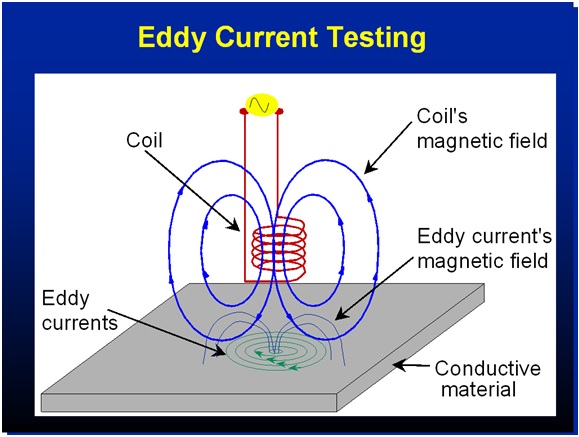
The process relies on the fundamental principle that when a magnetic field interacts with a conductive material, it creates small circular electrical currents called eddy currents within that material. These currents behave like tiny whirlpools of electricity.
Here's how the testing process works step by step:
Equipment setup
The testing equipment consists of three main components:
- An iron rod that acts as the core
- A copper coil wrapped around the iron rod
- An oscilloscope to measure and display results
Creating the magnetic field
When an electrical current flows through the copper coil, it transforms the iron rod into an electromagnet. This creates a magnetic field around the rod that can penetrate through materials.
Testing the component
When the electromagnet is placed near or against the test component, the invisible magnetic field passes through the material. The density and structure of the component naturally create some resistance to this magnetic field.
Detecting defects
The oscilloscope continuously measures the strength and behaviour of the magnetic field. Under normal conditions, it shows a steady, expected level of resistance. However, when the magnetic field encounters a flaw or defect inside the material, it causes a fluctuation in the field strength. This fluctuation appears as a change in the signal on the oscilloscope screen, alerting the operator to the presence of a defect.
Note
The principle behind eddy current formation is based on Faraday's law of electromagnetic induction. When a changing magnetic field passes through a conductive material, it induces circular electrical currents (eddy currents) that create their own magnetic field opposing the original field.
Advantages of eddy current testing
Eddy current testing offers several significant benefits that make it valuable for specific applications:
Suitable for non-ferrous materials: Unlike magnetic particle testing, eddy current testing works effectively on materials like aluminium, copper, and zinc that don't contain iron.
Non-contact testing: The probe doesn't need to touch the surface directly, making it ideal for testing delicate components.
Quick results: The oscilloscope provides immediate feedback, allowing for rapid inspection of multiple components.
Detects surface and near-surface defects: The method is particularly effective at finding cracks and flaws close to the surface of materials.
Note
The non-contact nature of eddy current testing makes it particularly valuable in production environments where components need to be tested without risk of contamination or surface damage.
Applications in industry
Eddy current testing is commonly used across various industries due to its effectiveness with non-ferrous materials:
- Aerospace industry: Testing aluminium aircraft components
- Automotive industry: Inspecting non-ferrous engine parts
- Electronics industry: Quality control of copper conductors
- Manufacturing: Checking the integrity of machined components
Limitations to consider
Understanding the constraints of eddy current testing is crucial for proper application and realistic expectations:
Important
Critical Limitations to Understand:
Limited to conductive materials: The material being tested must be able to conduct electricity for eddy currents to form.
Depth limitation: The method works best for detecting flaws near the surface, as the magnetic field strength decreases with depth.
Skilled operators required: Interpreting the oscilloscope readings requires training and experience to distinguish between actual defects and normal variations.
Surface condition sensitivity: Paint, coatings, or surface contamination can affect the accuracy of results.
Summary
Key Points to Remember:
- Eddy current testing uses electromagnetic induction to detect flaws in non-ferrous materials
- The equipment consists of an iron rod, copper coil, and oscilloscope
- Electrical current through the coil creates a magnetic field that penetrates the test material
- Defects cause fluctuations in the magnetic field that show up on the oscilloscope
- This method is particularly useful for testing aluminium, copper, and zinc components
- Results are immediate but require skilled interpretation