Basic Principles and Applications of Semiconductor Technology (2026) (Leaving Cert Engineering): Revision Notes
📚Revision Notes
Evolution of Semiconductor Technology
Introduction to semiconductor evolution
Semiconductor technology has fundamentally transformed our modern world, forming the backbone of virtually every electronic device we use today. These tiny electronic components power everything from smartphones and computers to cars and kitchen appliances. Understanding how this technology developed helps us appreciate both current capabilities and future possibilities in engineering.
Note
Semiconductors are so deeply integrated into modern life that most people interact with dozens of semiconductor-powered devices daily without realising it - from the microcontroller in your coffee maker to the processors in your smartphone.
The journey of semiconductor technology represents one of humanity's most remarkable technological achievements. From humble beginnings in laboratory research to the sophisticated chips that enable artificial intelligence, this evolution demonstrates how scientific breakthroughs can reshape entire industries and daily life.
Timeline of major semiconductor milestones
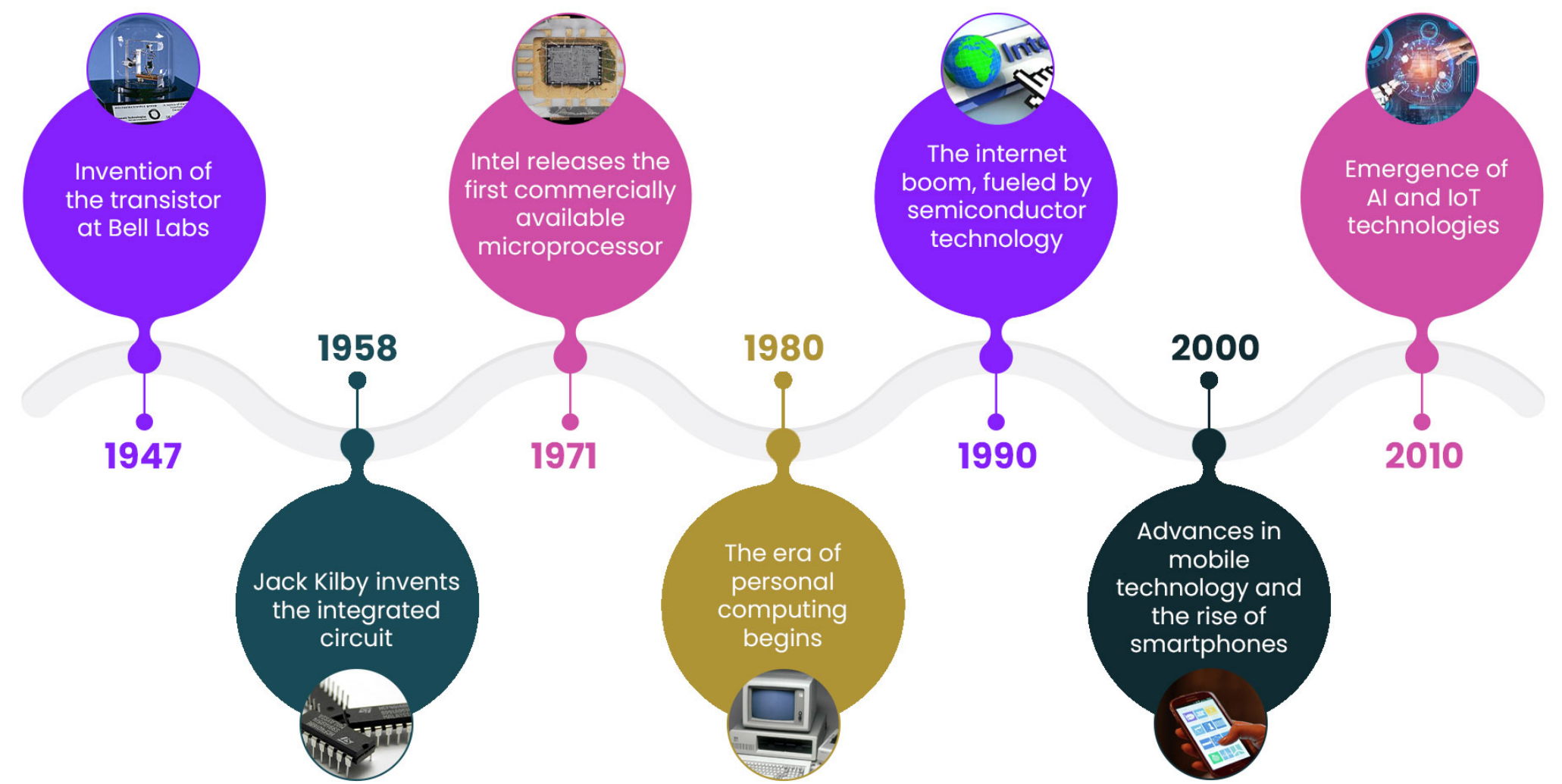
The development of semiconductor technology can be traced through several pivotal moments that changed the course of modern electronics. Each breakthrough built upon previous discoveries, creating a foundation for increasingly complex and powerful devices.
Important
Understanding this timeline is crucial because each milestone directly enabled the next breakthrough, creating an accelerating cycle of innovation that continues today.
Key historical developments:
- 1947 - Invention of the transistor at Bell Labs: Scientists developed the first working transistor, replacing bulky vacuum tubes with a much smaller, more reliable component. This breakthrough earned its inventors the Nobel Prize and marked the beginning of the semiconductor revolution.
- 1958 - Jack Kilby invents the integrated circuit: Rather than connecting individual transistors with wires, Kilby demonstrated how multiple components could be built on a single piece of semiconductor material. This innovation laid the groundwork for all modern computer chips.
- 1971 - Intel releases the first commercial microprocessor: The development of programmable processing units marked the birth of the computer age. These early microprocessors contained the logic circuits needed to execute instructions and perform calculations.
- 1980 - Era of personal computing begins: Semiconductor advances made computers small and affordable enough for individual ownership, transforming them from room-sized machines used by corporations to desktop devices for homes and offices.
- 1990 - Internet boom fuelled by semiconductor technology: Faster processors and improved networking components enabled the widespread adoption of internet connectivity, creating new industries and changing how people communicate.
- 2000 - Advances in mobile technology and smartphones: Miniaturisation of semiconductor components allowed powerful computing capabilities to fit in portable devices, revolutionising communication and access to information.
- 2010 - Emergence of AI and IoT technologies: Modern semiconductor capabilities enabled artificial intelligence applications and the Internet of Things, where everyday objects can connect to networks and share data.
Foundational semiconductor technologies
The transistor revolution
The transistor serves as the fundamental building block of all semiconductor devices. These components act as electronic switches that can either allow or block electrical current flow. By combining millions or billions of transistors on a single chip, engineers create complex circuits capable of processing information, storing data, and controlling other electronic systems.
Note
Think of transistors as incredibly tiny switches that can turn on and off billions of times per second. Modern processors contain billions of these switches working together to perform calculations and process information.
Early transistors were discrete components that required individual assembly into circuits. This approach limited the complexity and reliability of electronic devices while increasing their size and cost.
Integrated circuits transform electronics
Integrated circuits revolutionised electronics by combining multiple transistors, resistors, and other components on a single semiconductor wafer. This integration approach offered numerous advantages:
- Miniaturisation: Multiple components could fit in the space previously occupied by a single discrete transistor
- Reliability: Fewer individual connections meant fewer potential failure points
- Cost reduction: Mass production techniques made complex circuits economically viable
- Performance improvement: Shorter distances between components enabled faster operation
Microprocessors enable programmable devices
Microprocessors represent a special type of integrated circuit designed to execute instructions and perform calculations. These programmable components contain arithmetic logic units, memory interfaces, and control circuits that enable them to function as the "brain" of electronic systems.
The development of microprocessors enabled the creation of general-purpose computing devices that could be programmed for different tasks, rather than building separate hardware for each application.
Modern applications and the semiconductor revolution
Internet of Things and connected devices
Today's semiconductor technology enables the Internet of Things (IoT), where everyday objects can connect to networks and communicate with other devices. This connectivity relies on sophisticated microcontrollers that combine processing power, memory, and communication capabilities in compact, energy-efficient packages.
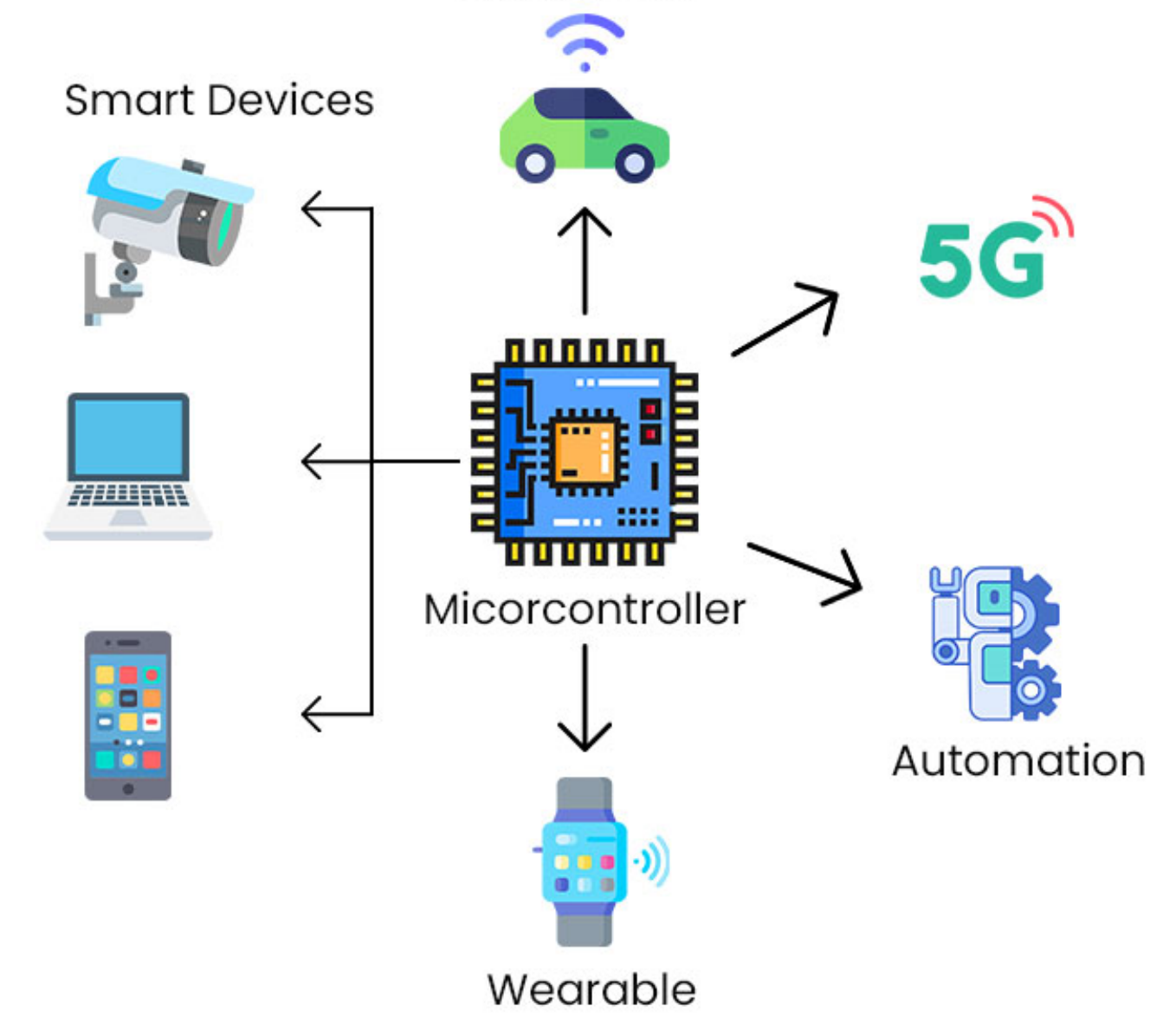
Modern IoT systems demonstrate how semiconductors enable seamless integration between various technologies:
- Smart devices: Home appliances, security cameras, and wearable technology
- Automotive applications: Connected cars with advanced driver assistance systems
- Industrial automation: Manufacturing equipment with remote monitoring capabilities
- 5G connectivity: High-speed wireless communication networks
- Wearable technology: Health monitoring and fitness tracking devices
Note
The IoT revolution is possible because modern semiconductors can operate on extremely low power, allowing battery-powered devices to run for months or years while maintaining network connectivity.
Smart manufacturing and Industry 4.0
Semiconductor technology drives the transformation of manufacturing through automation, data collection, and intelligent control systems. Modern factories use embedded processors to monitor production processes, optimise efficiency, and maintain quality standards.
Key applications in manufacturing:
- Robotic automation: Precise control of assembly line equipment
- Quality monitoring: Real-time inspection and defect detection
- Process optimisation: Data analysis for improved efficiency
- Predictive maintenance: Sensor networks that anticipate equipment failures
Healthcare and medical technology
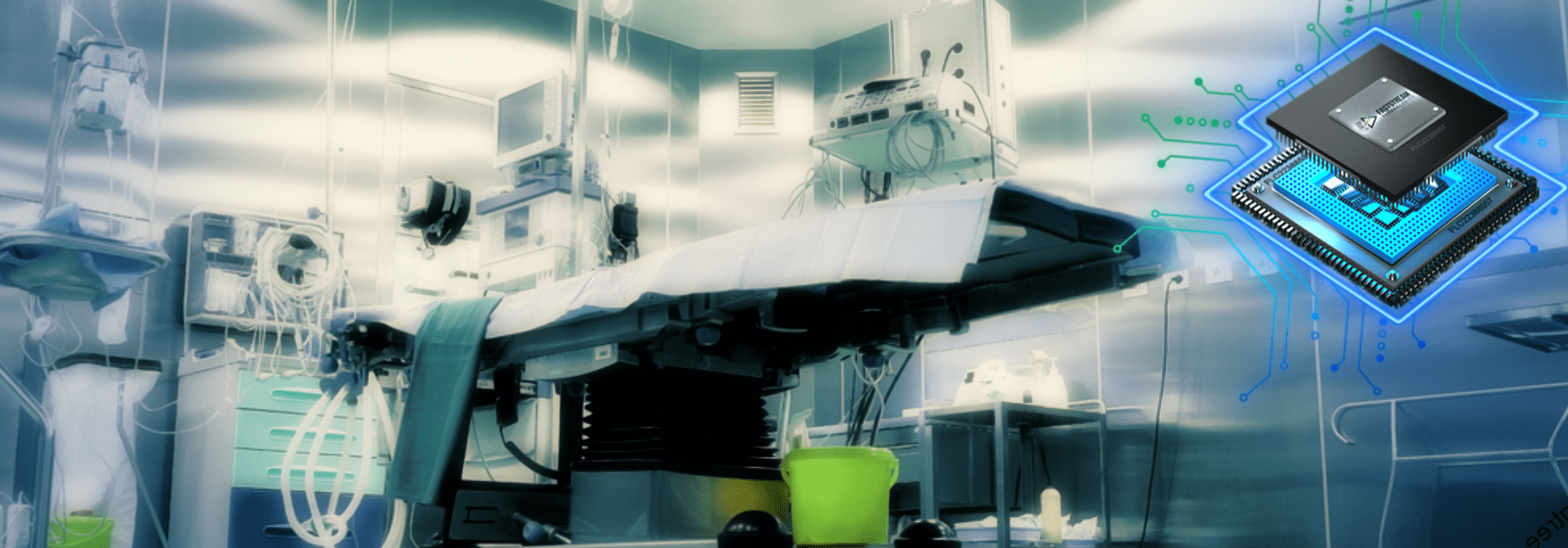
Semiconductor advances enable increasingly sophisticated medical devices and diagnostic equipment. From portable monitoring devices to complex imaging systems, these technologies improve patient care and enable new treatment approaches.
Important
Medical applications demonstrate the precision and reliability requirements that drive semiconductor innovation, as healthcare devices must meet strict safety and performance standards while often operating in challenging environments.
Advanced materials and current trends
Beyond silicon: new semiconductor materials
While silicon remains the dominant semiconductor material, researchers are exploring alternatives that offer superior performance for specific applications:
- Gallium Nitride (GaN): Enables high-frequency operation and improved power efficiency, particularly valuable for power electronics and RF applications
- Silicon Carbide (SiC): Provides better performance at high temperatures and voltages, making it suitable for automotive and industrial power systems
Important
These advanced materials help overcome fundamental limitations of traditional silicon technology, particularly in demanding applications requiring high power, high frequency, or extreme environmental conditions.
Process node evolution and Moore's Law
Moore's Law describes the historical trend of transistor density doubling approximately every two years. This progression has driven continuous improvement in semiconductor performance while reducing costs per function.
Example
Understanding Moore's Law with Numbers
If a chip in 1980 contained 100,000 transistors, Moore's Law predicts:
- 1982: 200,000 transistors (doubled)
- 1984: 400,000 transistors (doubled again)
- 1986: 800,000 transistors
- By 2000 (20 years later): approximately 100 million transistors
This exponential growth pattern has held remarkably well for decades, though it's becoming increasingly challenging to maintain.
Process nodes indicate the manufacturing precision used to create transistors, with smaller nodes generally enabling:
- Higher transistor density: More functionality in the same chip area
- Improved energy efficiency: Less power consumption per operation
- Enhanced performance: Faster switching speeds and reduced delays
However, as transistors approach atomic scales, maintaining this progression becomes increasingly challenging and expensive.
Impact on everyday life
Semiconductor technology influences virtually every aspect of modern life, often in ways that remain invisible to users. These components enable:
- Communication: Smartphones, internet connectivity, and social media platforms
- Transportation: Engine control systems, navigation, and electric vehicle technology
- Entertainment: Digital media, gaming systems, and streaming services
- Commerce: Online shopping, digital payments, and inventory management
- Healthcare: Medical monitoring, diagnostic equipment, and telemedicine
Note
The pervasive nature of semiconductor technology means that improvements in chip performance directly translate to better user experiences across numerous applications - from faster smartphone responses to more efficient electric vehicles.
Challenges and future prospects
Technical challenges
As semiconductor technology continues advancing, several significant challenges emerge:
- Physical limits: Approaching atomic scales makes further miniaturisation increasingly difficult
- Power consumption: Managing heat generation and energy efficiency in high-performance devices
- Manufacturing costs: Advanced production facilities require enormous capital investments
- Supply chain complexity: Global semiconductor manufacturing involves numerous specialised companies
Important
Critical Challenge: The End of Moore's Law
As transistors approach the size of individual atoms, the physical laws of quantum mechanics begin to interfere with normal operation. This represents a fundamental limit that cannot be overcome simply through better engineering - it requires entirely new approaches to computing.
Future opportunities
Despite these challenges, semiconductor technology continues evolving through:
- Quantum computing: Exploring fundamentally different approaches to information processing
- Artificial intelligence acceleration: Specialised chips designed for machine learning applications
- Sustainable technology: Developing energy-efficient solutions for environmental challenges
- Advanced packaging: New approaches to combining multiple chips in single systems
The semiconductor industry remains at the forefront of technological innovation, with researchers and engineers continuously pushing the boundaries of what's possible in electronic systems.
Summary
Key Points to Remember:
-
Semiconductor evolution spans over 70 years - from the 1947 transistor invention to today's AI-enabled chips, representing continuous innovation and improvement
-
Key milestones build upon each other - transistors enabled integrated circuits, which enabled microprocessors, which enabled personal computers and eventually smartphones and IoT devices
-
Modern applications are everywhere - semiconductors power IoT systems, smart manufacturing, healthcare technology, and virtually every electronic device we use daily
-
Advanced materials expand possibilities - GaN and SiC semiconductors enable applications beyond traditional silicon capabilities, particularly for high-power and high-frequency applications
-
Future challenges drive innovation - physical limits and power consumption issues are spurring research into quantum computing, AI acceleration, and sustainable technology solutions