Hardness Testing (Leaving Cert Engineering): Revision Notes
📚Revision Notes
Hardness Testing
What is hardness testing?
Hardness testing measures a material's ability to resist scratching or permanent deformation when a force is applied. This property tells engineers how well a material can withstand surface damage or wear during use.
Note
The fundamental principle involves pressing a hard object (called an indenter) into the surface of the test material using a controlled force. The size of the depression created indicates the material's hardness - softer materials create larger indentations, while harder materials resist deformation and produce smaller marks.
Testing equipment and procedure
A hardness testing machine performs these measurements precisely. The process follows these key steps:
- A small test piece called a widget is positioned on the machine table
- An activating lever applies a predetermined force
- The indenter presses into the material surface at a set load
- The size of the resulting indentation is measured
- This measurement is compared against standardised reference tables
Important
The indenter must always be manufactured from extremely hard materials to ensure accurate and consistent results across different tests.

Vickers method
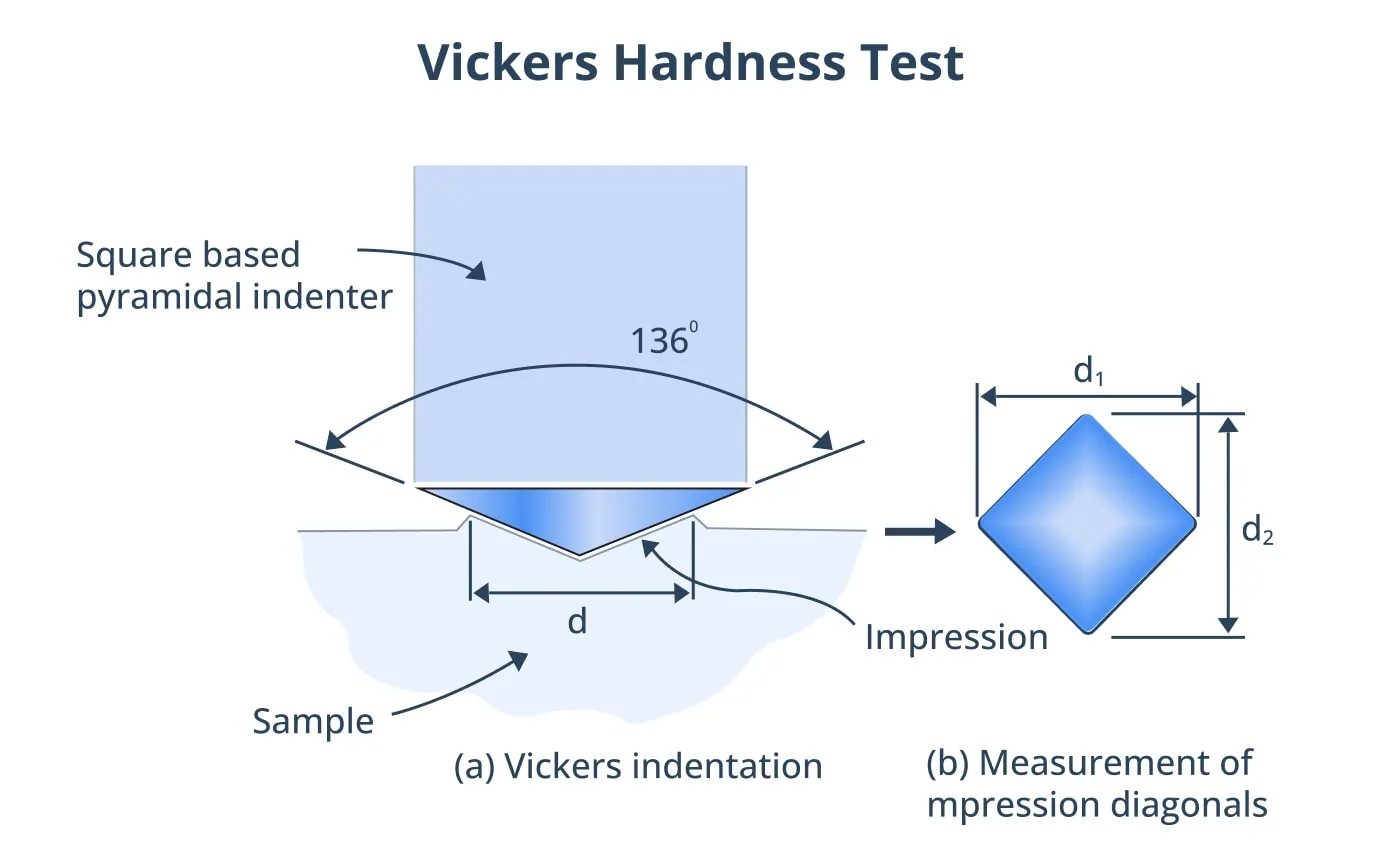
The Vickers method uses a diamond pyramid-shaped indenter to create a square impression on the material surface. This technique offers high precision for measuring hardness across a wide range of materials.
Example
Vickers Testing Procedure:
Step 1: Press the diamond pyramid into the material under controlled load Step 2: Measure the length of both diagonals of the square indentation left behind Step 3: Calculate the average diagonal measurement Step 4: Determine the Vickers Hardness Number (VHN) using the formula
The square shape created by the pyramid indenter makes measurement straightforward and provides consistent results.
Brinell method
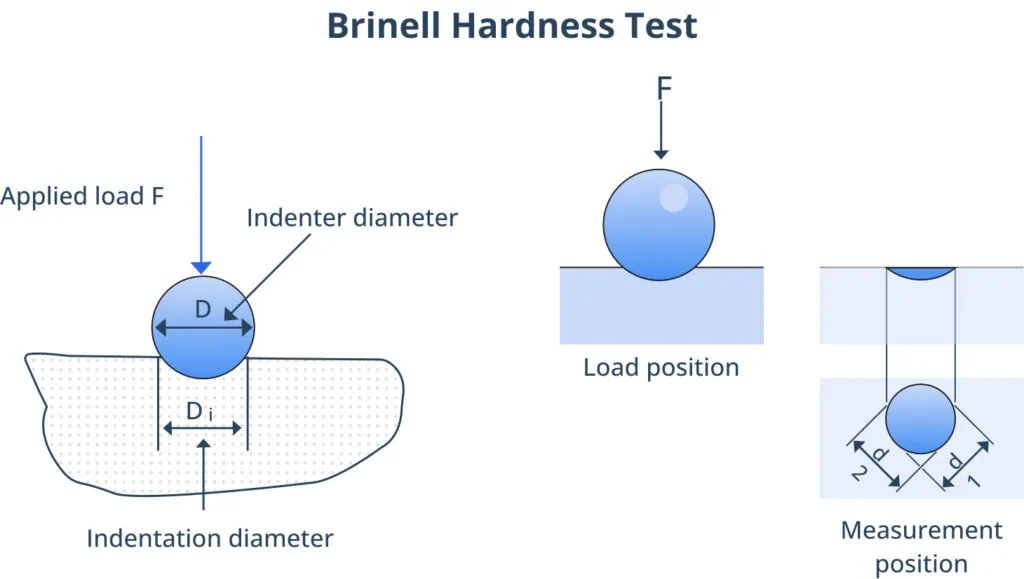
The Brinell method employs a hardened steel sphere as the indenter, which creates a circular depression in the test material. This method works particularly well for softer metals and provides reliable results for many engineering applications.
Example
Brinell Testing Procedure:
Step 1: Press the steel ball into the material surface under specified load Step 2: Measure the diameter of the circular indentation produced Step 3: Calculate the Brinell Hardness Number (BHN) using the formula
The spherical indenter distributes the applied force over a curved area, making this method suitable for materials that might crack under the sharp point of other indenters.
Comparing the methods
Both Vickers and Brinell methods follow the same basic principle - relating the applied load to the size of indentation created. However, they differ in several important ways:
Indenter shape: Vickers uses a diamond pyramid while Brinell uses a steel sphere
Indentation pattern: Vickers creates square impressions, Brinell produces circular ones
Measurement approach: Vickers measures diagonal lengths, Brinell measures diameter
Material suitability: Vickers works across wider hardness ranges, Brinell suits softer materials better
Calculation method: Each uses different formulas reflecting their distinct indentation geometries
Summary
Key Points to Remember:
- Hardness testing measures a material's resistance to permanent surface deformation
- The indenter creates a controlled impression whose size indicates material hardness
- Vickers method uses diamond pyramid creating square indentations measured by diagonals
- Brinell method uses steel sphere creating circular indentations measured by diameter
- Both methods calculate hardness numbers by comparing applied load to indentation size