Impact Testing (Leaving Cert Engineering): Revision Notes
📚Revision Notes
Impact Testing
What is impact testing?
Impact testing is a destructive testing method used to measure the toughness of a material. Toughness refers to a material's ability to absorb energy before breaking when subjected to sudden impact forces.
The test works by measuring how much energy a material can absorb when struck by a heavy object moving at high speed. This tells engineers whether a material will shatter easily under sudden loads or absorb the impact energy safely.
Note
Impact testing is fundamentally different from static strength tests - it specifically measures how materials behave under sudden, dynamic loading conditions that occur in real-world applications like crashes or impacts.
How impact testing works
The basic principle involves using a pendulum system with a heavy striker at the end. The process follows a systematic approach to ensure consistent and reliable results.
Example
Step-by-Step Impact Testing Process:
Step 1: A test specimen is prepared with precise dimensions and a small notch cut into it
Step 2: The specimen is clamped securely in the testing machine
Step 3: The pendulum is raised to a predetermined height to give it potential energy
Step 4: The pendulum is released and swings down, striking the test piece
Step 5: The striker breaks the specimen and continues swinging
Step 6: The distance the pendulum travels past the specimen is measured
The key measurement is how much energy was used to break the specimen. If the material is tough, it absorbs lots of energy and the pendulum doesn't swing very far past the specimen. If the material is brittle, it breaks easily and the pendulum retains most of its energy.
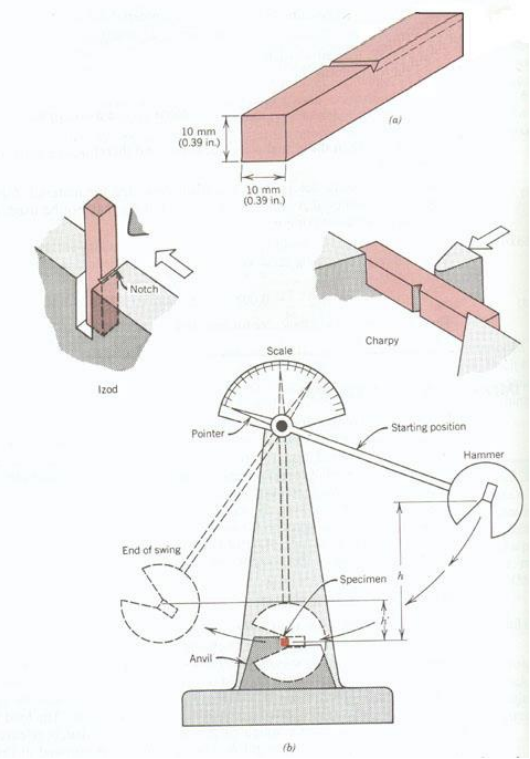
Types of impact test
There are two main types of impact test that work on the same principle but position the specimen differently:
Izod test
- Holds the test specimen vertically in a vice
- The specimen is clamped at one end like a cantilever beam
- The striker hits the free end of the specimen
Charpy test
- Supports the test specimen horizontally between two supports
- The specimen rests on two anvils with a gap between them
- The striker hits the specimen in the middle of the gap
Both tests essentially measure the same property - material toughness - just using different specimen orientations.
Important
The choice between Izod and Charpy tests often depends on the material type and industry standards. Both methods provide equivalent toughness measurements when properly calibrated.
What the results tell us
Impact testing reveals several important material properties that are crucial for engineering applications.
Toughness - The main measurement showing how much energy the material absorbed before breaking. Higher values indicate tougher materials.
Note
Fracture Behaviour Analysis
The way the specimen breaks provides additional information beyond just the energy measurement:
- Brittle fracture - The specimen snaps suddenly with a clean break
- Ductile fracture - The specimen bends and tears, showing plastic deformation before breaking
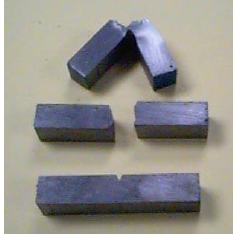
Engineers examine both the energy absorbed and the appearance of the fractured surfaces to understand how the material will behave in real applications.
Specimen preparation
Test specimens must be prepared to exact standards to ensure reliable and comparable results:
- Rectangular cross-section (typically 10mm × 10mm)
- Precise length as specified by testing standards
- A small notch cut into the specimen to create a stress concentration
- Smooth, clean surfaces free from scratches or defects
Important
The notch is critical because it ensures the specimen breaks at a predictable location and creates consistent test conditions. Without the notch, specimens might break randomly, making results unreliable.
Exam tips
Understanding impact testing requires focusing on both the theoretical principles and practical applications. Here are key points that frequently appear in examinations:
- Remember that impact testing measures toughness, not strength
- Know the difference between Izod (vertical) and Charpy (horizontal) test setups
- Understand that tough materials absorb more energy before breaking
- Be able to explain why a notch is cut into the test specimen
- Recognise that both the energy value and fracture appearance provide useful information
Summary
Key Points to Remember:
- Impact testing measures material toughness by striking specimens with a pendulum
- Tough materials absorb lots of energy before breaking, brittle materials break with little energy absorption
- Izod tests hold specimens vertically, Charpy tests support them horizontally
- The notch in the specimen ensures consistent breaking location and test conditions
- Results show both energy absorbed and fracture behaviour (brittle vs ductile)