Clutch (Leaving Cert Engineering): Revision Notes
📚Revision Notes
Clutch
What is a clutch?
A clutch is a rotating mechanical device that connects or disconnects two shafts when needed. It acts as a coupling mechanism that allows power to be transmitted from one shaft to another, or completely disconnected when required.
The clutch works by linking a driving member (the power source) to a driven member (the output shaft). When the clutch is engaged, both members rotate at the same speed and power is transmitted. When disengaged, the members can rotate independently at different speeds, effectively cutting off power transmission.
Note
The ability to control power transmission between rotating shafts is what makes clutches essential in mechanical systems where you need to start, stop, or change the speed of driven components independently of the driving source.
Purpose and applications
Clutches are essential in systems with two rotating shafts where you need control over power transmission. The driving member typically connects to a motor or power unit, while the driven member provides output power for the actual work.
Example
Practical Example: Power Drill Operation
In a power drill:
- Driving member: Motor shaft (connected to the electric motor)
- Driven member: Chuck shaft (holds the drill bit)
- Operation: The clutch allows you to start the motor without immediately spinning the drill bit, then engage when ready to drill
This prevents sudden jerking motions and gives you better control over when drilling begins.
Clutch in automotive systems
In motor vehicles, the clutch plays a crucial role in the transmission system. It sits between the engine and the manual transmission, allowing the driver to disconnect the engine from the gearbox when changing gears or coming to a stop.
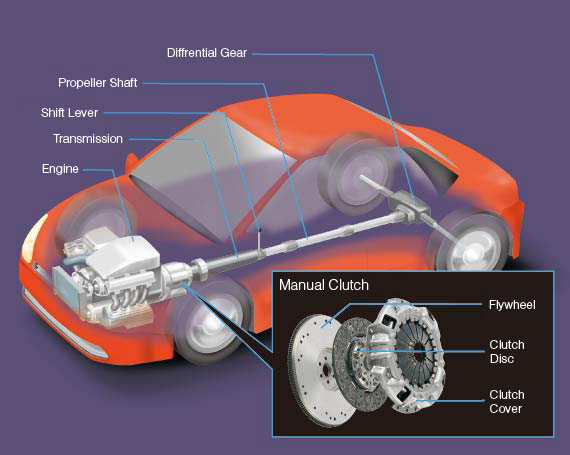
The automotive clutch system consists of several key components working together. When you press the clutch pedal, it operates the clutch mechanism to disengage the engine from the transmission. This prevents the engine from stalling when the vehicle stops and allows smooth gear changes.
Note
Without a clutch system, manual transmission vehicles would stall every time they came to a complete stop, as the engine would be forced to stop rotating along with the wheels.
Main components of a clutch system
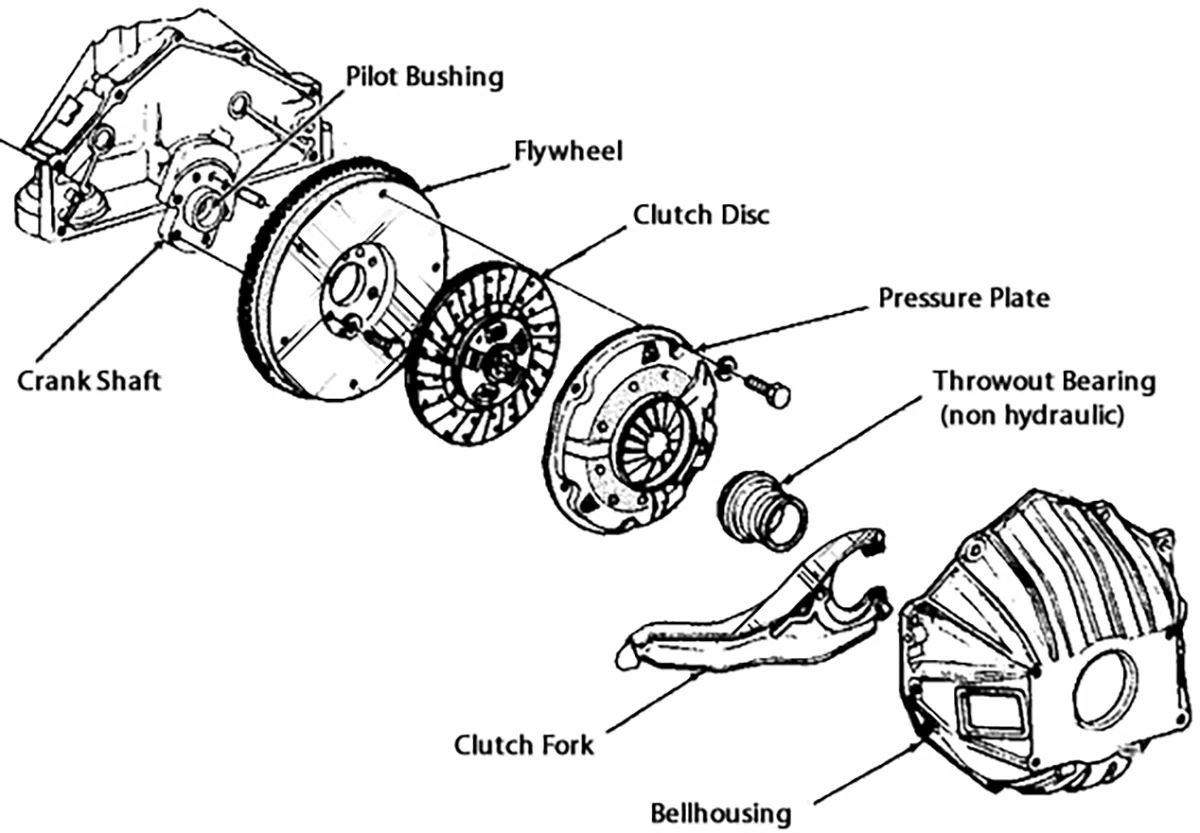
Modern automotive clutches contain multiple precision-engineered components that work together to provide smooth engagement and disengagement.
Important
Each component in a clutch system must be precisely manufactured and properly maintained. Even small wear or misalignment in one component can affect the entire system's performance and lead to clutch failure.
The main components include:
- Flywheel: A heavy disc attached to the engine's crankshaft that stores rotational energy
- Clutch disc: The friction plate that transfers power between the flywheel and input shaft
- Clutch cover: The housing that contains the pressure plate and diaphragm spring
- Diaphragm spring: Provides the clamping force to engage the clutch disc
- Pressure ring: Applies pressure to sandwich the clutch disc against the flywheel
- Input shaft: Carries power from the clutch to the transmission
- Throw-out bearing: Allows the release fork to operate the diaphragm spring
- Release fork: The lever that operates the clutch when the pedal is pressed
How clutches operate
The clutch operates on the principle of friction between surfaces. When engaged, the diaphragm spring forces the pressure ring to clamp the clutch disc against the flywheel. This friction connection allows power to transfer from the engine to the transmission.
When you press the clutch pedal, the release fork pushes the throw-out bearing against the diaphragm spring. This releases the clamping pressure, allowing the clutch disc to separate from the flywheel and disconnecting the engine from the transmission.
The engagement and disengagement must be smooth to prevent damage and ensure comfortable operation. The diaphragm spring design allows for progressive engagement as you release the clutch pedal.
Note
The friction principle that makes clutches work is the same as applying brakes - controlled friction between surfaces allows for precise control of rotational motion and power transfer.
Remember!
Summary
Key Points to Remember:
- A clutch is a rotating coupling device that connects or disconnects two shafts for power transmission control
- The driving member (engine) connects to the driven member (transmission) through friction
- Engaged clutches transmit power with both shafts at the same speed, while disengaged clutches allow independent rotation
- Key components include the flywheel, clutch disc, diaphragm spring, and pressure ring working together
- Automotive clutches use friction between the clutch disc and flywheel to transfer engine power to the transmission