Universal Joint (Leaving Cert Engineering): Revision Notes
📚Revision Notes
Universal Joint
What is a universal joint?
A universal joint is a mechanical connection that allows a rigid rod to bend and flex in multiple directions while still transmitting rotary motion. This clever device solves the problem of how to transfer power between two shafts that are not perfectly aligned.
The joint enables the rod to change direction during operation, making it essential for applications where the driving and driven components need to move relative to each other.
Note
The universal joint is particularly valuable in situations where rigid connections would fail due to misalignment or movement between connected components.
Structure and components
A universal joint has a specific design that gives it its flexibility. The key structural elements work together to create a robust yet flexible connection:
- Two hinges positioned close together
- Cross shaft that connects the hinges
- 90° orientation between the two hinges
- This arrangement creates two perpendicular axes of rotation
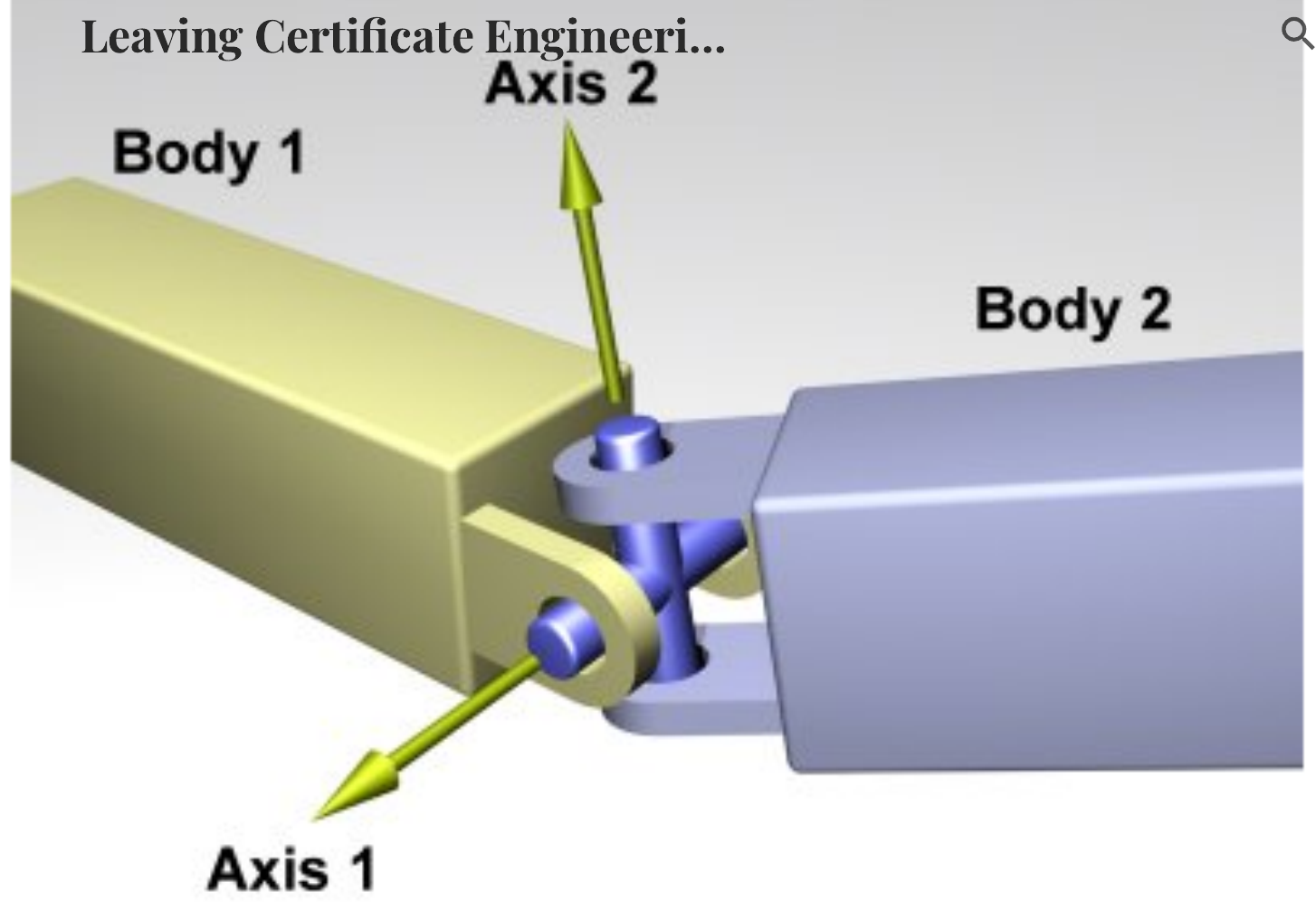
Note
The diagram shows how Body 1 connects to Body 2 through the universal joint mechanism. Notice how Axis 1 and Axis 2 are positioned at right angles to each other, which is the key to the joint's ability to transmit motion while allowing angular movement.
How it works
The universal joint operates on a simple but effective principle that demonstrates elegant mechanical engineering:
- Rotary motion enters through one shaft
- The cross shaft transfers this motion between the two hinges
- Each hinge can rotate independently around its axis
- This allows the overall assembly to bend in any direction
- Power transmission continues even when the shafts are at an angle
Important
The 90° hinge arrangement ensures that as one hinge reaches its limit of movement, the other hinge can continue the motion transfer. This perpendicular orientation is critical to the joint's functionality.
Applications
Universal joints are commonly found in various mechanical systems where flexible power transmission is essential:
- Agricultural machinery - connecting tractors to implements
- Round balers and other farm equipment
- Vehicle drive systems
- Industrial machinery where flexible power transmission is needed
Note
The most familiar example is the connection between a tractor and trailing equipment like balers. This allows the tractor to turn corners and navigate uneven ground while continuously powering the attached machine.
Key advantages
The universal joint design offers several important benefits that make it indispensable in mechanical applications:
- Continuous power transmission even during direction changes
- Flexibility in multiple directions
- Robust construction suitable for heavy-duty applications
- Maintains rotational speed (with some variation depending on angle)
Summary
Key Points to Remember:
- A universal joint connects two shafts and allows bending while transmitting rotary motion
- It consists of two hinges at 90° connected by a cross shaft
- The joint has two perpendicular axes of rotation
- Common applications include tractor-to-implement connections in agriculture
- The design allows continuous power transfer even when the connected shafts change their relative positions