Resistance Seam Welding (Leaving Cert Engineering): Revision Notes
📚Revision Notes
Resistance Seam Welding
What is resistance welding?
Resistance welding is a metal joining process that creates heat through electrical resistance. When electric current flows through materials that resist the flow of electricity, heat is generated at the point of contact. This heat becomes intense enough to melt and fuse the metal pieces together.
The process differs significantly from arc welding methods because it does not require external heat sources, fluxes, or filler materials. Instead, the heat comes entirely from the electrical resistance encountered as current passes through the workpieces.
Note
The key advantage of resistance welding is its simplicity - no additional materials like flux or filler metals are needed, making it faster and more cost-effective than many traditional welding methods.
There are two main types of resistance welding widely used in industry:
- Spot welding - creates individual weld points
- Seam welding - produces continuous weld lines
Resistance seam welding process
Resistance seam welding extends the principles of spot welding to create continuous joints rather than individual spot welds.
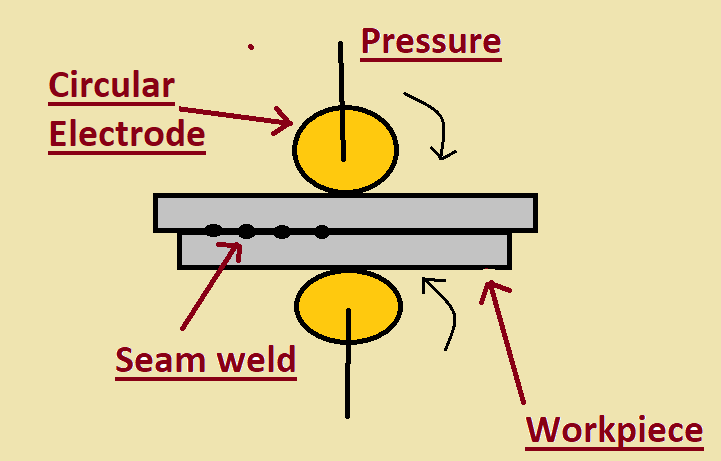
The fundamental difference lies in the electrode design. Instead of straight copper electrodes, seam welding employs wheel electrodes that can rotate as they move along the workpiece.
How seam welding works
The seam welding process creates continuous welds through a series of overlapping spot welds:
Example
Process Demonstration: Creating a Continuous Seam
Step 1: Wheel electrodes replace the stationary copper electrodes used in spot welding
Step 2: These wheels apply pressing force while rotating along the joint line
Step 3: The welding machine delivers pulsing current rather than continuous current
Step 4: Each pulse creates an individual spot weld
Step 5: As the wheels progress, successive pulses create overlapping spots
Step 6: The overlapping pattern produces what appears to be a continuous seam
Key components and operation
The seam welding setup includes several critical elements:
- Wheel electrodes - copper wheels that conduct current and provide pressure
- Pressing force - applied downward to maintain contact and create proper fusion
- Rotational movement - wheels move along the joint path
- Pulsed current control - times electrical pulses to create overlapping welds
- Work positioning - material guided through the electrode wheels
The pulsing current system allows the machine to create discrete weld nuggets that overlap sufficiently to form a continuous, leak-tight seam.
Applications of seam welding
Seam welding proves particularly valuable for manufacturing applications requiring continuous, sealed joints:
- Steel containers - tins, cans, and drums for various storage needs
- Pressure vessels - where leak-tight seams are essential
- Automotive fuel tanks - requiring both strength and sealing
- HVAC ductwork - for air-tight joint integrity
- Food packaging - where hygiene and sealing are critical
Note
The process can handle various materials but works best with thin to medium thickness metals that have good electrical conductivity. Thicker materials may require more sophisticated power control systems.
Power control considerations
All resistance welding equipment requires careful power control to achieve consistent results. Standard mains electricity (230V AC) poses challenges for welding applications:
- High voltage creates safety hazards during operation
- Low current levels insufficient for generating adequate heat
- Variable voltage affects weld quality consistency
Important
Safety and Performance Requirements
To address these critical issues, resistance welding machines use step-down transformers and rectifiers to:
- Transform high voltage to safer, lower voltage levels
- Convert AC to DC current for more stable welding conditions
- Increase current capacity to generate necessary heat
- Provide precise control over welding parameters
This power conditioning ensures both operator safety and reliable weld quality across different material thicknesses.
Summary
Key Points to Remember:
- Resistance welding generates heat through electrical resistance rather than external heat sources
- Seam welding uses rotating wheel electrodes instead of fixed electrodes to create continuous joints
- Pulsing current creates overlapping spot welds that form continuous seams
- Wheel electrodes provide both electrical conduction and mechanical pressure while moving
- Applications focus on containers, tanks, and sealed joints where continuous welds are essential