The Impact of Earthquakes (Leaving Cert Geography): Revision Notes
📚Revision Notes
The Impact of Earthquakes
Earthquakes can strike suddenly and violently without warning, causing devastating effects on human communities and the environment. Understanding what makes earthquakes destructive and how we can reduce their impact is crucial for protecting lives and property.
Factors that determine earthquake destructiveness
Several key factors influence how much damage an earthquake will cause when it strikes:
Physical factors
Intensity refers to the amount of energy an earthquake releases. Higher intensity earthquakes tend to be more destructive, with the most devastating earthquakes typically occurring at subduction zones where tectonic plates collide.
Important
Intensity: The amount of energy released by an earthquake, which directly affects its destructive potential.
- Depth plays a crucial role in determining damage levels.
- Shallow focus earthquakes prove more destructive than deep focus earthquakes when all other factors remain equal, as the seismic energy has less distance to travel before reaching the surface.
- Location significantly affects the scale of destruction.
- Urban areas face greater risks due to their dense populations and tall buildings, putting more people in harm's way compared to rural regions.
- Time of day influences casualty numbers.
- Earthquakes striking at night often trap more people in their homes, leading to higher death tolls as people cannot evacuate quickly.
- Local geology determines how seismic waves travel through the ground.
- Areas with unconsolidated surface materials (loose, sandy, or soggy soils) experience greater damage because these materials can liquefy during the earthquake.
Important
Liquefaction: A process where saturated or partially saturated soil loses strength and behaves like a liquid when placed under stress by an earthquake.
Secondary effects
Earthquakes can trigger additional hazards that often cause more damage than the original tremor:
- Landslides and avalanches: The 2015 Nepal earthquake (magnitude 7.8) triggered major landslides that blocked rivers and caused flooding. An avalanche on Mount Everest killed 19 people.
- Tsunamis: The 2004 Indian Ocean earthquake (magnitude 9.3) off Sumatra didn't directly cause widespread damage, but the resulting tsunami devastated coastal communities across multiple countries.
Note
Secondary effects like tsunamis and landslides can be far more destructive than the original earthquake, often affecting areas hundreds of kilometres away from the epicentre.
Human factors
Architecture and building standards greatly influence survival rates. Developed countries like the USA typically have higher quality construction materials and stricter building regulations compared to developing countries like Nepal. This means buildings are less likely to collapse during earthquakes in wealthier nations.
Technological advancement affects response capabilities. Developed countries maintain sophisticated emergency services, rescue equipment, and communication systems. They also stockpile emergency supplies and run public education programmes teaching earthquake response procedures.
Effects of earthquakes
Damage to infrastructure
Earthquake vibrations cause buildings, bridges, and other structures to sway and crumble. Falling debris becomes extremely dangerous and accounts for many earthquake deaths. Rescue workers must carefully search through rubble to find survivors trapped underneath collapsed structures.
Example
Case Example: 2010 Haiti Earthquake
The 2010 Haiti earthquake (magnitude 7.0) caused widespread infrastructure damage in the capital Port-au-Prince. Poor building construction meant most structures couldn't withstand the shaking. The airport became unusable due to control tower damage. Approximately 160,000 people died and 300,000 were injured, mostly from falling debris. About 19 million cubic tonnes of rubble had to be removed from the city.
The 2010 Christchurch, New Zealand earthquake severely damaged the city centre, toppling two bell towers on the Catholic Cathedral and destroying many historic buildings.
Tsunami
When underwater earthquakes occur, they can displace massive amounts of water, creating devastating tsunami waves. As tectonic plates move suddenly, they can force the overlying plate upwards, creating an excess hump of water on the ocean surface. This water then radiates outwards in all directions at speeds reaching 800 km/h.
Most tsunamis result from uplifts of less than one metre, but powerful earthquakes can create much larger waves. For boats in deep ocean waters, tsunamis remain barely noticeable. However, as waves approach coastlines, the shallow seabed causes them to slow down and increase in height, often quadrupling in size before hitting the shore.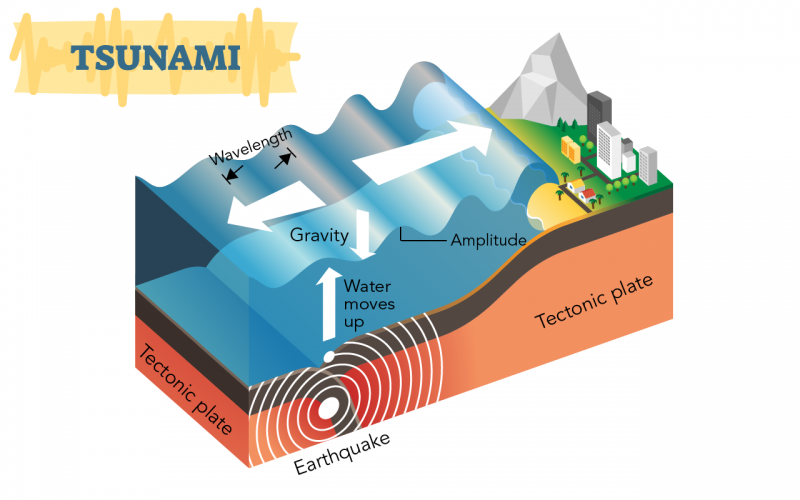
Example
Case Example: 2004 Indonesian Tsunami
The 2004 Indonesian tsunami was triggered by a magnitude 9.0 earthquake beneath the Indian Ocean. Water displacement from the uplifting Burma Plate created waves that travelled across the Indian Ocean, hitting 14 countries at heights between 24-30 metres. An estimated 220,000 people died, mostly from drowning.
Liquefaction
During intense ground shaking, soil can become saturated with groundwater and lose its ability to support structures, behaving like quicksand. This process causes buildings to collapse as their foundations sink into the liquified ground.
Liquefaction caused extensive damage in Christchurch, New Zealand (2010) and contributed significantly to the destruction in Kobe, Japan (1995). In Kobe, entire apartment blocks collapsed as their foundations sank, while broken gas and sewage pipes led to fires across the city, contributing to 5,000 deaths.
Reducing earthquake effects
While earthquakes cannot be prevented, proper planning and preparation can dramatically reduce casualties and damage.
Early warning systems
Modern seismograph networks can detect earthquake primary waves and alert communities before the more destructive secondary and surface waves arrive. The warning time depends on distance from the epicentre - sometimes only seconds, but occasionally up to a minute of advance notice.
Even brief warnings allow people to take protective action, trains to slow down, and factory assembly lines to stop safely.
Example
Case Example: Japan's Early Warning System
Japan operates the world's most advanced earthquake warning system, currently detecting 85% of all earthquakes in the region. Since the 2011 earthquake and tsunami, the system has been upgraded further. When strong tremors are detected, messages immediately go out to televisions, radios, and mobile phones, followed by alarm chimes. People can now download early warning apps to their smartphones.
Earthquake-proof infrastructure
In earthquake-prone regions like California and Japan, strict building regulations have significantly reduced structural damage. Key earthquake-resistant features include:
- Flexible design: Buildings are constructed to be slightly elastic rather than rigid, allowing them to sway with seismic waves without breaking apart
- Strong foundations: Structures are built on solid rock rather than soil to avoid liquefaction damage
- Mechanical dampers: These act as shock absorbers, reducing vibration energy
- Steel reinforcement: Building frames are reinforced with steel to prevent collapse
- Cross-bracing: This minimises the effect of shearing forces during earthquakes
Bridges receive similar treatment, being designed to sway gently without breaking during seismic events.
Note
Modern earthquake-resistant construction doesn't aim to prevent all damage, but rather to ensure buildings don't collapse catastrophically, giving occupants time to evacuate safely.
Efficient urban planning
Smart city planning can prevent the "domino effect" where one collapsed building causes others to fall. Buildings are spaced appropriately to avoid this chain reaction.
Essential services like hospitals, schools, and fire stations are located in areas least likely to experience severe tremors, ensuring emergency services remain operational and children stay safe.
Emergency preparedness
Effective earthquake preparedness includes:
- Installing earthquake drills to familiarise people with emergency procedures
- Placing utility pipelines (water, gas, electricity) deep underground with automatic shut-off valves
- Constructing power stations away from fault lines
- Retrofitting older buildings with steel-reinforced concrete frames
- Maintaining emergency supplies and communication systems
Important
The most effective earthquake preparedness combines multiple strategies: early warning systems, resistant infrastructure, smart urban planning, and community education programmes working together.
Case studies
Haiti earthquake (2010)
Background: Haiti, located on the Caribbean island of Hispaniola, ranked as one of the world's poorest countries in 2010. Over 70% of its 10 million people lived below the poverty line, and it ranked 149th out of 182 countries on the UN Human Development Index. The country sits on a transform plate boundary where Caribbean and North American plates slide past each other, but had very few building regulations to protect against earthquakes.
Example
The 2010 Haiti Earthquake Event
On 12 January 2010 at 16:53 local time, a magnitude 7.0 earthquake struck Haiti. The epicentre lay approximately 25 km west of Port-au-Prince, the capital city. As a shallow focus earthquake with a depth of just 13 km, the energy release occurred very close to the surface, making it highly destructive. By 24 January, at least 52 aftershocks measuring 4.5 or greater had been recorded.
Short-term effects:
- Over 3.5 million people affected, with 230,000 deaths and 300,000 injuries
- Approximately 1.5 million people (20% of the population) became homeless, living in temporary camps
- 250,000 homes destroyed or severely damaged
- Water shortages due to contaminated river supplies
- Rescue efforts hampered by damaged airports, seaports, and communication networks
- Hospital overcrowding as medical facilities were damaged
- Prison inmates escaped, leading to increased crime and violence
Long-term effects:
- Contaminated drinking water caused a cholera outbreak killing nearly 6,000 people
- Many injured children and disabled people were left without adequate care
- Unemployment rose to 20% as 30,000 commercial buildings were damaged, devastating industries like textiles
- 60% of government buildings were damaged, severely affecting public administration
- Tourism industry collapsed due to damaged hotels and transport infrastructure
- Important landmarks including the Presidential Palace and Port-au-Prince Cathedral were destroyed or severely damaged
Japanese earthquake and tsunami (2011)
Background: Japan consists of a chain of volcanic islands in the Pacific Ocean and ranked as the world's 12th most developed country in 2011 according to the UN Human Development Index. Due to its location on the Pacific Ring of Fire, Japan has extensive experience with earthquakes and tsunamis, with its most devastating previous earthquake occurring in 1923, killing 140,000 people.
Example
The 2011 Japanese Earthquake and Tsunami Event
On 11 March 2011, a magnitude 9.0 earthquake lasting approximately six minutes struck 72 km off Japan's coast. This megathrust earthquake occurred where the Pacific Plate converges with the Eurasian Plate. The lighter continental Eurasian Plate rose over the denser Pacific Plate, causing the ocean floor to rise more than 10 metres and displacing billions of tonnes of seawater.
This created a powerful tsunami travelling at speeds up to 500 km/h. As waves reached shallow coastal waters, they compressed and rose to heights of 40 metres. The tsunami travelled up to 10 km inland, flooding approximately 561 km² and causing massive destruction.
Short-term effects:
- Approximately 16,000 deaths, with over 90% from drowning
- 25,000 people injured, many caught by surprise despite believing they were on safe high ground
- Contaminated water supplies affected 1.5 million people
- Nearly 4.4 million households lost electrical power
Long-term effects:
- 2,500 people remain missing
- Over 125,000 buildings completely collapsed, leaving 250,000 people homeless
- Transport and communication networks were destroyed but rebuilt rapidly
- The tsunami triggered explosions at three reactors in the Fukushima Daiichi Nuclear Power Plant Complex when cooling systems failed due to power loss
- Residents within 20 km of the nuclear plant were evacuated due to massive radiation release
- Many areas remain uninhabitable, and agricultural products from the region face ongoing consumer rejection
- The World Bank estimated economic costs at US$235 billion, making it the costliest natural disaster in history
Summary
Key Points to Remember:
-
Multiple factors determine earthquake destructiveness - intensity, depth, location, geology, and human factors like building standards all play crucial roles
-
Secondary effects often cause more damage - tsunamis, liquefaction, and landslides triggered by earthquakes can be more devastating than the original tremor
-
Proper planning saves lives - earthquake-resistant building design, early warning systems, and emergency preparedness dramatically reduce casualties and damage
-
Development level affects impact - developed countries like Japan suffer less damage due to better building standards, technology, and emergency response capabilities compared to developing countries like Haiti
-
Prevention is better than response - while earthquakes cannot be stopped, their effects can be minimised through smart urban planning, strict building codes, and public education programmes