Flora (Leaving Cert Geography): Revision Notes
📚Revision Notes
Flora
Introduction to desert vegetation
Plant life in hot deserts face enormous challenges that make survival extremely difficult. The combination of water scarcity, intense evaporation rates, poor soil quality, and harsh environmental conditions means that vegetation coverage remains very limited across desert regions.
Despite these hostile conditions, certain plant species have developed survival strategies. These adaptations allow them to cope with extreme temperatures and prolonged drought periods. To reduce competition for the few available resources, desert plants typically grow far apart from one another, creating the characteristic sparse appearance of desert landscapes.
Note
The spacing between desert plants isn't random - it's an evolutionary strategy that ensures each plant has access to the maximum amount of scarce resources in its immediate area.
Plant adaptation strategies
Desert flora has evolved five main types of adaptations to survive in this challenging environment:
- Root systems - designed for efficient water collection
- Ephemerals - plants with adapted life cycles
- Succulents - specialised water storage systems
- Fruit growth - strategies for seed dispersal
- Defence systems - protection from herbivores and environmental stress
Root systems
Important
Desert plants use two main root strategies - shallow spreading roots for surface water collection or deep taproots for accessing groundwater.
Water scarcity forces desert plants to develop highly efficient root networks. These systems fall into two distinct categories that represent completely different approaches to water acquisition.
Shallow root networks
Many desert species develop extensive shallow root systems that spread horizontally just beneath the surface. These roots are perfectly positioned to:
- Quickly absorb rainwater before it evaporates
- Collect moisture from dew formation during cooler night periods
- Avoid penetrating deeper soil layers where mineral deposits can create barriers
Example
Plant Example: Surface Water Collection
The creosote bush and many cacti use shallow root networks effectively. The creosote bush's roots can extend up to 10 metres horizontally while staying within the top 30cm of soil. This allows them to capture water from even the lightest rainfall across a wide area.
Deep taproot systems
Other species develop substantial taproots that penetrate deep into the soil to access groundwater reserves. The acacia tree provides an excellent example, with taproots extending 6-7 metres below ground level to reach reliable water sources.
Ephemerals
Important
Ephemerals are plants with very short life cycles that have adapted to take advantage of brief wet periods in the desert.
These remarkable plants have developed a "wait and sprint" survival strategy. Their seeds possess waxy protective coatings that help retain moisture over extended dormant periods, sometimes lasting several years underground.
When rainfall finally arrives, ephemerals spring into action with extraordinary speed:
- Seeds germinate rapidly
- Plants grow quickly
- Flowers bloom and produce new seeds
- The cycle completes before drought returns
Example
Plant Example: Ephemeral Strategy
The mouse-ear cress demonstrates this strategy perfectly, creating spectacular blooms across desert landscapes during rare wet periods. These plants can complete their entire life cycle - from germination to seed production - in just 6-8 weeks when conditions are favourable.
Succulents
Important
Succulents are plants that store water in thick, fleshy tissues and have waxy surfaces to prevent moisture loss.
Water storage represents another crucial survival adaptation. Succulents have developed specialised tissues that function like natural water tanks, allowing them to survive extended dry periods.
These plants combine water storage with water conservation techniques:
- Thick, fleshy stems or leaves store substantial water reserves
- Waxy outer surfaces minimise evaporation
- Many species store water in underground bulbs
- The giant saguaro exemplifies this adaptation strategy
Note
The giant saguaro cactus can store up to 200 gallons of water in its tissues, allowing it to survive for two years without rainfall.
Cactus adaptations
The cactus represents perhaps the most recognisable example of desert plant adaptation, combining multiple survival strategies into a single, highly efficient organism.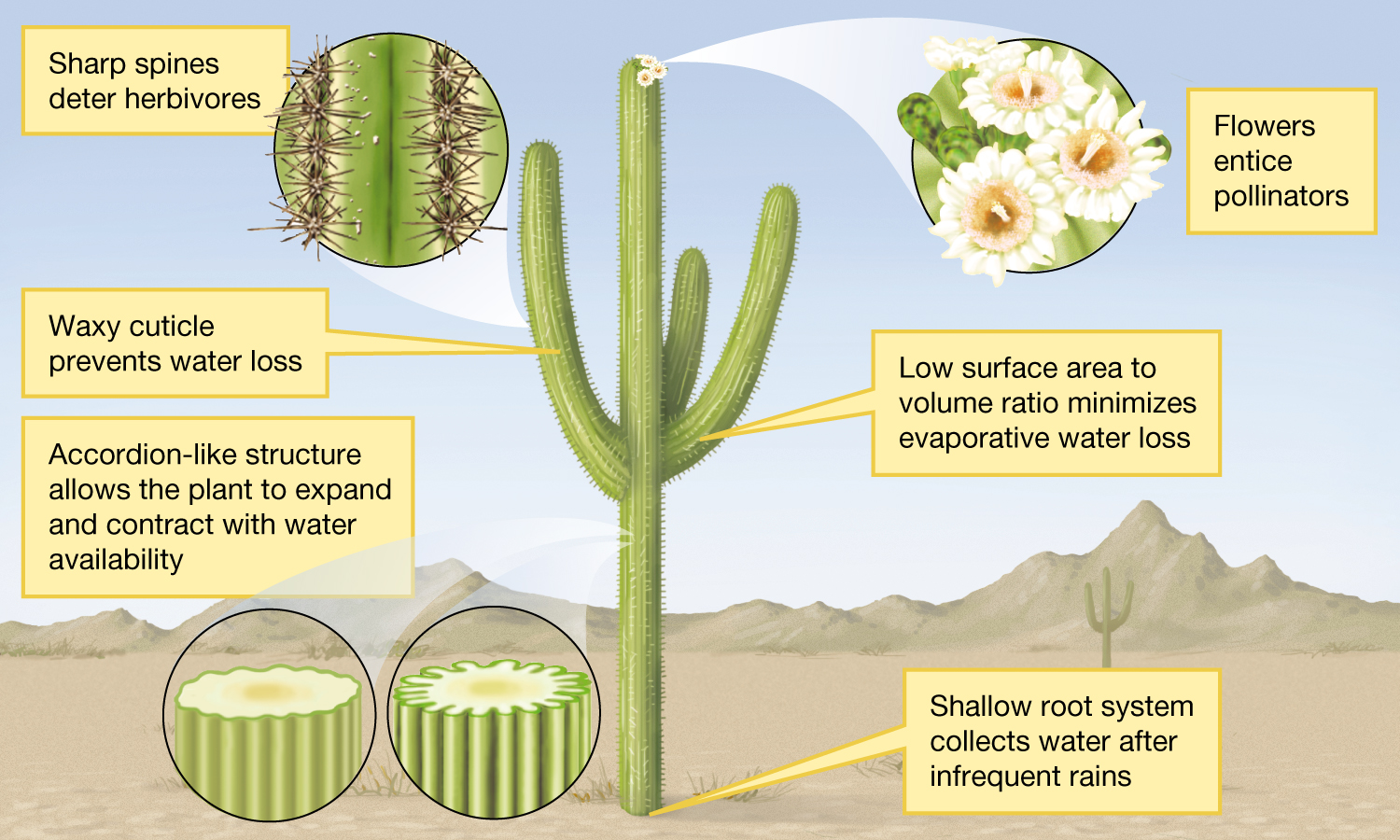
Water collection and storage
- Vertical grooves along the stem allow expansion when water becomes available
- These same grooves channel rainwater directly to the root system
- Spongy interior tissue stores large quantities of water for drought periods
- Shallow radial roots spread widely to maximise water collection from surface moisture and dew
Protection mechanisms
- Sharp thorns deter animals from accessing stored water
- These narrow structures also reduce moisture loss compared to broad leaves
- Waxy skin prevents water evaporation and protects against sun damage
Example
Complete Adaptation: The Barrel Cactus
The barrel cactus combines all these features: its accordion-like ridges expand to store up to 94% water by weight, sharp spines provide protection while creating shade, and its shallow root system extends three times wider than the plant is tall to maximise water collection.
Fruit growth and seed dispersal
Many desert plants have developed partnerships with wildlife for seed distribution. Plants produce fruits that attract birds and other animals. After consumption, seeds pass through the animal's digestive system unharmed and get dispersed across the desert in droppings.
This mutualistic relationship helps plants:
- Spread to new areas with potentially better growing conditions
- Reduce competition between parent and offspring plants
- Increase species survival rates
Note
Some desert seeds actually require passage through an animal's digestive system to break down their hard outer coating before they can germinate successfully.
Defence systems
Desert plants must protect themselves not only from harsh environmental conditions but also from animals seeking food and water. They have evolved both chemical and behavioural defences.
Chemical defences
Many shrubs produce poisonous compounds or develop foul-tasting bark and leaves. The oleander plant uses this strategy to discourage herbivores from consuming its tissues.
Timing adaptations
Some plants avoid daytime heat stress by shifting their active periods:
- Flowers remain closed during intense daytime heat
- Blooming occurs at night when temperatures drop
- This prevents excessive water loss through transpiration
- Night blooming also conserves the plant's stored water reserves
Summary
Key Points to Remember:
- Desert plants survive through five main adaptations: root systems, ephemeral life cycles, water storage, fruit production, and defence mechanisms
- Root strategies divide into shallow spreading networks for surface water collection versus deep taproots for groundwater access
- Ephemerals use a "wait and sprint" approach - lying dormant until rainfall triggers rapid growth and reproduction cycles
- Succulents like cacti combine multiple survival features including water storage, waxy surfaces, protective spines, and efficient water collection systems
- Many desert plants have evolved partnerships with animals for seed dispersal and use chemical or timing defences against herbivores