Hot Desert Climate (Leaving Cert Geography): Revision Notes
📚Revision Notes
Hot Desert Climate
What makes hot desert climates unique?
Hot deserts are characterised by extremely dry conditions, with annual rainfall typically ranging between 0 and 250 millimetres. This limited precipitation is highly unpredictable and usually arrives in the form of short, intense downpours known as torrential rainfall.
When these brief but heavy rains do occur, they face a challenging environment. The intense desert sunlight causes rapid evaporation of any surface water, whilst the compacted soil structure prevents water from soaking deep into the ground through percolation. Instead, these sudden downpours often contribute to soil erosion by washing away valuable topsoil.
Note
During cooler night-time hours, when temperatures drop significantly, small amounts of fog and dew may form as moisture in the air condenses. This creates a thin layer of water on the ground surface, particularly in coastal desert areas like the Namib Desert in Africa, where moisture from cool ocean currents can reach inland areas and create fog.
Why deserts are dry
Desert aridity results from four main geographical processes that work individually or in combination to create these extremely dry conditions.
The rain-shadow effect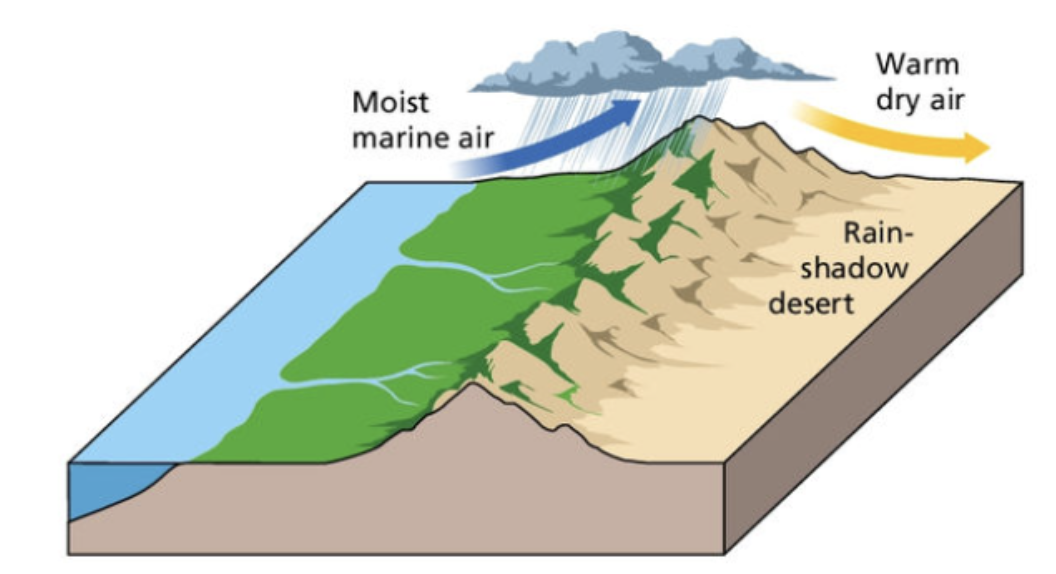
Important
The rain-shadow effect occurs when mountain ranges block moisture-laden winds, creating dry conditions on the leeward side of mountains.
Many of the world's major hot deserts are located along the western edges of continents, where this phenomenon plays a crucial role. Here's how it works:
- Windward side: Moist air from the ocean is forced upward when it encounters coastal mountain ranges
- Cooling and condensation: As the air rises, it cools and loses its ability to hold moisture, creating clouds and rainfall on the ocean-facing slope
- Leeward side: The air, now stripped of most of its moisture, descends on the inland side of the mountains
- Heating and drying: As this dry air descends, it warms up and becomes even more capable of absorbing moisture from the landscape
Example
Real-world Example: The Atacama Desert
The Atacama Desert in Chile exemplifies this effect perfectly - the Andes Mountains prevent moisture from moving inland from the Pacific Ocean, making it one of the world's driest places. Similarly, the Sahara experiences increased aridity due to the rain-shadow effect created by the Atlas Mountains and Ethiopian Highlands.
Trade winds and high-pressure belts
Most hot deserts are strategically positioned between 15° and 30° north and south of the equator, where global atmospheric circulation patterns create consistently dry conditions.
The process begins at the equator, where intense solar heating causes air to warm and rise rapidly. This ascending air can hold large amounts of moisture, leading to the heavy rainfall characteristic of equatorial regions. However, as this air moves away from the equator at high altitudes, it gradually cools and becomes denser.
Around 30° north and south latitude - known as the horse latitudes - this cool, dry air descends back towards Earth's surface, creating high-pressure systems. These descending air masses compress and warm up as they approach the ground, increasing their capacity to absorb rather than release moisture.
Important
Trade winds are the consistent dry winds that blow from these high-pressure zones back towards the equator, maintaining clear skies and arid conditions in desert regions.
This atmospheric circulation creates a self-reinforcing cycle where warm air holds moisture more effectively, preventing precipitation until the air rises again at the equator.
Cold ocean currents
Cold ocean currents significantly influence desert formation by creating dry air systems that affect coastal regions. When moisture-laden winds encounter these cold currents, they undergo rapid cooling.
Cold air has a much lower capacity for holding moisture compared to warm air. As the winds cool over the ocean, they release their moisture as fog or light precipitation over the sea. By the time these air masses reach the coastline, they have become relatively dry.
Note
Once over land, these air masses warm up again, which increases their ability to absorb moisture from the environment rather than release it. This process effectively prevents precipitation from occurring in coastal desert regions.
Continentality
Important
Continentality refers to how an area's climate becomes increasingly similar to that of a continent's interior - typically drier and more extreme.
Deserts located in the centres of large continents face a different challenge. Moisture-laden winds from oceans must travel vast distances across land before reaching these interior regions. During this journey, the air masses gradually warm up and lose their moisture through precipitation over intervening areas.
By the time these winds reach continental interiors, they have become dry and are more likely to absorb moisture from the landscape rather than provide it. The Great Australian Desert serves as an excellent example of how continentality creates arid conditions far from oceanic moisture sources.
Desert temperatures
Hot desert temperatures are characterised by extreme heat during the day and significant cooling at night, creating what geographers call a large diurnal range.
Daily temperature patterns
During summer months, daytime temperatures regularly exceed 45°C, with the intense tropical sun beating down from almost directly overhead. However, these extreme temperatures can drop by 15-30°C within hours of sunset, creating dramatic temperature swings.
Winter conditions are somewhat more moderate, with daytime temperatures around 25°C, but night-time temperatures can still fall close to freezing point (0°C). This creates challenging conditions for both plant and animal life.
Why temperature ranges are so extreme
Several interconnected factors explain why hot deserts experience such dramatic temperature variations:
Intense solar radiation: Hot deserts are located in tropical regions where the sun's rays strike the Earth's surface at very steep angles, concentrating maximum energy over relatively small areas.
Clear skies: The absence of moisture means there are no clouds to block incoming solar radiation during the day. This allows maximum heating of the ground surface.
Minimal vegetation: With little to no plant cover, desert soils absorb and store large amounts of heat throughout the day rather than losing energy through plant transpiration.
Rapid heat loss: The same clear skies that allow maximum heating during the day also permit rapid heat escape at night. Without cloud cover to act as an insulating layer, ground heat radiates quickly back into the atmosphere once the sun sets.
Important
Radiation is the process by which heat energy travels through space without requiring a medium, allowing desert surfaces to both absorb heat during the day and release it rapidly at night.
This combination of intense heating and rapid cooling creates the extreme diurnal temperature ranges that characterise hot desert climates worldwide.
Summary
Key Points to Remember:
- Hot deserts receive between 0-250mm of annual rainfall in unpredictable, torrential downpours that evaporate quickly
- Four main factors create desert aridity: rain-shadow effect, trade winds and high-pressure belts, cold ocean currents, and continentality
- Temperatures can exceed 45°C during the day but drop by 15-30°C at night, creating large diurnal ranges
- Clear skies and minimal vegetation allow intense solar heating during the day and rapid heat loss at night
- Most hot deserts are located between 15-30° north and south of the equator due to global wind patterns