Natural Soil-forming Processes (Leaving Cert Geography): Revision Notes
📚Revision Notes
Natural Soil-forming Processes
Understanding how soils develop requires examining the various physical processes occurring within soil and the environmental factors controlling these processes. There are eight fundamental processes that shape soil formation across different landscapes and climates.
The eight main soil-forming processes
The key processes responsible for soil development are:
- Weathering - Physical and chemical breakdown of rock
- Erosion - Movement and deposition of weathered material
- Humification - Decomposition of organic matter
- Leaching - Removal of nutrients by water
- Podzolisation - Extreme nutrient removal in acidic conditions
- Laterisation - Intensive leaching in tropical climates
- Calcification - Calcium accumulation in dry areas
- Salinisation - Salt build-up in arid regions
Note
These eight processes work together in different combinations depending on local climate, vegetation, and geological conditions to create the diverse range of soil types found across the globe.
Weathering
Weathering transforms solid rock into the small particles that become the foundation of soil. This process creates what we call parent materials, which typically make up around 45% of most soil types.
Important
Weathering is the breakdown of solid rock into smaller mineral particles through physical and chemical processes.
Physical weathering
Physical weathering breaks rocks apart without changing their chemical composition. The main processes include:
- Freeze-thaw action: Water enters cracks in rocks, freezes and expands, causing the rock to split apart
- Exfoliation: Occurs in areas with large daily temperature variations, such as deserts, where repeated heating and cooling causes rock layers to peel away
This mechanical breakdown gradually reduces solid rock to loose fragments called scree, which can then be weathered further into fine soil particles.
Example
Worked Example: Freeze-Thaw Weathering in Mountain Regions
Step 1: Water enters cracks in exposed rock faces during warmer periods Step 2: Temperature drops below freezing at night or in winter Step 3: Water expands by approximately 9% as it freezes, creating enormous pressure Step 4: Rock cracks widen and eventually split the rock apart Step 5: Repeated cycles create loose rock fragments that accumulate as scree slopes
Chemical weathering
Chemical weathering alters the actual chemical composition of rocks and minerals. The main processes are:
- Carbonation: Rainwater containing carbonic acid dissolves limestone and chalk by reacting with calcium carbonate
- Hydrolysis: Water breaks down minerals like feldspar in granite, transforming it into kaolin clay
- Oxidation: Iron in rocks reacts with atmospheric oxygen, causing it to rust and crumble, giving soils a characteristic reddish-brown colour
Erosion
Erosion involves both the breakdown and transportation of weathered rock material by natural forces such as water, ice and wind.
Important
Erosion is the process of breaking down and transporting rock fragments by water, ice and wind.
Rivers are particularly effective at creating fertile agricultural soils. They deposit fine particles of silt and clay mixed with larger sand grains along their floodplains, forming extremely fertile alluvial soils that are ideal for intensive farming.
Wind erosion can transport material over vast distances before depositing it elsewhere. For example, winds have created fertile limon soil across the North European Plain, including areas like the Paris Basin, by depositing fine particles carried from distant locations.
Note
Glacial activity produces boulder clay soil through the deposition of mixed rock fragments. However, these soils present challenges for agriculture as they are poorly drained, have high moisture content, and become sticky and difficult to cultivate. They are better suited to pastoral farming rather than crop production.
Humification
Humification transforms dead organic matter into humus, a dark, nutrient-rich substance that significantly improves soil fertility.
Important
Humification is the breakdown and decomposition of organic matter into humus, which increases soil fertility.
The rate of humification varies dramatically with climate. In warm, wet regions like tropical areas, high temperatures and frequent rainfall accelerate the decomposition process. Conversely, in colder regions, humification occurs much more slowly. In permanently frozen areas, humification cannot occur at all, limiting soil development.
Example
Climate Impact on Humification Rates
- Tropical regions: Complete decomposition in 6-12 months due to high temperatures (25-30°C) and abundant moisture
- Temperate regions: Decomposition takes 2-3 years with moderate temperatures (5-20°C) and seasonal moisture
- Arctic regions: Decomposition may take decades or centuries due to low temperatures (-10 to 5°C) and frozen conditions
Leaching
Leaching occurs when water moves through soil, dissolving and carrying away nutrients and minerals.
Important
Leaching is the washing away and removal of nutrients from soil by water movement.
In small amounts, leaching can actually benefit soil fertility by dissolving nutrients near the surface and carrying them down to plant root zones. However, severe leaching removes minerals from the upper soil layer (A horizon) far beyond the reach of plant roots, leaving the soil infertile and nutrient-poor.
Podzolisation
Podzolisation represents an extreme form of leaching occurring in specific environmental conditions.
Important
Podzolisation is extreme leaching caused by acidic water moving through soil, most common in coniferous forests and peat soils.
This process typically occurs in areas with high precipitation and coniferous forest cover. As water passes through the acidic plant litter of coniferous forests, it becomes increasingly acidic. This acidic water dissolves and washes away almost all minerals and nutrients from the soil, leaving the A horizon 'bleached' and highly infertile.
Only quartz can resist this acidic water, giving the remaining soil a distinctive grey colour. The dissolved minerals accumulate lower down in the B horizon, where they form a hardpan - an impermeable layer that makes the soil prone to waterlogging.
Note
Podzolisation is particularly common in northern coniferous forests (boreal/taiga regions) where pine and spruce trees drop acidic needles that break down slowly, creating highly acidic conditions in the soil.
Laterisation
Laterisation is another form of extreme leaching, but occurs in tropical and equatorial regions.
Important
Laterisation is intensive leaching in hot, wet tropical climates that prevents normal soil horizon development.
In these regions, high temperatures and heavy rainfall cause rapid chemical weathering of plant litter. The resulting humus dissolves quickly and leaches deep into the soil profile. This prevents the development of distinct soil horizons and creates infertile conditions.
Only iron oxide and aluminium oxide can resist this intensive leaching process. When iron is exposed to the atmosphere, it oxidises and gives these tropical soils their characteristic rusty red appearance. These soils are known as latosols.
Calcification
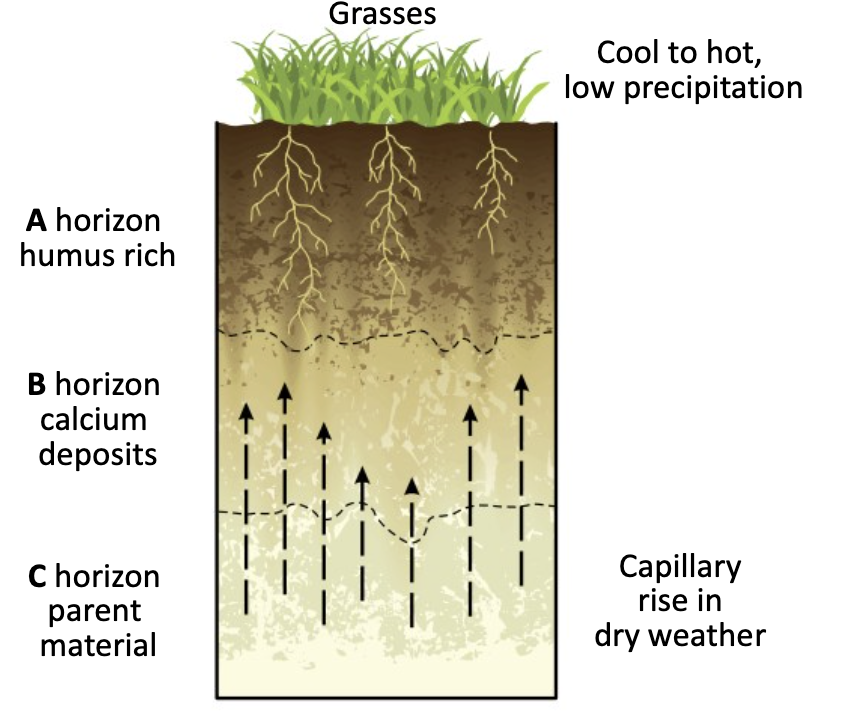
Calcification occurs in regions where evaporation exceeds precipitation, causing calcium carbonate to accumulate near the soil surface.
Important
Calcification is the accumulation of calcium carbonate near the soil surface in areas with low rainfall and high evaporation rates.
The process works through capillary action - water moves upward through the soil as surface moisture evaporates. This upward-moving water carries dissolved calcium carbonate towards the surface. When the water evaporates, the calcium carbonate accumulates in the A horizon.
This process creates fertile, calcium-rich soils that are particularly well-suited for grassland development and grazing agriculture.
Example
Calcification Process in Semi-Arid Grasslands
Step 1: Limited rainfall (200-500mm annually) provides moisture but insufficient for deep leaching
Step 2: High evaporation rates draw water upward through capillary action
Step 3: Dissolved calcium carbonate moves with the rising water
Step 4: Surface evaporation leaves calcium carbonate deposits in the upper soil layers
Step 5: Over time, these deposits create calcium-rich, alkaline soils perfect for grass growth
Salinisation
Salinisation involves the build-up of soluble salts near the soil surface in arid environments.
Important
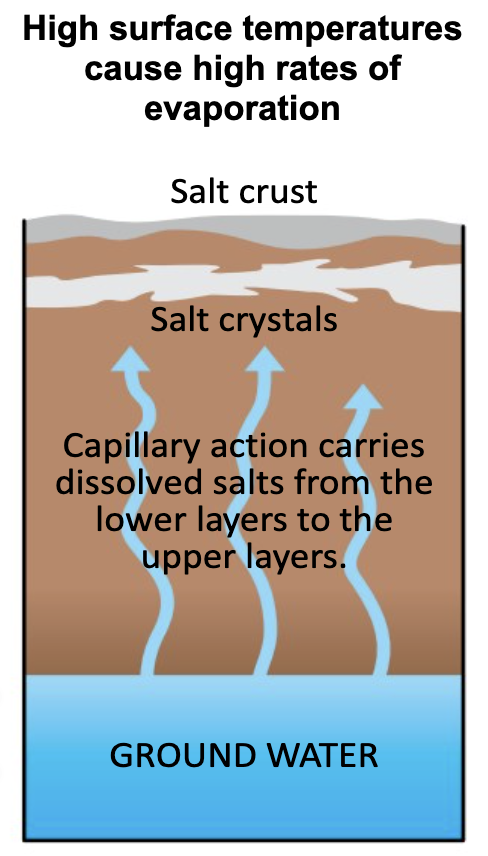
Salinisation is the accumulation of soluble salts close to the soil surface in hot desert and semi-desert regions.
This process occurs where precipitation is very low and evaporation rates are extremely high. Capillary action draws groundwater upward through the soil profile. Since groundwater naturally contains dissolved salts, these accumulate as the water evaporates at the surface.
Over time, salt concentrations become so high that they solidify to form a hard, toxic crust that poisons plant life. Human activities such as irrigation can worsen salinisation by raising groundwater levels, bringing salt deposits closer to the surface where crops are grown.
Note
Salinisation is a major agricultural problem worldwide, affecting approximately 20% of irrigated farmland globally. Poor drainage and excessive irrigation are the primary human causes of this soil degradation process.
Summary
Key Points to Remember:
- Weathering creates the foundation - Parent materials from weathered rock make up about 45% of most soils
- Climate controls the rate - Warm, wet conditions accelerate most soil-forming processes like humification and leaching
- Extreme leaching destroys fertility - Both podzolisation and laterisation create nutrient-poor, infertile soils
- Water movement is crucial - Whether moving up (calcification, salinisation) or down (leaching), water transport shapes soil characteristics
- Location determines process - Coniferous forests favour podzolisation, tropics favour laterisation, and arid areas favour calcification and salinisation