Determinist Model (Leaving Cert Geography): Revision Notes
📚Revision Notes
Determinist model
What is the determinist model?
The determinist model is a geographical theory suggesting that the natural environment significantly shapes a region's economic and social development. This model emphasises how physical factors such as climate, topography, and natural resources directly influence a country's progress and prosperity.
According to this theory, areas with favourable environmental conditions are more likely to experience successful development, while regions facing environmental challenges may struggle to achieve economic growth.
Note
The determinist model represents one of the foundational theories in economic geography, though it has evolved significantly since its early formulations to account for human agency and technological factors.
How the determinist model works
The model identifies three key environmental factors that determine development outcomes:
Climate
Climate type significantly impacts development potential in several ways:
- Mild and temperate climates tend to support thriving agriculture and attract tourism, both boosting economic growth
- Extreme climates (such as deserts or frozen tundras) present challenges for supporting large populations and economic activities
- Favourable climates enable year-round agricultural production and comfortable living conditions
For example, the Kalaalit Nunaat (High Arctic Tundra biome) in Greenland demonstrates how extreme climate conditions severely limit development opportunities in the region.
Natural resources
The abundance or scarcity of natural resources plays a crucial role in economic development:
- Resource-rich areas can exploit minerals, oil, or fertile soil to drive economic growth
- Resource-poor regions may struggle to achieve significant progress due to limited natural assets
- Resource extraction can provide export income and fund infrastructure development
Topography
Physical landscape features shape how people live and conduct economic activities:
- Mountainous regions often face difficulties with transportation and communication, hindering development compared to flat terrains
- Coastal areas may benefit from maritime trade opportunities
- Plains and valleys typically offer better conditions for agriculture and settlement
Example
Example: Middle East and North Africa (MENA) region
The MENA region illustrates the determinist model through its oil wealth. Countries such as Saudi Arabia and the United Arab Emirates have leveraged their vast oil reserves to drive economic development. This natural resource abundance has enabled these nations to fund infrastructure projects and improve living standards significantly.
Criticisms and limitations of the determinist model
While the determinist model highlights environmental influences on development, it faces several important criticisms:
Neglecting human agency
Important
The model's major weakness is overlooking the role of human actions and decisions in shaping development outcomes. In reality, human agency, effective policies, and good governance are crucial factors that can either amplify or reduce environmental effects on development.
Inequalities and vulnerabilities
The determinist approach can worsen inequalities between regions. Areas with rich natural resources may experience rapid development, while resource-poor areas face marginalisation and poverty.
For instance, in sub-Saharan Africa, countries like Nigeria and Angola possess abundant oil reserves, yet many other nations in the region struggle with development due to resource disparities.
Technological advancements
Note
The model may not adequately account for technology's potential to overcome environmental limitations. Human innovation has enabled countries to improve agricultural practices, access renewable energy, and manage water resources more effectively, reducing dependence on natural advantages.
Environmental vulnerability
Heavy reliance on resource extraction can lead to environmental degradation. Deforestation for agricultural expansion often results in soil erosion and biodiversity loss, creating long-term sustainability challenges.
Climate change impacts
The determinist model may not fully address climate change challenges, which involve complex interactions between human activities and natural processes. Climate change affects agriculture, water availability, and vulnerability to natural disasters, adding new dimensions to development challenges.
The Amazon Rainforest provides an example of environmental vulnerability, where overreliance on deforestation for economic gains has led to ecological imbalances, impacting both local communities and global climate patterns.
Case study: The equatorial paradox in Indonesia
The equatorial paradox challenges traditional determinist thinking by questioning why countries near the equator with abundant resources don't necessarily achieve high development levels.
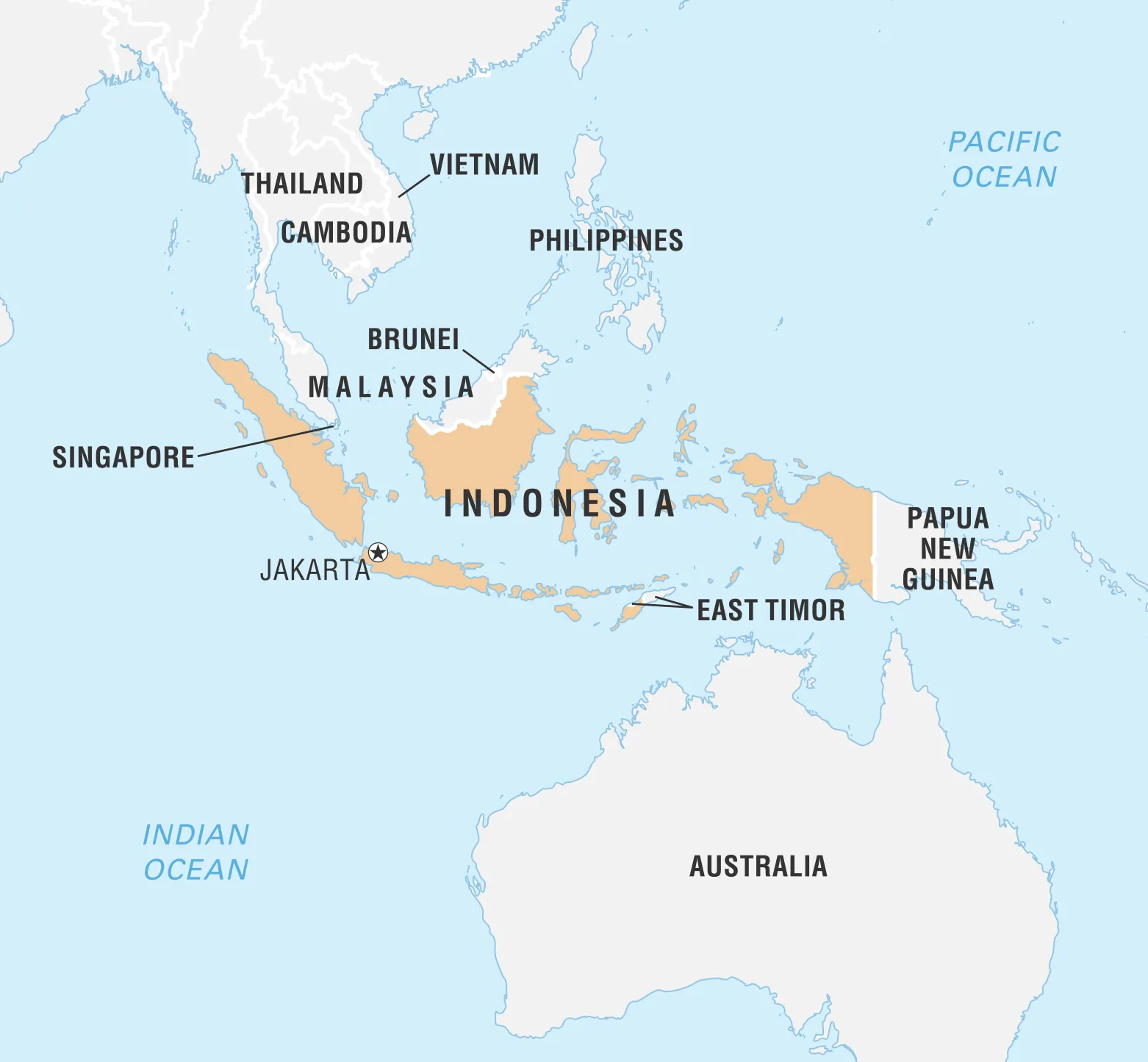
Indonesia's abundant resources
Indonesia is an archipelago located near the equator in Southeast Asia, blessed with:
- Fertile soil suitable for agriculture
- Tropical climate conducive to farming
- Vast biodiversity providing natural wealth
Note
These factors should theoretically position Indonesia for robust economic development according to the determinist model.
Development challenges
Despite its natural advantages, Indonesia faces significant development obstacles:
Income inequality
Indonesia experiences substantial income inequality, with a Gini coefficient of approximately 38.2. This reveals a considerable income gap, where the top 10% of the population enjoys a significantly higher share of income compared to the bottom 10%. This disparity creates a disproportionate concentration of wealth among the affluent few.
Environmental degradation
Important
Rampant deforestation, illegal logging, and forest fires have damaged Indonesia's natural ecosystems. The country has one of the highest deforestation rates globally, with an estimated annual loss of over 300,000 hectares of forest. This alarming rate disrupts vital ecosystems and contributes to climate change.
Political instability
Periods of political instability, corruption, and governance challenges have hindered progress. The Transparency International Corruption Perceptions Index 2022 ranked Indonesia 94th out of 180 countries, indicating persistent corruption challenges that erode institutional trust and divert resources from essential services.
Infrastructure gaps
Inadequate infrastructure, particularly in remote regions, limits economic opportunities and access to basic services.
Addressing the equatorial paradox
To overcome these challenges and foster development, several strategies are essential:
- Good governance: Addressing corruption and ensuring political stability are vital for sound economic development
- Sustainable resource management: Implementing sustainable forestry and environmental policies can protect natural resources
- Investment in infrastructure: Developing transport, education, and healthcare infrastructure is crucial for equitable development
- Social equality: Initiatives to reduce income inequality and improve access to education and healthcare services are essential
Important
The equatorial paradox, as demonstrated by Indonesia, shows that natural resources alone do not guarantee development. Political stability, sustainable resource management, infrastructure development, and efforts to reduce socioeconomic disparities are equally vital for achieving sustainable development.
Summary
Key Points to Remember:
- The determinist model suggests that natural environment (climate, resources, topography) strongly influences regional development
- Favourable climates and abundant resources can boost economic growth, while extreme conditions pose challenges
- The model has significant limitations, particularly in neglecting human agency and technological capabilities
- The equatorial paradox (exemplified by Indonesia) shows that natural advantages don't automatically guarantee development success
- Effective governance, sustainable practices, and social equality are crucial factors alongside environmental conditions