Transport by the Sea (Leaving Cert Geography): Revision Notes
📚Revision Notes
Transport by the Sea
The sea acts as a powerful transport system, moving vast amounts of material along coastlines and across ocean basins. Before materials can be transported, they must first be prepared through weathering and erosion processes.
Note
Understanding marine transportation is essential for studying coastal geomorphology and how our coastlines are constantly being shaped and reshaped by natural processes.
The sea's load
Important
Sea's load refers to all the material that is carried and transported by waves and ocean currents.
When waves erode coastal rocks and cliffs, the resulting fragments undergo a process called attrition. This process involves rocks and pebbles colliding with each other, gradually wearing down and becoming smaller and more rounded. Once sufficiently broken down, this material becomes part of the sea's load.
The sea's load consists of sediment from two main sources:
- Material deposited by rivers as they flow into the sea
- Sediment created through wave erosion of coastlines
Processes of transportation
The sea transports material through several key mechanisms, with longshore drift being the most significant process affecting coastlines.
Longshore drift
Important
Longshore drift is the movement of sediment along a coastline, caused by waves approaching the shore at an angle.
How longshore drift works
The process begins when prevailing winds create waves that approach the coastline at an oblique angle rather than straight on. This angled approach is crucial to the transportation process.
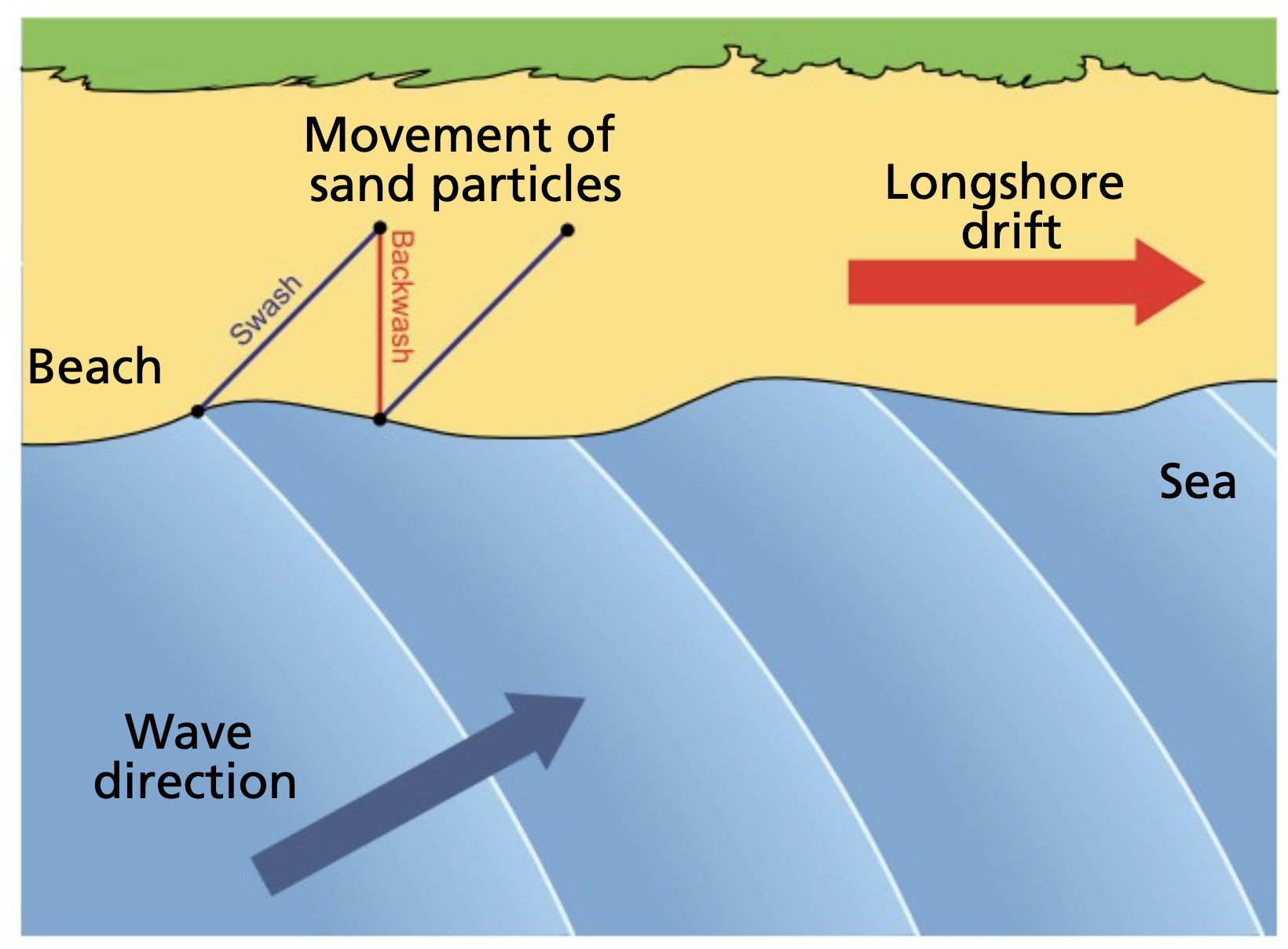
When waves reach shallow water near the shore, friction with the seabed causes them to slow down and eventually break. As waves break onto the beach, they create what is known as swash - the rush of water that carries sediment up the beach.
The swash moves in the same direction as the incoming waves, pushing pebbles, sand, and other materials diagonally up the beach. However, when this water flows back down to the sea (called backwash), it moves straight down the beach at a 90-degree angle to the coastline due to gravity.
Note
The key difference between swash and backwash is their direction: swash moves diagonally following the wave direction, while backwash moves straight down due to gravity.
The zigzag pattern
This creates a distinctive zigzag movement pattern:
- Swash carries material diagonally up the beach
- Backwash drags material straight down the beach
- The next wave repeats the process
- Over time, sediment gradually moves along the coastline
Example
Worked Example: Longshore Drift in Action
Imagine a beach where waves approach from the southwest at a 45-degree angle:
Step 1: Wave breaks and swash carries sand diagonally up the beach towards the northeast
Step 2: Backwash flows straight down the beach slope towards the sea
Step 3: The next wave repeats this pattern
Result: After hundreds of wave cycles, sand has moved several metres eastward along the coastline, demonstrating the cumulative effect of longshore drift.
Factors affecting longshore drift
The direction and strength of longshore drift depend on:
- Wind direction: Determines the angle at which waves approach the shore
- Wave energy: Stronger waves can transport larger materials
- Beach gradient: Affects how far swash travels up the beach
- Sediment size: Smaller particles are more easily transported
Note
Wind direction is the primary control on longshore drift direction, which is why studying prevailing wind patterns is essential for predicting sediment movement along coastlines.
The role of wind
Wind plays a fundamental role in determining both the direction and intensity of longshore drift. The prevailing wind direction in an area largely controls which way sediment will be transported along the coast. Changes in seasonal wind patterns can even cause the direction of longshore drift to reverse.
Transportation efficiency
Longshore drift is remarkably effective at moving large volumes of sediment. On some coastlines, millions of tonnes of material can be transported annually. This process is responsible for building many coastal features such as spits, beaches, and barrier islands.
Summary
Key Points to Remember:
- The sea's load consists of material from both river deposits and coastal erosion
- Longshore drift moves sediment along coastlines through the combined action of swash and backwash
- Swash carries material diagonally up the beach, while backwash flows straight down
- Wind direction determines the angle of wave approach and the direction of sediment transport
- This zigzag pattern of movement gradually transports enormous amounts of sediment along coastlines