Waves (Leaving Cert Geography): Revision Notes
📚Revision Notes
Waves
Key Terms:
| Term | Definition |
|---|---|
| Swash | Water carried up the beach after a wave breaks |
| Backwash | The water that flows back down the beach to the sea |
| Shingle | Made up of small rounded pebbles or stones brought ashore by the sea |
| Marine Deposition | Another way of saying Coastal Deposition |
| Backshore | The area of a beach that lies above the high tide level. It is reached by waves only during stormy weather |
| Foreshore | The lower section of the beach next to the water |
| Storm Beach | Located in the backshore area and mainly consists of stones and gravel |
Waves
- Coastal processes of erosion, deposition and transportation are influenced by the actions of waves
- Waves are created by friction between the wind and sea
- The size of waves depends on two things:
- Wind Strength: the stronger the wind, the more powerful the wave
- Fetch: The size of the ocean the wind blows over
- Large ocean combined with high winds = Stronger waves
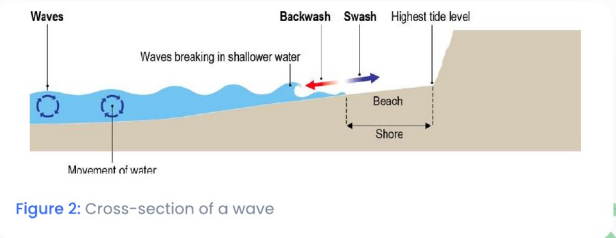
- When waves reach shallower water at the coast, they break
- Waves running up the shore = swash
- Waves that run back towards the sea = backwash
- Top of the wave = crest
- Bottom = trough
Types of Waves
Constructive Waves
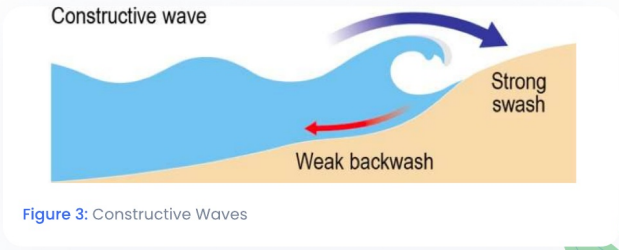
- Formed when the swash is stronger than the backwash
- As the stronger swash runs up the beach, some of the wave soaks into the sand depositing material on the beach
- The weaker backwash then returns to the sea
- They are low energy waves that are also flat and low, less than 1m high
- Constructive waves are most common during summer time
Destructive Waves
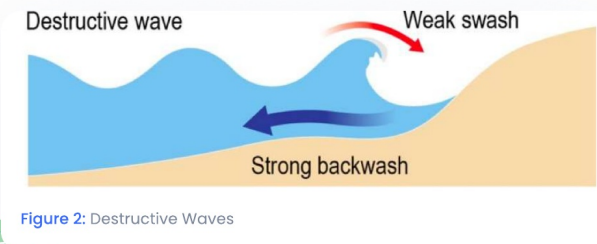
- Backwash is stronger than the swash
- Tall, powerful waves break rapidly and plunge onto the beach
- The stronger backwash drags the material back out to sea, eroding the coastline
- The backwash returns quickly without soaking into the sand
- Destructive waves are most common during winter time
Wave Refraction
- Wave Refraction is when waves bend and change their direction as they approach the shore
- As the waves reach the coastline, the headland is encountered first
- As they enter shallow water, they begin to slow down near the headland
- In deeper water the waves continue at greater speeds
- This difference in speed causes the waves to bend inwards around either side of the headland
- The erosive power of the wave is concentrated on the headland, so erosion mainly occurs here
- It is less powerful when it reaches bays, so deposition occurs