The Drift to Civil War (Leaving Cert History): Revision Notes
📚Revision Notes
The Drift to Civil War
The Provisional Government in Ireland and Why it Was Important
-
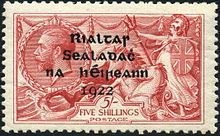
The Provisional Government of Ireland was established in January 1922 following the signing of the Anglo-Irish Treaty.
- Led by Michael Collins, the Provisional Government was tasked with overseeing the transition from British rule to the newly established Irish Free State. The government's primary responsibilities included:
- Setting up the institutions of the Free State
- Organising elections,
- Maintaining order during the volatile post-Treaty period.
-
However, the government faced significant challenges from the outset. The Treaty had deeply divided the Irish nationalist movement, with many, including Éamon de Valera and a substantial portion of the Irish Republican Army (IRA), vehemently opposing the terms.
-
These anti-Treaty factions viewed the Provisional Government as illegitimate, believing that it had betrayed the republican ideals for which they had fought during the War of Independence.
-
The government's authority was further undermined by the presence of British forces still in the country and the ongoing partition of Ireland, which the Treaty had accepted.
-
Despite these obstacles, Collins and his colleagues worked to establish the administrative framework of the new state.
-
They sought to balance the implementation of the Treaty with the need to maintain unity within the nationalist movement, but this proved increasingly difficult as tensions grew between pro- and anti-Treaty forces.
-
The Provisional Government's efforts to assert its authority, such as taking control of key military barracks from the British, were often met with resistance, signalling the beginning of a deeper crisis that would eventually lead to civil war.
The IRA and Army Convention of the Treaty (The Breaking Down of Law and Order)
- The Anglo-Irish Treaty led to a severe split within the Irish Republican Army (IRA), which had been the principal military force fighting for Irish independence.
- The Treaty's acceptance of dominion status within the British Commonwealth and the requirement of an oath of allegiance to the British Crown were seen as betrayals by many in the IRA, who had fought for a fully independent republic.
- This division culminated in the IRA Army Convention held in March 1922, where the anti-Treaty faction, led by figures such as Liam Lynch, rejected the authority of the Provisional Government and declared their allegiance to the original Irish Republic proclaimed in 1916.
- The convention effectively marked the breaking down of law and order in Ireland. The anti-Treaty IRA, now often referred to as the Irregulars, refused to recognise the Provisional Government and began to prepare for armed resistance.
- This defiance led to a state of near-anarchy in parts of the country, as both pro- and anti-Treaty forces vied for control. In many areas, local IRA units that had once fought side by side now turned against each other, leading to violent clashes and the seizure of military installations.
- The breakdown of law and order was further exacerbated by the refusal of the anti-Treaty IRA to disarm or integrate into the newly formed National Army, which was loyal to the Provisional Government.
- As the situation deteriorated, it became increasingly clear that the divisions within the IRA and the broader nationalist movement were irreconcilable, setting the stage for the outbreak of the Irish Civil War.
Meetings with Collins and Craig & Violence in Northern Ireland
-
As tensions mounted in the south of Ireland, the situation in Northern Ireland also became increasingly volatile.
-
The partition of Ireland, as recognised by the Anglo-Irish Treaty, had created a new state of Northern Ireland with a Protestant Unionist majority, which led to significant unrest and violence, particularly against the Catholic minority.
-
Michael Collins recognised the importance of addressing the growing violence in the north and the need to maintain some semblance of cooperation with the Northern Ireland government.
-
In early 1922, Collins held a series of meetings with Sir James Craig, the Prime Minister of Northern Ireland, to reduce sectarian violence and find common ground between the North and the South.
-
These meetings, although initially promising, were fraught with difficulty. Collins sought to protect the rights of Catholics in Northern Ireland, while Craig was focused on securing the position of the unionist government and ensuring the stability of the new Northern Irish state.
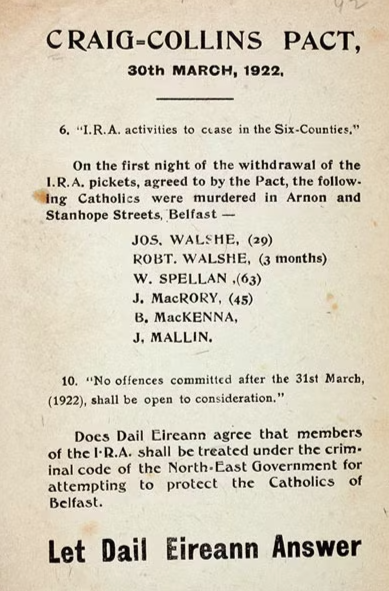
- Despite their differences, the two leaders managed to reach a temporary agreement known as the Craig-Collins Pact, which aimed to curb violence and improve relations between the North and South.
- However, the violence in Northern Ireland continued to escalate, with sectarian attacks becoming more frequent and brutal.
- The lack of a lasting resolution and the ongoing hostilities further strained relations between the Provisional Government in the South and the Unionist government in the North.
-
Collins, already under immense pressure from the divisions within the south, found his efforts to stabilise the situation in Northern Ireland increasingly undermined by the ongoing violence.
-
The breakdown of order in the North, coupled with the mounting tensions in the South, contributed to the overall drift towards civil war as the fragile peace established by the Treaty began to unravel on multiple fronts.