Using Factors to Solve Quadratic Equations (Leaving Cert Mathematics): Revision Notes
📚Revision Notes
Using Factors to Solve Quadratic Equations
What does it mean to solve a quadratic equation using factors?
Solving a quadratic equation means finding the values of x that make the equation true. When we use the factorisation method, we rewrite the quadratic expression as a product of two simpler expressions (called linear factors) and then use a special property to find our solutions.
Note
Key definition: When a quadratic equation is in the form , we can express the left-hand side as the product of two linear factors, then solve the equation.
The zero product property
This method works because of a fundamental mathematical principle:
Important
Zero Product Property: If two numbers multiply together to give zero, then at least one of those numbers must be zero.
In mathematical terms: If , then either or , which means or .
These values of x are called the solutions or roots of the equation.
Step-by-step method
Note
To solve a quadratic equation using factors:
- Rearrange the equation so it equals zero
- Factorise the left-hand side into two linear factors
- Apply the zero product property
- Solve each linear equation separately
- State your solutions clearly
Worked examples
Example
Worked Example 1: Standard factorisation
Solve
Step 1: The equation is already equal to zero.
Step 2: Factorise the left-hand side. We need two numbers that multiply to give -14 and add to give -5. These are -7 and +2.
Step 3: Apply the zero product property:
Step 4: Solve each factor:
Solution: or
Example
Worked Example 2: Common factor case
Solve
Step 1: The equation already equals zero.
Step 2: Notice there's no constant term. Factor out the common factor of x:
Step 3: Apply the zero product property:
Step 4: Solve each equation:
Solution: or
Example
Worked Example 3: Difference of squares
Solve
Step 1: The equation already equals zero.
Step 2: Recognise this as a difference of squares pattern:
Step 3: Apply the zero product property:
Step 4: Solve each equation:
Solution: or
Connection to graphs
The solutions of a quadratic equation correspond to where the parabola crosses the x-axis. These crossing points are called the x-intercepts or roots.
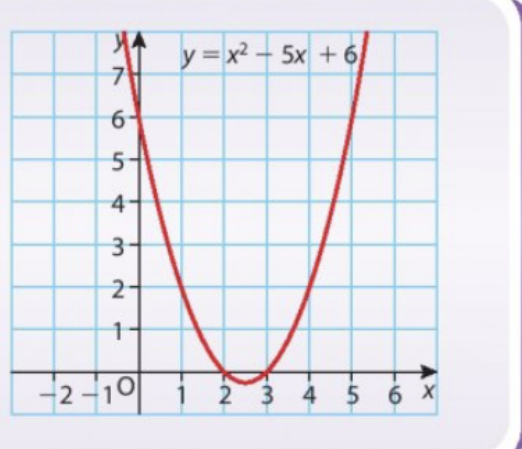
When you look at the graph above, you can see that the parabola crosses the x-axis at two points. These x-coordinates are exactly the solutions we find when solving the equation algebraically using factorisation.
Multiple parabolas example
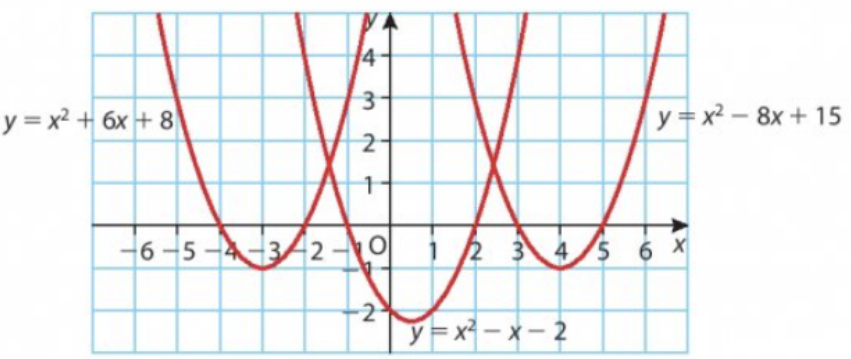
This graph shows three different parabolas. Each equation can be solved by factorisation to find where it crosses the x-axis. The visual representation helps us understand that some quadratic equations have two solutions, and these correspond to the two points where the parabola intersects the x-axis.
Real-world applications
Factorisation is particularly useful when solving problems involving areas and measurements.
Area problems
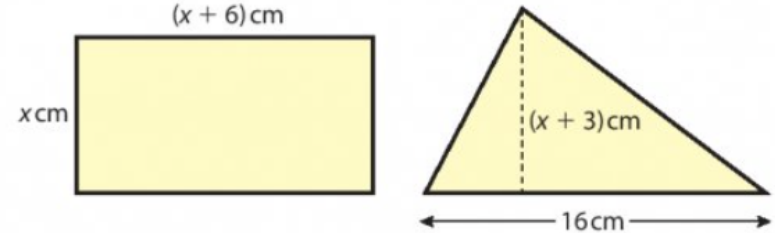
When dealing with geometric shapes, we often create quadratic equations from area formulas. For example, if a rectangle and triangle have the same area, we can set up an equation and solve it using factorisation to find unknown measurements.
Right triangle problems
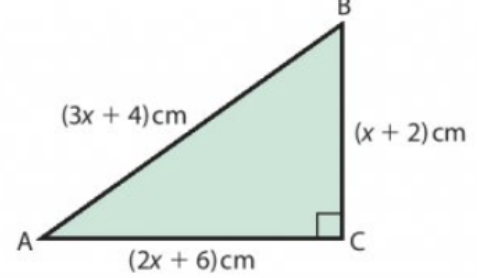
Using Pythagoras' theorem with algebraic expressions often leads to quadratic equations. The factorisation method provides an efficient way to solve these problems and find the actual measurements.
Common exam tips
Note
Essential Tips for Success:
- Always check your solutions by substituting back into the original equation
- Look for common factors first before attempting other factorisation methods
- Recognise special patterns like difference of squares:
- Remember that most quadratic equations have two solutions
- In context problems, check that your solutions make practical sense (e.g., lengths cannot be negative)
Summary
Key Points to Remember:
- The zero product property is the key: if two factors multiply to give zero, at least one factor must be zero
- Always rearrange your equation so one side equals zero before factorising
- Factor completely - look for common factors first, then use appropriate patterns
- Every quadratic equation (that can be factorised) typically has two solutions
- Solutions correspond to x-intercepts on the graph of the parabola