Solving Linear Equations (Leaving Cert Mathematics): Revision Notes
📚Revision Notes
Solving Linear Equations
What is a linear equation?
A linear equation is a mathematical statement that contains an equals sign (=) and shows that two algebraic expressions are equal to each other. The equation contains one or more variables (usually x) raised to the power of 1 only.
Key features:
- Contains an equals sign (=)
- Variable appears to the power of 1 only
- No multiplication of variables together
- Forms a straight line when graphed
Important
Definition: Solving an equation means finding the value of the variable that makes the equation true.
Basic principles for solving linear equations
When solving linear equations, you must follow these fundamental rules to ensure accuracy and maintain mathematical integrity.
Note
Fundamental Rules for Linear Equations:
- Balance principle: Whatever you do to one side of the equation, you must do exactly the same to the other side
- Inverse operations: Use opposite operations to "undo" what has been done to the variable
- Isolation goal: Your aim is to get the variable by itself on one side of the equation
The balance principle is the foundation of equation solving - it ensures that the equality remains true throughout your solution process.
Step-by-step method for solving linear equations
Simple linear equations
For equations like or , follow this streamlined approach:
- Identify what operation is being performed on the variable
- Apply the inverse operation to both sides
- Simplify to find the value of the variable
- Check your answer by substituting back into the original equation
Multi-step linear equations
For more complex equations, follow this systematic approach:
- Remove brackets using the distributive property (if present)
- Collect like terms on each side
- Move all terms with variables to one side
- Move all number terms to the other side
- Simplify both sides
- Divide or multiply to isolate the variable
- Check your solution
Worked examples
Example
Worked Example 1: Multi-step equation
Solve:
Step 1: Add 3 to both sides
Step 2: Subtract 2x from both sides
Step 3: Divide both sides by 3
Check: Substitute back into the original equation:
Left side:
Right side: ✓
Example
Worked Example 2: Equation with brackets
Solve:
Step 1: Remove brackets using the distributive property
Step 2: Simplify the right side
Step 3: Add 20 to both sides
Step 4: Subtract 6x from both sides
Step 5: Divide both sides by 4
Check: Substitute back into the original equation to verify.
Example
Worked Example 3: Simple one-step equation
Solve:
Step 1: Divide both sides by 3
Types of linear equations you'll encounter
Understanding the different types of linear equations helps you choose the most efficient solution method:
One-step equations
- (multiply/divide)
- (add/subtract)
Two-step equations
- (add then divide)
- (subtract then multiply)
Multi-step equations
- (variables on both sides)
- (brackets to expand)
Applications in geometry
Linear equations frequently appear in geometric contexts, providing practical applications for algebraic problem-solving skills.
Note
Common Geometric Applications:
Linear equations are particularly useful when working with:
- Perimeter problems where sides are expressed algebraically
- Angle calculations using known geometric properties
- Area relationships involving unknown dimensions
Perimeter problems
When shapes have sides expressed algebraically, you can form equations to solve for unknown values.
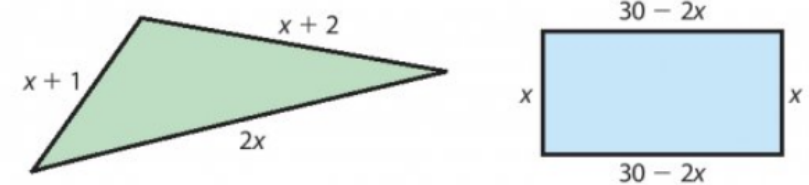
For the triangle and rectangle shown:
- Triangle perimeter:
- Rectangle perimeter:
Angle problems
In triangles, the sum of angles equals 180°, creating linear equations.
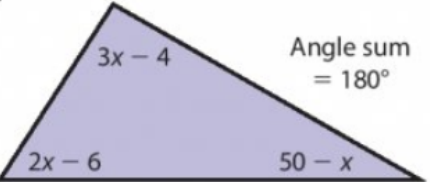
For the triangle with angles , , and :
Simplifying: Therefore: , so
Common exam tips and traps
Note
Exam Success Tips:
- Always show your working - marks are awarded for method
- Check your answer by substituting back into the original equation
- Be careful with signs when moving terms across the equals sign
- Use brackets when substituting negative values during checking
Important
Common Traps to Avoid:
- Sign errors: When moving from left to right, it becomes
- Forgetting to distribute: , not
- Dividing incorrectly: When you have , remember
- Not checking: Always verify your solution makes the original equation true
Key formulas and rules
Understanding these fundamental mathematical rules will support your equation-solving process:
Summary
Essential Formulas and Rules:
Distributive property:
Balance rule: If , then and
Multiplication rule: If , then and (where )
Summary
Key Points to Remember:
- Linear equations contain variables to the power of 1 only and form straight lines when graphed
- Always maintain balance - what you do to one side, do to the other side
- Work systematically - remove brackets, collect like terms, move variables to one side, solve
- Check your answer by substituting back into the original equation
- In geometry applications, use known properties like triangle angles summing to 180° or perimeter formulas to create your equations