Circles and Sectors (Leaving Cert Mathematics): Revision Notes
📚Revision Notes
Circles and Sectors
Understanding circles and sectors is essential for calculating areas and perimeters of curved shapes. This topic builds on basic geometry and introduces you to working with π (pi) in practical calculations.
Basic circle properties
A circle is a perfectly round shape where every point on the edge is the same distance from the centre. This distance from the centre to the edge is called the radius (r). The diameter is the distance across the circle through the centre, which is always twice the radius.
Note
The relationship between radius and diameter is fundamental: diameter = 2 × radius. This means if you know one measurement, you can always find the other by multiplying or dividing by 2.
Key formulas for circles
The area of a circle tells us how much space is inside it. The formula uses the radius squared:
The circumference is the distance around the edge of a circle. Think of it as the perimeter:
Important
When working with these formulas, remember that , but your calculator's π key gives a more accurate value. Always use the π key for calculations rather than approximations.
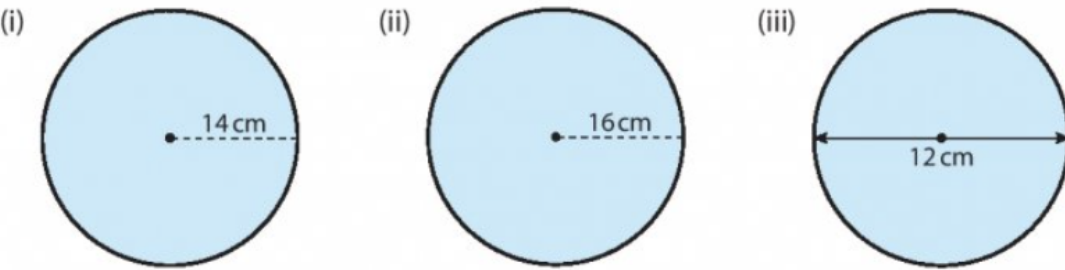
Understanding sectors
A sector is like a slice of a circle - imagine cutting a piece of pie. It's the area between two radii and the arc (curved edge) that connects them.
Sector formulas
The key to sector calculations is understanding that a sector is a fraction of the whole circle. If the central angle is x degrees out of 360°, then:
Important
The fraction represents what portion of the complete circle your sector represents. This is the foundation for all sector calculations - always think "what fraction of the whole circle am I working with?"
Worked examples
Example
Worked Example: Composite Shape Calculation
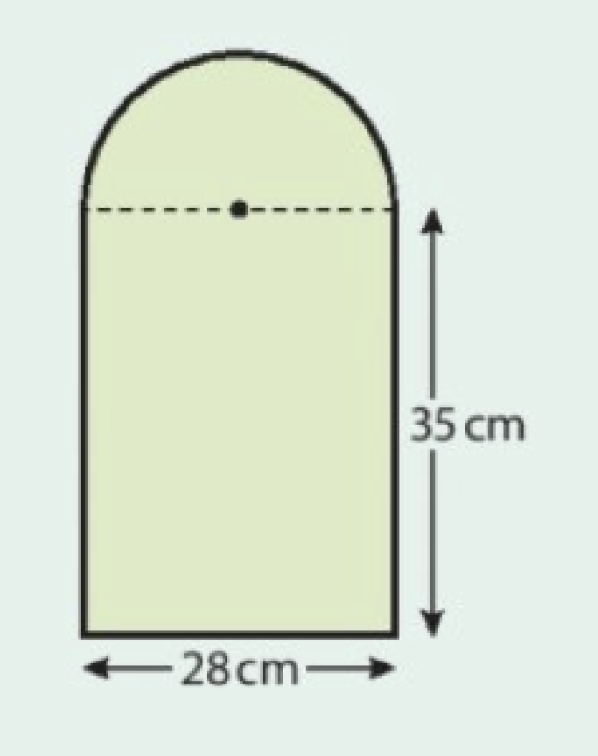
Let's work through a shape that combines a semi-circle with a rectangle, showing how to find both perimeter and area.
For a semi-circle with radius 14 cm attached to a rectangle (28 cm × 35 cm):
Finding the perimeter:
- Semi-circle perimeter = cm ≈ 44 cm
- Rectangle sides needed = cm
- Total perimeter = cm
Finding the area:
- Semi-circle area = cm² ≈ 308 cm²
- Rectangle area = cm²
- Total area = cm²
Example
Worked Example: Sector Calculations
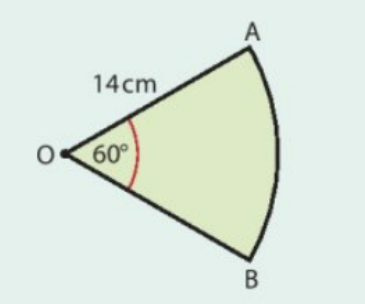
For a sector with central angle 60° and radius 14 cm:
Area of sector:
- Use the formula:
- Area =
- Area =
- Area = cm²
Arc length:
- Use the formula:
- Arc length =
- Arc length =
- Arc length = cm
Example
Worked Example: Finding Radius from Area
When given that a circle has area 803.84 cm², we can work backwards to find the radius:
- Start with: Area =
- Substitute:
- Solve for :
- Find r: cm
Working with different circular shapes
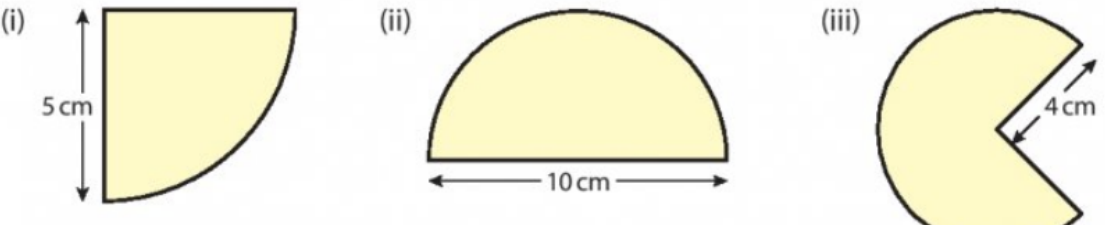
Understanding fractions of circles helps with complex problems. Each type represents a different fraction of the complete circle:
Note
Circular Shape Formulas:
- Quarter circle: Area = , Arc length =
- Semi-circle: Area = , Arc length =
- Three-quarter circle: Area = , Arc length =
Notice how each formula uses the appropriate fraction (1/4, 1/2, 3/4) of the complete circle formulas.
Composite shapes in real life
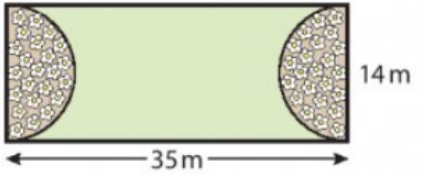
Many real-world shapes combine circles with rectangles or other polygons. These appear frequently in practical problems and exams.
Note
Strategy for Composite Shapes:
For shapes like sports fields or garden designs, break them into simpler parts:
- Identify the circular portions (often semi-circles)
- Identify the rectangular portions
- Calculate each part separately
- Add them together for total area or perimeter
This systematic approach prevents confusion and ensures you don't miss any components of the shape.
Important
Common Mistakes to Avoid:
- Always check whether you need area or perimeter - read the question carefully
- For sectors, make sure your angle is in degrees when using the formulas
- When finding radius from area, remember to take the square root at the end
- Use your calculator's π key for accuracy, but round your final answer appropriately
- For composite shapes, sketch and label each part to avoid confusion
Summary
Key Points to Remember:
- Circle area = and circumference = - these are your foundation formulas
- Sectors are fractions of circles - use to find what fraction
- Break composite shapes into simpler parts - circles, semi-circles, rectangles, etc.
- Always check units - area is in square units, perimeter/circumference in linear units
- Use the π key on your calculator for accurate results, then round appropriately